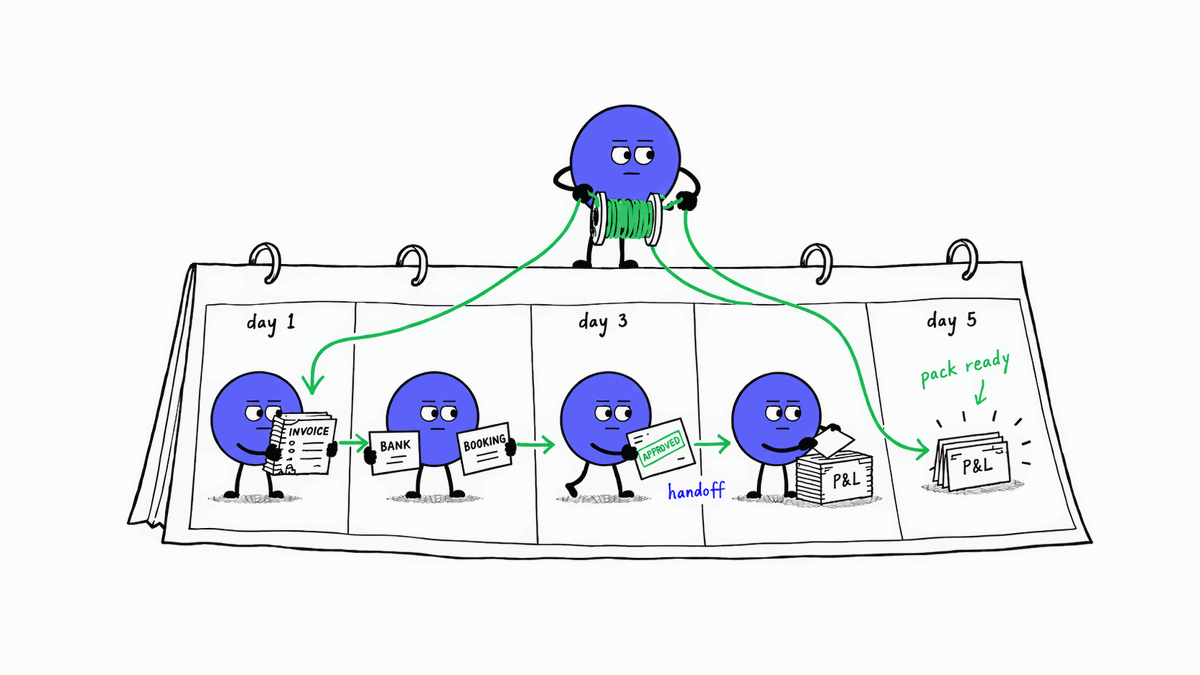
Give them a close calendar. Give one agent the manager's job.
Most finance teams I work with use one AI assistant today. They ask it to draft an email, explain a variance or tidy up a spreadsheet. Very few have tried the next step, which is several agents working on different parts of a process at the same time.
With the right system access and controls, agents can already help with many tasks in parallel. However, a hard problem arises when five agents are working across several days on dozens of tasks, and one agent's work depends on another finishing first. How do you coordinate all of that? I want to answer that question here, with a month-end close as the example.
#
With one assistant, you review its work by reading the conversation. That works for one task. It does not work for an entire quarter end process.
Picture a small company closing its books for September:
- One agent books supplier invoices and payroll
- One matches the bank statements
- One drafts client invoices for approval
- One prepares follow-ups on late payments
- One prepares the P&L and the cash view
Their work spans a five-day close, and one task often depends on another.
On day one, that looks manageable. By day three, tasks have moved, stalled or changed order. A late bank file pushes the reconciliation back. The draft P&L waits for the bookings and reconciliations. An unanswered approval consumes the spare time in the plan. Someone has to track those dependencies, decide what can move and tell each agent what happens next.
If your working in five chats, you cannot see what is finished, what is stuck or what is waiting for you. You end up reading everything, and the time the agents saved goes back into reviewing. If you also coordinate every handoff yourself, you have simply traded doing the work for managing the agents. The answer is simple: you do not coordinate them but delegate to an orchestrator.
#
Close managers know the answer because they use it every month: It is the close calendar. Each activity has an owner, a due date, dependencies and a status.
A team of agents needs the same thing. So I built a prototype: a September close calendar for a fictional 14-person firm. Each agent and the owner have a row and each working day is a column. Every card shows the task, its owner and its status. The owner's row is only for approvals and decisions.
#
The calendar is the shared plan, but it requires someone to keep it up to date. This is the role of the orchestrator agent which takes on the manager's coordination work. The orchestrator checks dependencies, collects evidence from the other agents, spots delays, resequences work within agreed limits and brings decisions to the owner.
Every morning it checks each task. A task counts as done when the evidence of completion is there. For instance, the bank transactions are matched or the invoice was sent.
Some tasks additionally need to fulfill checks, e.g. passing booking rules, reconciliations or any other control.
The orchestrator then updates the statuses and resequences work within the dependencies and spare time. Changes that affect an approval gate or the submission date go to the owner.
In the example, one bank file arrived a day late. The orchestrator moved the bank matching by half a day. It used part of the spare time in the plan, and the submission date stayed the same. Then it wrote a short brief for the owner.
#
The Monday brief lists two decisions for the owner:
- A CHF 4,850 payment arrived without a reference. Two open invoice lines for one client add up to that amount, so the agents think it belongs to the client.
- Another client wants to split a 94-day-old invoice into three payments.
The brief also says the pack is still due on Wednesday. If the first decision is not made by 14:00, the draft P&L moves by a day and the spare time is gone.
That is the entire review. The owner does not re-check 212 matched bank lines. They only need to look at the three entries that did not match and make two calls.
The agents do the work and the orchestrator does the coordination. Your time goes into decisions, and you can see progress at all times in a clear calendar view.
#
This is an illustration, not an actual production close. A few things matter before anyone runs a real close this way.
First, the calendar is only as good as the evidence provided. If an agent marks a task as done without proof, the calendar looks clean but it is wrong. The rules for “done” need to be written down, and the orchestrator checks them, not the agent that did the work.
Second, the owner remains accountable for delivering the close, even when agents carry out the work.
Third, the orchestrator also needs limited access and a change log. You should be able to see what it changed, which rule it applied and when it escalated a decision.
Creating this agentic workflow requires a written process. If your close lives in a person's head, write it down first. The orchestrator works from the template with clear owners, durations and dependencies.
#
You do not need five agents to start. Put your month-end checklist into a calendar with owners and dependencies. Give one agent the manager's job: keep the plan current and coordinate the handoffs. Each morning, it should tell you what got delayed, what needs a decision and what threatens the submission date. Then add the other agents one task at a time.