I read LeadDev's AI Code Review Report 2026, and I'm not surprised by what it found. AI coding agents are writing code at a pace never seen before, and developers are still being asked to trust agentic code they haven’t read and will likely never read. The result is a trust gap, with developers still owning the consequences of shipping AI code they don’t have the tools to understand or trust.
What stands out to me is that 47% of the teams surveyed rely on the coding agent to review its own work. I don’t think asking the coding agent to take another look is enough. Code review needs a dedicated harness built for adversarial reviews that challenge the implementation. It needs to understand the codebase context and how a new commit fits in, follow changes through their callers and dependencies, and check them against team standards. A separate agent should validate that suspected bugs are real, not noise, before reporting them. The prompts, tools and context selection need to be tuned to catch real defects, and that's a different harness from the one a coding agent uses.
More code creates more review work #
The survey shows the pressure on reviewers. Half of respondents say PRs opened per developer have increased by at least 25% since adopting AI coding tools, and 67% say their PRs have grown in size. Your reviewers are being asked to work through more changes, often larger ones, while still doing the rest of their jobs.
That work has to come out of someone’s day. A typical developer now spends at least 25% more time reviewing PRs, according to 40% of respondents, and nearly as many say the review cycle has slowed.
So it makes sense that 45% name code-review capacity as their biggest delivery bottleneck, ahead of unclear requirements (19%) and QA/testing (17%). Your coding agents can keep producing changes, but that doesn’t give the rest of the team more time to work through them.
*Published rounded values total 101%. Question-specific sample size not stated.* [LeadDev, AI Code Review Report 2026, p. 8](https://leaddev.com/the-ai-code-review-report-2026)

For senior engineers, that means more review work on top of architecture, planning, and building features. If they keep getting handed larger PRs, I see it going one of three ways:
- You take the coding agent’s “LGTM” as the review and move on.
- Your release waits while a senior engineer works through a dozen PRs.
- You build a DIY reviewer around another LLM and the PR diff, without enough of the surrounding codebase.
Dev teams that I speak to have been taking another look at how code reviews happen in their org, but they typically mix manual review, static rule-based checks, internal tools, and coding-agent self-review. The internal tools are usually an API call to an LLM with some access to ticketing systems and requirements documents. I don’t think stitching those checks together is enough when the senior engineer is still left to reconstruct the change and figure out the impact on downstream code.
*Multiple responses allowed. All seven published response options shown.
Question-specific sample size not stated.* LeadDev, AI Code Review Report 2026, p. 12 You want changes moving through the SDLC, but you also need a review that looks for the race condition, the memory leak or the downstream assumption that a PR could break. Asking your senior engineers to spend more hours reading code won’t keep pace with the coding agents.
What code changes in the PR really need your attention? #
Developers are still doing plenty of manual review, but only 26% are very confident they understand an AI-generated PR as thoroughly as human-written code. Another 58% understand the intent but not every detail, and 11% mostly check that it runs and passes tests, which can obviously be risky.
For me, the era of humans reading every line of code is over. But that doesn’t let us off the hook when it comes to explaining what the code does. You can ask an agent to walk you through a change, but if it can’t follow that change through the codebase, you’re still only getting part of the answer.

*Published rounded values total 101%. Question-specific sample size not stated.* [LeadDev, AI Code Review Report 2026, p. 12](https://leaddev.com/the-ai-code-review-report-2026)
Only 18% say reviewers consistently have enough context to understand a change’s architectural impact, dependencies, and potential blast radius. That's the part I'd want help understanding. What does this change affect beyond the files in the PR?
Say your coding agent changes the data returned by a shared function. The implementation can look right in the file it edited while another service still expects the old structure. To catch that, the reviewer needs to follow the function into its callers and check the assumptions they make.
There’s a speed benefit associated with having that context, too. Respondents whose reviewers consistently have enough context are more likely to report faster review cycles: 40%, compared with 25% overall. To me, that’s a reason to give reviewers a way to understand how the change fits together, rather than another large diff to read.
Yet 68% of respondents say reviewers don’t consistently know which changes are routine and which need deeper scrutiny. Only 25% say every change is appropriately flagged or triaged. I don’t think your senior engineers should have to reconstruct every PR just to decide whether it needs their attention. The review system should explain what changed, what it could affect, and why it deserves a closer look.
I would optimize for helping engineers understand the consequences of a change and decide which ones need them, so not every PR becomes an investigation they start from scratch. You then have a basis for deciding what moves automatically and what needs an engineer.
*“Sometimes” (44%) + “No” (24%) = 68%; excludes “Don’t know.”
Question-specific sample size not stated.* [LeadDev, AI Code Review Report 2026, p. 18](https://leaddev.com/the-ai-code-review-report-2026)
Faster reviews lead to more changes to test #
Among respondents whose review cycles became faster, 26% named QA/testing as their biggest delivery bottleneck, compared with 17% overall. I read that as a reminder to look past the review queue at the whole path to production. What happens when all those reviewed changes reach QA?
Think about a checkout change that looks right in review but loses an order after the customer reloads the page. You still need to go through the purchase, check the confirmation, and inspect order history. If a developer or QA colleague has to do that by hand for every agent-generated feature, the change is still waiting on someone before it can ship.
*Reconstructed from the report’s explanatory text. Groups overlap; not independent samples.
Association does not establish causation. Question/subgroup sample sizes not stated.* LeadDev, AI Code Review Report 2026, pp. 8, 10
Give faster coding a faster path to production #
My takeaway from LeadDev’s AI Code Review Report 2026 is that developers are already putting plenty of work into checking AI code. I want that work to keep pace with the coding agents without making someone run every review, correction, and test by hand or with the same general-purpose coding agent.
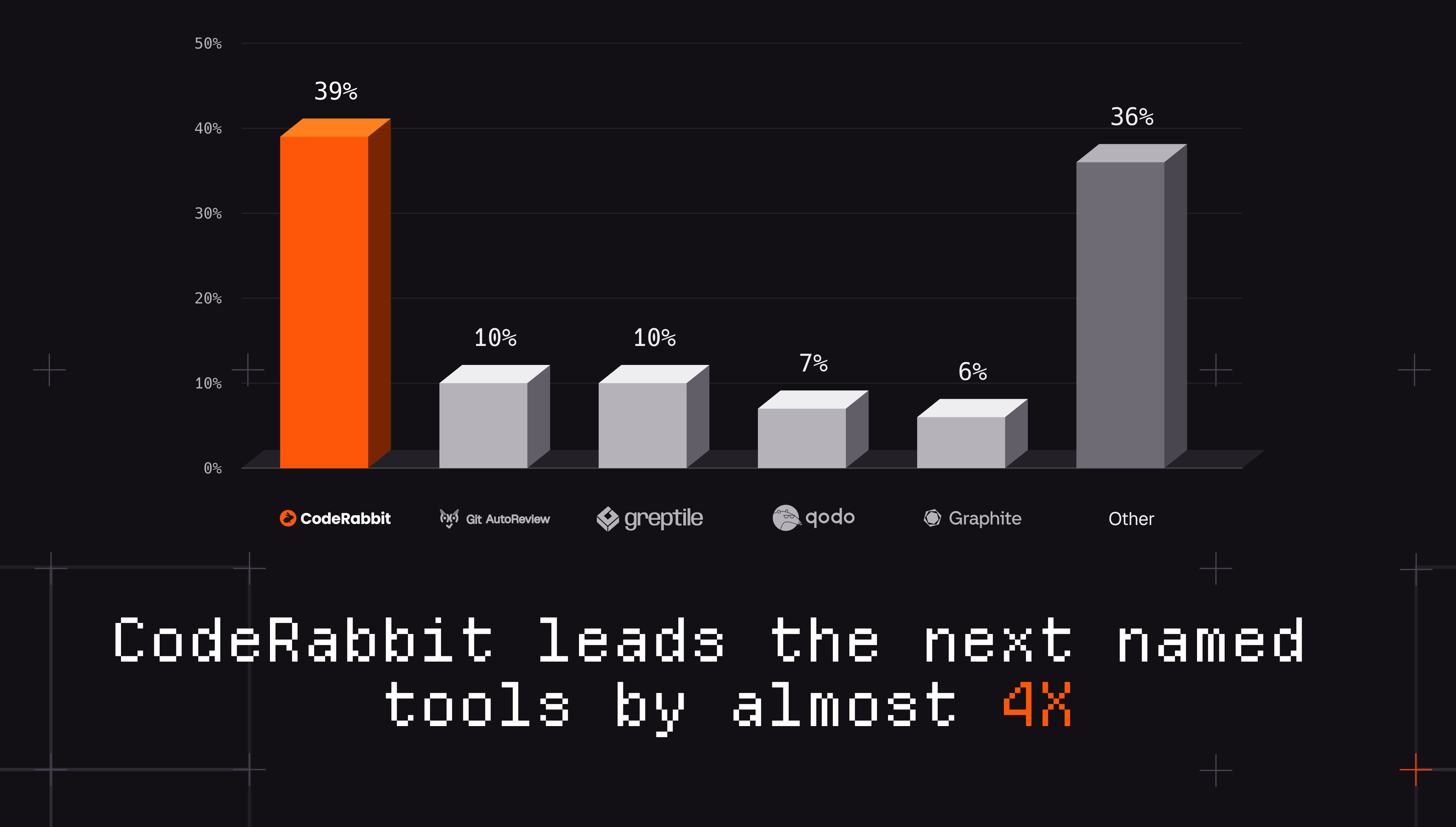
And that's exactly what we are doing at CodeRabbit with specialized harnesses and dedicated agents that help you review, validate, test, and secure AI-generated code so you can trust what you ship. In the LeadDev survey, CodeRabbit was the most common choice among respondents using a specialized third-party AI review tool.
*Reconstructed from the report’s narrative. Reported percentages; not normalized.
Subgroup sample size not stated. Survey usage, not industry market share.* LeadDev, AI Code Review Report 2026, p. 20 We’ve built CodeRabbit as the governance and control layer for agentic software development, working alongside the coding agents your team already uses. We started with code review, but helping you trust agentic code takes more than finding bugs in a diff. You need to understand what changed, check how it fits your codebase and engineering standards, decide which changes deserve attention, test whether the application behaves as intended, and look for vulnerabilities the change introduces.
- Review the commit. CodeRabbit Review uses a specialized review harness to investigate changes, follow their callers and dependencies, and check them against your team’s standards. Separate verification agents challenge suspected bugs before they become reported findings. Reviews run locally in the developer's coding app and in pull requests, supporting an agentic build → review → fix loop.
- Explain the changes that matter. CodeRabbit Explain organizes large PRs into ordered layers, with explanations and dependency graphs tied to the code. Reviewers can understand the intent, behavior, and potential blast radius without reconstructing the PR from an unordered list of file changes.
- Prioritize engineering time. CodeRabbit Triage prioritizes PRs using merge risk, severity, and dependencies. Your team can set rules to send fixes to an agent and move eligible PRs forward once required checks and approvals pass.
- Test the functional behavior. CodeRabbit Verify generates test scenarios from PR changes and codebase context, then runs the application in a test environment it prepares, validating user journeys and recording failures. You can follow execution in a live built-in browser and inspect recordings, screenshots and logs for each failure.
- Find and fix security vulnerabilities. CodeRabbit Secure investigates new PRs or your whole repository, checks for vulnerabilities a malicious AI agent could exploit, and opens a PR that fixes them.
You can use these capabilities throughout the agentic software development lifecycle. Have your coding agent act on CodeRabbit’s review findings and request another review before involving a colleague. Use Explain when a large change is difficult to follow, Verify to test an affected user journey, or Secure to investigate older code outside the current PR. Agents then handle more of the investigation and repair work, with less manual coordination from your team.
For me, this is how the engineer's role needs to evolve. Engineers should be setting direction, shaping the architecture, and deciding which risks are acceptable. CodeRabbit helps turn those expectations into checks and actions throughout development, so your team can delegate more work to agents and turn faster coding into software you’re ready to ship.

[Read the full LeadDev AI Code Review Report 2026](https://leaddev.com/the-ai-code-review-report-2026) and see how the findings compare with your own team’s experience.

If you're running into the same problems, [try CodeRabbit](https://app.coderabbit.ai/) for independent review, validation, and security alongside the coding agent you already use.
About the research: LeadDev surveyed 377 engineers and engineering leaders between September 29 and October 17, 2026, and 325 completed the full survey. Results describe respondents’ experiences and reported associations. Question-specific and subgroup counts are not published alongside the selected findings.