Grok Bot vs. OpenClaw: why I replaced my entire agent stack
Listen now on YouTube • Spotify • Apple Podcasts
Brought to you by:
**[WorkOS](https://workos.com/?utm_source=lennys_howiai&utm_medium=podcast&utm_campaign=q22025)**—Make your app enterprise-ready, with SSO, SCIM, RBAC, and more

**[Hyperagent](https://hyperagent.com/howiai)**—Deploy fleets of agents that handle real work
In this solo episode, Claire explains why she replaced her entire OpenClaw setup with Grok Bot. She walks through the bots she now uses to manage six inboxes, coordinate her family, review pull requests, monitor SOC 2 compliance, support customers, audit subscriptions, and shop for clothes. She also shares how she safely gives agents permission to take action, what Grok Bot still gets wrong, and the migration process she used to move every agent without losing its personality, context, or routines.
Biggest takeaways:
- The real moat for agent platforms may be user experience, and Grok Bot wins on simplicity. Claire is highly technical. She runs Tailscale, connects to a Mac Mini over SSH, and even built a rescue bot to manage her other bots. Still, OpenClaw eventually became too difficult to maintain. Grok Bot offers many of the same capabilities in a product that reliably stays online, which was enough to convince her to migrate everything.
- Thinking of each bot as a new hire makes agent design much easier. Claire gives every Grok Bot a specific name, job, and scope, just as she would when hiring someone for a team. Grok Bot can even infer an agent’s role from its name. Create one called “Prody McProd,” and it already has a sense of what it should do. This framing makes it easier to build focused specialists instead of agents that gradually become unfocused generalists.
- Multi-account support is a killer feature for entrepreneurs running multiple businesses. Grok Bot allows Claire to connect six Gmail accounts alongside multiple Slack and Linear workspaces, then gives a single agent access across all of them. Other platforms are only beginning to support this kind of setup. For someone operating across several companies or projects, it makes the difference between an agent that is merely interesting and one that is actually useful.
- Agents built for the home should help people spend less time on their computers. Claire’s guiding principle for TradBot is simple: if she has to spend time interacting with it, something has gone wrong. Its kitchen-table newspaper succeeds because the output is printed, physical, and waiting beside her family at breakfast. Sending the same personalized digest to a Kindle offers another way to bring the information into daily life without adding another screen-bound workflow.
- Approval gates offer the right balance between autonomy and trust for high-stakes actions. Claire’s customer support agent, Holly Helpdesk, can handle refunds, but it cannot issue one without her approval. When a refund is needed, Claire receives a button that opens the actual Stripe request. She reviews it, confirms it, and the refund goes through. Within a week of launching, Holly began receiving unsolicited five-star reviews. The lesson is not that agents need approval for everything. It is that they should act independently on low-risk work and involve a human when the consequences are meaningful.
- Grok’s default writing style is too compressed, so it needs explicit training on the user’s voice. While Claude often writes too much, Grok Bot has the opposite problem. It trims sentences so aggressively that its writing can become fragmented and difficult to follow. Claire fixed this by having it study her sent emails and create a detailed voice profile before writing on her behalf. With that context in place, it became capable of handling lower-stakes outbound communication.
- A good compliance agent should fix problems, not just report them. Claire’s SOC 2 agent, Lockdown, logs into the controls dashboard, scans for issues, investigates new vulnerabilities, and opens a pull request with a proposed fix before notifying her. Claire reviews and approves the change, but the agent handles the underlying work. The broader opportunity is to have AI actively improve a company’s compliance posture, not simply generate another list of tasks for someone else to complete.
- A structured migration process makes switching agent platforms feel safe and reversible. Before Claire shut down any of her OpenClaw agents, Lifeguard exported a secrets-free archive containing each agent’s identity, scheduled tasks, and gateway configuration. She uploaded those folders into Grok Bot, which effectively performed a brain transplant. The agents returned with their personalities and responsibilities intact. Because the migration preserved everything she needed to go back, switching platforms felt far less risky.
- Agent proactivity must be intentionally scheduled. OpenClaw’s heartbeat feature made its agents feel naturally proactive, while Grok Bot remains passive unless the user creates routines. The benefit is transparency: every recurring action is visible and easy to audit in the settings. The tradeoff is that users must consciously decide when each agent should act. Without those routines, even a highly capable agent will simply wait for someone to message it.
Blog and detailed workflow walkthroughs from this episode:
Grok Bot Agent Templates and Workflows: https://www.chatprd.ai/how-i-ai/grok-bot-agent-templates-and-workflows ↳ How to Build a Personal AI Stylist to Curate Your Wardrobe: https://www.chatprd.ai/how-i-ai/workflows/how-to-build-a-personal-ai-stylist-to-curate-your-wardrobe
↳ How to Create an AI-Powered Family Newspaper and Logistics Coordinator: https://www.chatprd.ai/how-i-ai/workflows/how-to-create-an-ai-powered-family-newspaper-and-logistics-coordinator
↳ How to Automate Customer Support with a 5-Star AI Agent: https://www.chatprd.ai/how-i-ai/workflows/how-to-automate-customer-support-with-a-5-star-ai-agent
Build your own company brain: the enterprise AI playbook from Stripe’s engineering team | Sharadh Krishnamurthy
Listen now on YouTube • Spotify • Apple Podcasts
Brought to you by:
**[DX](https://getdx.com/howiai)**—Engineering intelligence for the AI era

**[Hyperagent](https://hyperagent.com/howiai)**—Deploy fleets of agents that handle real work
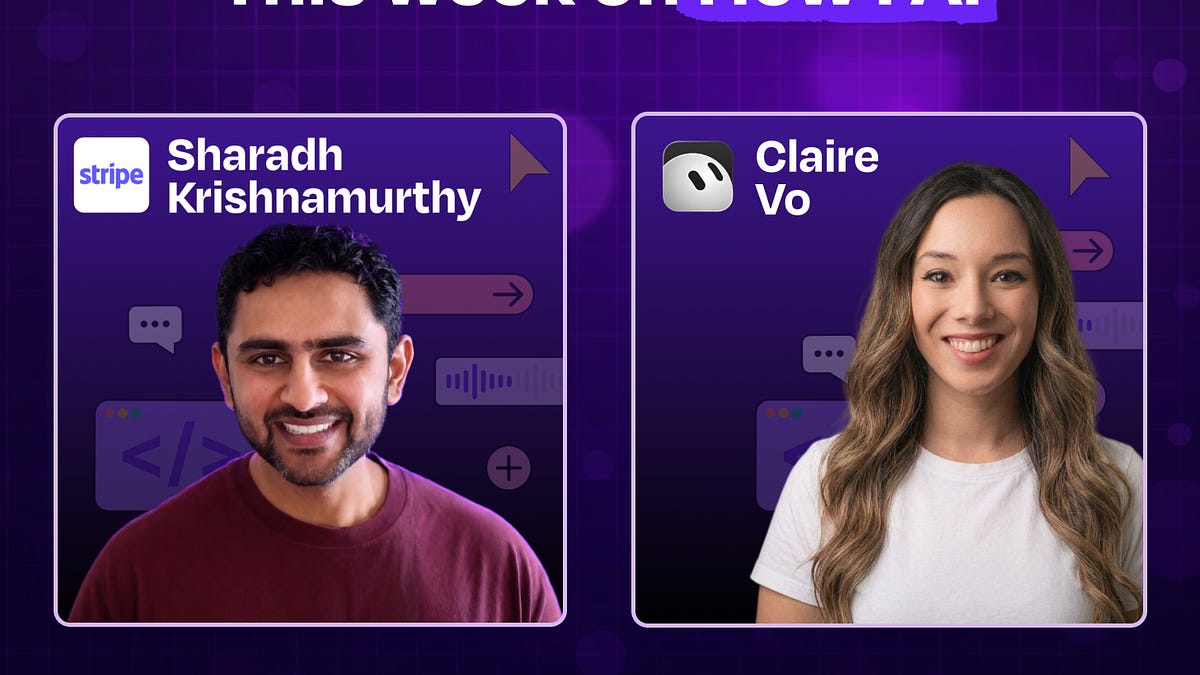
Sharadh Krishnamurthy is an engineering manager at Stripe who helped build Kai, the company’s internal AI agent, in just two weeks with a team of 1.5 engineers. In this episode, he explains how Kai grew to serve more than 10,000 employees each week, why scaling AI across a company is ultimately a governance problem, and how Stripe uses projects, skills, tool policies, and human oversight to keep agents useful and safe. He also shares what happened when agents nearly overwhelmed production systems, how Stripe manages a library of more than 2,000 skills, and why strong data and developer infrastructure matter far more than simply choosing the best model.
Biggest takeaways:
- The hardest part of bringing AI into a large company isn’t the model—it’s governance. When Sharadh and a colleague began building Kai, they quickly realized that giving every employee access to AI was not primarily a technical challenge. The real work was teaching the system how a complex global company operates. That is why Kai’s most distinctive features, including projects, tool policies, and skill routing, are designed to manage access and behavior rather than improve the underlying model.
- Projects are configuration layers for how teams use AI, not simply folders for organizing work. In Kai, a small group of knowledgeable employees can choose the default model, approve the available tools, and define which actions require human review for an entire team or workflow. Everyone else gets the right setup automatically. Stripe’s HR project, for example, runs on a separate secure backend with tightly controlled tool access, preventing sensitive employee data from leaking into public documents.
- Infrastructure built before the AI boom becomes even more valuable once agents arrive. Stripe had already invested in a tiered analytics catalog, a resilient Trino query engine, and a trusted metrics layer for its human developers. That same foundation now allows agents to query data safely and reliably at enormous scale. Sharadh’s provocative advice is to double the size of the developer experience and data teams before investing heavily in agents. Without strong infrastructure underneath them, even the smartest agents will struggle.
- Agents amplify every weakness that already exists in a company’s systems. Sharadh does not believe agents create entirely new categories of problems. Instead, they dramatically increase the volume and severity of existing ones. Stripe saw agents behave unpredictably, overwhelm core systems, and nearly take down production. Better prompts were not enough to solve those problems. Stripe needed agent-specific identities, priority signals, load shedding, and a query layer capable of absorbing the additional demand.
- Skills are what turn an AI assistant into dependable infrastructure. Kai allows any employee to convert a successful session into a reusable skill. Each skill includes guidance on when it should run, a specification written for the Kai system, and an editor for testing it before release. Stripe now has roughly 2,000 skills, including about 50 used daily across the company. Because Kai automatically selects the right skill, employees can simply describe what they need instead of learning how the system works.
- With skills, quantity is part of the quality problem. Every new skill adds more information to the system’s retrieval pool, and irrelevant context can reduce the quality of the results. Stripe built telemetry to distinguish between skills used across the company, highly valuable workflows used by small teams, and tools that have not been touched in weeks. That data helps the team promote, combine, or retire skills while preserving useful niche workflows.
- A small team can build an enterprise AI platform quickly when the underlying foundation is strong. Sharadh and one colleague created the first working version of Kai in just two weeks. A company-wide demonstration triggered a steep rise in adoption, and the platform is now used weekly by more than 10,000 Stripe employees, with an 86% adoption rate. Fewer than 10 people manage it today. That scale is possible because the team is supported by coding agents and years of investment in Stripe’s internal infrastructure.
- The best enterprise AI products hide organizational complexity from the people using them. Kai appears to employees as a single, straightforward product, but it is built from many configurable layers designed to accommodate different teams, data types, and security requirements. Employees do not have to decide which connector to enable, which model to select, or whether a tool is appropriate for the information they are handling. Removing those decisions improves adoption while reducing the temptation to bypass safeguards because the approved path feels too slow.
Blog and detailed workflow walkthroughs from this episode:
How Stripe Built Kai: Data Dashboards, Reusable Skills, and Enterprise AI Governance: https://www.chatprd.ai/how-i-ai/how-stripe-built-kai-data-dashboards-reusable-skills-and-enterprise-ai-governance
↳ How to Create a Custom Data Dashboard on the Fly with a Natural Language AI Agent: https://www.chatprd.ai/how-i-ai/workflows/how-to-create-a-custom-data-dashboard-on-the-fly-with-a-natural-language-ai-agent
↳ How to Turn a One-Off AI Chat Session into a Reusable Workflow for Your Team: https://www.chatprd.ai/how-i-ai/workflows/how-to-turn-a-one-off-ai-chat-session-into-a-reusable-workflow-for-your-team
↳ How to Implement AI Governance with Context-Aware Project Controls: https://www.chatprd.ai/how-i-ai/workflows/how-to-implement-ai-governance-with-context-aware-project-controls
GPT-6 Astra is a banger—here’s everything I’ve built
Listen now on YouTube • Spotify • Apple Podcasts
In this solo episode, Claire puts GPT-6 Astra through a series of real-world tests across computer use, coding, design, QA, hardware, and 3D development. She shares how Astra finally solved a ChatPRD feature she had been stuck on for six months, navigated complex production tools without her touching the keyboard, and reverse-engineered a Bluetooth display with no public API. She also explores what the model’s leap in capability means for software interfaces, ambitious personal apps, and the kinds of projects that suddenly feel possible to build.
Biggest takeaways:
- The biggest leap with Astra is that it expands what someone is willing to attempt. Claire had spent six months trying to build a product intelligence feature for ChatPRD, but earlier models consistently made poor architectural decisions because she could not fully explain the system in a prompt. Astra got the feature 90% of the way there on its first attempt, then finished it with a few follow-ups. When previously impossible projects start working, the real change is not just productivity; it’s ambition.
- Computer use is finally precise enough to handle complex visual interfaces. Claire now spends roughly 90% of her day with her hands off the keyboard. Astra navigated Adio’s node-based workflow builder, added new nodes, reconnected the logic, and generated custom lead-response emails without requiring her to click anything. She had abandoned similar attempts with earlier models because they lacked the necessary precision. That gap appears to be closing quickly.
- Browser-based QA may be one of the most valuable uses of computer-use agents. Astra spent an hour and 45 minutes testing a branch for race conditions and streaming edge cases. It inspected the console, deliberately refreshed the application, and continued probing for failures. This is exactly the kind of repetitive but important testing that humans tend to rush through or skip. An agent’s willingness to stay patient with tedious work can be as valuable as its intelligence.
- SaaS is back, and the case for eliminating interfaces is getting weaker. The “no UI is the next UI” argument assumed that AI would need direct access through APIs or command-line tools. But if an agent can reliably navigate visual software, product teams can choose the interface that best expresses the product rather than optimizing entirely around machine access. In other words, buttons are back.
- Hardware hacking is becoming a serious use case for frontier models. Claire had spent months trying to work with the Divoom Mini 2, a device with no public API, without making much progress. Astra reverse-engineered its pixel algorithm, built a live-streaming command-line tool, and enabled her to send episode information and images directly to the display. That is more than a clever demo. It suggests AI can unlock physical devices that were previously too difficult or poorly documented to customize.
- One-shot 3D game development is raising the ceiling for personal software. Astra built a functional Barbie-style dress-up game in Blender from a single prompt. It also created a 3D world for Claire’s family app where her kids can walk to a library or visit a pond to check in with their emotions. These are not projects she could have built with earlier models. As the cost of creating interactive worlds falls, deeply personal software starts to feel much more practical.
- Astra’s AIM-style Codex wrapper shows how accessible ambitious desktop development has become. In one shot, Astra built a functional 1990s-inspired AIM interface around Claire’s live Codex threads, complete with active-writer indicators and away messages. The nostalgia is fun, but the bigger lesson is that custom desktop tools and unusual personal software ideas are now within reach, even when they would never justify a traditional development team.
- Astra produces artifacts that fit into an existing brand instead of starting over. When Claire needed thumbnails while her designer was unavailable, Astra worked inside Flora and Figma, studied the existing workflows, and matched the established aesthetic. That ability to understand and extend an existing visual system is what makes the output useful in production. A polished artifact is impressive, but one that actually looks like it belongs is far more valuable.
- Astra’s pricing makes choosing the right tasks more important than minimizing usage. At $10 per million input tokens and $50 per million output tokens, long-running computer-use and QA sessions can become expensive, particularly on the output side. The key is to deploy Astra where its additional capability is worth the premium: stubborn coding problems, complex visual interfaces, and high-toil QA work. The question is not whether the model is expensive but whether the task is valuable enough to justify using it.
Blog and detailed workflow walkthroughs from this episode:
GPT-6 Astra Review: Hardware, 3D Games, and Coding: https://www.chatprd.ai/how-i-ai/gpt-6-astra-review-hardware-3d-games-and-coding
↳ How to Automate YouTube Thumbnail Creation from Flora to Figma with AI: https://www.chatprd.ai/how-i-ai/workflows/how-to-automate-youtube-thumbnail-creation-from-flora-to-figma-with-ai
↳ How to Automate Complex Lead Routing in a CRM with GPT-6 Astra: https://www.chatprd.ai/how-i-ai/workflows/how-to-automate-complex-lead-routing-in-a-crm-with-gpt-6-astra
↳ How to Hack and Control a Bluetooth Speaker Using GPT-6 Astra: https://www.chatprd.ai/how-i-ai/workflows/how-to-hack-and-control-a-bluetooth-speaker-using-gpt-6-astra
If you’re enjoying these episodes, reply and let me know what you’d love to learn more about: AI workflows, hiring, growth, product strategy—anything.

Catch you next week,
Lenny
P.S. Want every new episode delivered the moment it drops? Hit “Follow” on your favorite podcast app.