Flitto now sits inside training pipeline of some of world's largest AI models
In July 2013, with "Gangnam Style" past a billion views on YouTube and still climbing, Psy sent his global followers to a tiny Seoul startup: "Use flitto.com to read my tweets in your own language."
Flitto was then a small Seoul-based translation app built around K-pop fans translating celebrity posts for reward points. K-pop gave the young service a ready-made global community.
Thirteen years later, the app is a Kosdaq-listed artificial intelligence company whose largest customers are US technology giants. In late June, Flitto disclosed that two data supply contracts with global IT clients had been more than doubled to a combined 31.6 billion won ($21.2 million). The larger of the two, at 22.7 billion won, exceeds Flitto's entire 2024 revenue.
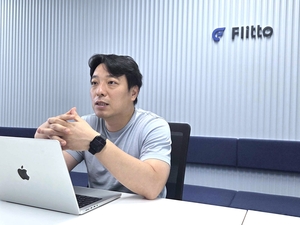
"When we started, we said we were a data company. Nobody believed us," said founder and CEO Lee Jung-soo, also known internationally as Simon Lee. He was seated in front of a screen showing his newest project, Flitto Marketplace — a platform where firms with unused data can list it for AI buyers. "I'm just glad we could prove it before the company went under."
The proof is now in the finances. Revenue rose 77 percent last year to 36 billion won, and the operating margin swung from minus 2 percent in 2024 to 17 percent in 2025, the first meaningful annual profit in the company's history. About 71 percent of first-quarter revenue this year came from exports, and within the core data business, roughly 95 percent went to customers in the United States.
How translation became data business
Flitto's founding bet in 2012 was that language data would become valuable to whichever AI technology eventually won. That hypothesis took nearly a decade to pay off.
"Crowdsourced translation was never the end goal," Lee said. "It was the only practical way to collect data at the time."
The market arrived with neural machine translation. Services such as Naver's Papago, launched in late 2016, weakened Flitto's original consumer platform but raised demand for the sentences, voices and corrections used to train the new systems. "Deep learning didn't improve the old translation technology. It replaced it," Lee said. "Suddenly the market wanted exactly the kind of data we had been collecting since 2012." Corporate data sales began in earnest in 2017.
The business model then shifted from waiting for translation requests to producing data on demand. Flitto Arcade, launched in 2018, turned data work into small paid missions. Users translate sentences, correct transcripts or record themselves speaking given phrases, earning points redeemable for cash.
Today the company operates with 14 million users in 173 countries.
Teaching AI for the real world
The missions are often designed around unique situations in which an AI model is likely to fail. An automaker may need people to issue commands while a car engine is running. A karaoke equipment maker might want speech recorded over loud music, so its system can separate a request from the song.
Data has to meet two standards, according to Lee: accurate enough to improve a model, and legally clear for commercial training. "Fail either test and the volume doesn't matter," he said.
Raw incoming data, by his estimate, is typically 70 to 80 percent accurate. Flitto runs it through three to seven review layers, with contributors sorted by skill and past performance and higher-rated ones assigned to final checks. When a client's model encounters an unfamiliar proper noun or a noisy environment, he argues, only a vendor that owns and can retrain on its own data can fix it.
Clients typically test a small sample before scaling up. One recent contract began at 568 million won in October 2025, rose to 3.9 billion won by April and reached 8.9 billion won by June. Another more than doubled in three days after the client requested additional volume. The pattern, in Lee's view, reflects a shift in what Big Tech buyers now want: not the general-purpose language data that can be scraped from the internet, but the "narrower, cleaner, edge-case-heavy material that only a purpose-built pipeline can produce."
For all the traction abroad, Lee's frustration is with how little of the business is understood at home. He noted that even the largest Korean conglomerates active in AI rarely spend more than 5 billion won a year on training data, and most spend closer to 1 billion. He claims Chinese competitors routinely spend 10 to 100 times as much. "Domestic buyers treat data as a consumable expense rather than an investment," Lee said. "That is why almost none of our revenue comes from Korea. The companies who understand what data is worth are all somewhere else."
mjh@heraldcorp.com