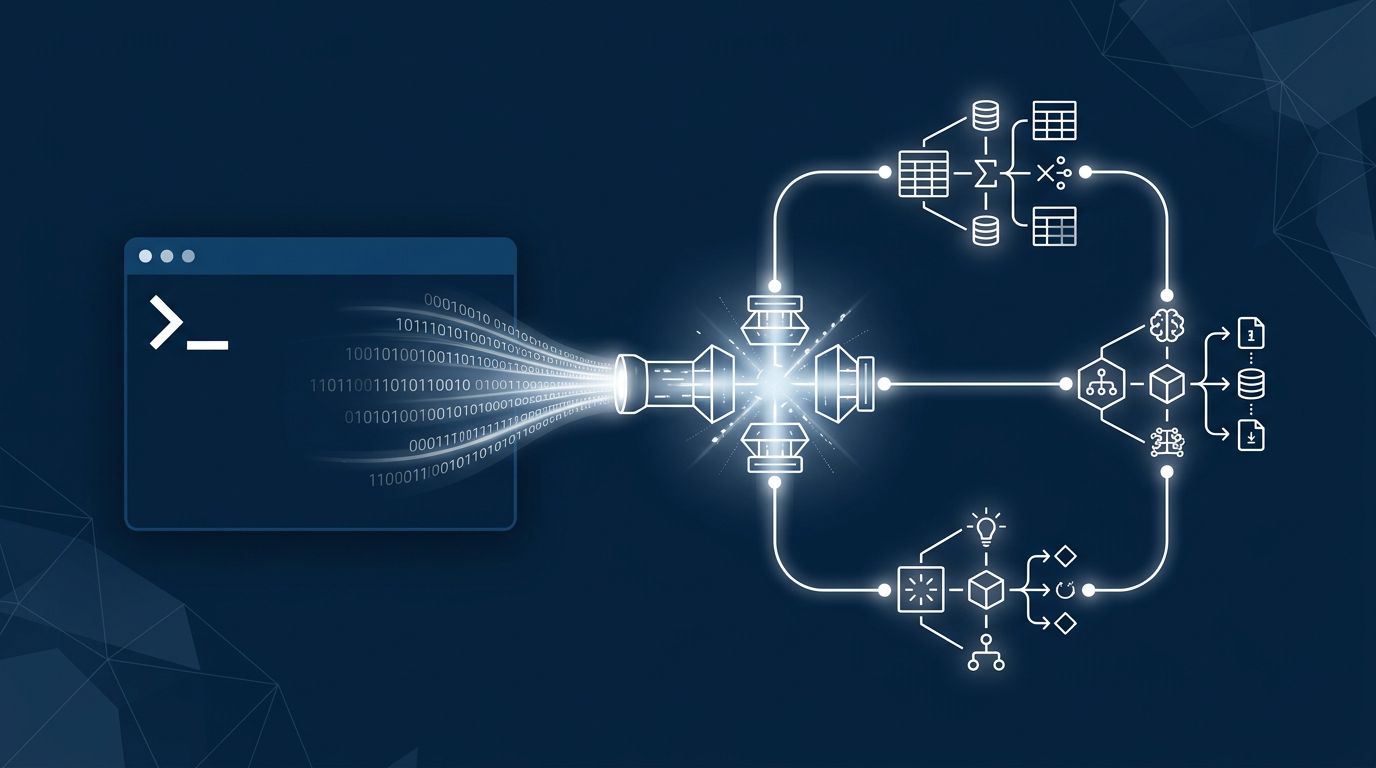
Hopsworks shipped version 5.0 on June 30 with Claude Code and Codex pre-installed inside the platform itself. For ML engineers, the workflow shift is significant: describe what you want — a feature pipeline, a training job, an inference endpoint — and the agent writes, runs, and iterates the code directly on the platform. No switching to your IDE, no separate terminal, no re-authenticating against three different services to run a single experiment.
What the Coding AI Stack Actually Means #
Hopsworks 5.0 introduces what the company calls a “Coding AI and Data Stack” — a dev container terminal baked into the platform with Claude Code and Codex already installed. The agent has full access to the Hopsworks environment: Python, Spark, and GPU runtimes; the feature store; the model registry; and persistent storage on HopsFS. You can run multiple parallel agent sessions, so one session handles a feature pipeline while another runs a training job configuration simultaneously.
“The low-code and no-code tooling that dominates other Lakehouses is obsolete.”
Jim Dowling, CEO, Hopsworks
That is a pointed claim, but the logic holds. Drag-and-drop pipeline builders abstract away exactly what experienced ML engineers need to control. An agent that reads and writes code in context does not.
The Problem It Is Solving #
Most ML teams operate across eight to fifteen separate tools across the ML lifecycle: an IDE, a feature store UI, a training job launcher, a model registry, a deployment CLI, a monitoring dashboard, and an analytics layer. Every hand-off between these tools is a context switch — credentials to re-enter, UIs to reload, state to reconstruct.
Hopsworks 5.0 collapses feature pipelines, training pipelines, inference pipelines, Streamlit applications, and dashboards into a single Terminal UI. You build and operate the entire ML stack from one place. The coding agent is the interface. This is not a marginal convenience improvement; it eliminates the category of work that exists only because the tools do not talk to each other.
Three Other Changes Worth Knowing #
Platform Intelligence. Hopsworks 5.0 uses an embedded LLM to auto-configure data sources. Connect Databricks, Snowflake, BigQuery, MongoDB, or SAP HANA and the model generates human-readable column names, infers primary keys and event times, and sets ingestion schedules automatically. Schema wrangling when onboarding a new data source was previously a half-day task. This removes most of it.
Full analytics built in. Hopsworks now includes a Trino SQL engine and Apache Superset dashboards. Query feature groups and inference predictions with raw SQL, build shareable dashboards, export them as PDFs — all without standing up separate tooling. Batch inference pipelines write predictions back to feature groups, making them immediately queryable. This closes the feedback loop between what your model outputs and what you can analyze.
Column-level access control on feature groups. Wide feature tables are common in production ML. Teams share one table across many models, but some columns carry sensitive data. Version 5.0 adds column-level ACL so data owners can expose selected columns per project without copying or masking the entire table.
How to Get Started #
The full Coding AI Stack is available on Hopsworks SaaS now. Self-hosted deployments on AWS EKS, GKE, Azure AKS, and OVHCloud are supported. The free tier includes $4,000 in Hops Credits with no credit card required — enough to run a real workload before committing. Paid usage runs at $0.35 per credit. Enterprise plans add SSO (LDAP, AD, OAuth-2) and professional services. Full documentation is at docs.hopsworks.ai, and the official release announcement is on GlobeNewswire.
Coding agents embedded in data platforms is the direction this space is heading. Hopsworks 5.0 shipped the first real version of it at GA quality. Whether Databricks, Vertex AI, or SageMaker respond with something comparable is the question to watch through the rest of 2026.