Here is what a real lead typed into a tax-preparation intake form:
“Got married in June, haven’t figured out how we’re filing yet. There’s an IRS letter somewhere in a kitchen drawer I haven’t opened. I also deliver groceries on weekends.”
Only one fact in that paragraph is clear: the weekend side gig. A model read it anyway and set filing_status to married_jointly.
Helpful. Wrong. The form then skipped the filing-status question and treated a guess as settled. That is the failure I care about most, and it is invisible if you only eyeball a few outputs.
I built llm-evals so I would stop writing scripts/eval.rb for the fourth time. It is a Ruby CLI for multi-dataset, multi-case evaluation suites. Compare models, efforts, temperatures. Rank them by one weighted score that balances accuracy, hallucinations, errors, latency, and cost. On RubyGems as of writing: 0.5.0. Two commands: evals and llm-evals.
gem install llm-evals
Home-made pasta tastes better because you chose the flour. Home-made evals taste better because you chose the weights, the cases, and the failure modes that matter to your product. Store-bought leaderboards cannot taste your soup.
Evals are unit tests for probabilistic software #
A unit test asks: given this input, does my code return exactly this output? An eval asks a softer question: given representative inputs, how often and how well does the model produce what I expect? You cannot assert equality against a probability distribution. You can score it. Score the same cases every time, and you can finally measure what a prompt tweak, a temperature change, or a model swap actually did.
The scorer decides what “good” means. The eval makes the comparison honest and repeatable.
Background I keep recommending:
- AI Evals: Everything You Need to Know by Hamel Husain
- Demystifying Evals for AI Agents from Anthropic
- Eval-Driven System Design from OpenAI
The problem that started it: Qualified.At #
The gem grew out of Qualified.At, which I wrote about when it launched. A business builds an intake form, embeds it, and visitors answer questions before anyone picks up the phone. The forms use the Inquirex gems. Many start with a free-text box: tell us about your situation. An LLM reads that paragraph and extracts structured answers, so a 20- or 30-question form can shrink to a few follow-ups.
Here is the extraction step from the tax preparation demo, copied from the suite’s dsl.rb:
extract :understanding do
  from :situation
  prompt "Extract the taxpayer's situation from their description. Only fill a " \
         "field when the text genuinely supports it — leave anything the writer " \
         "did not mention unset rather than guessing. ..."
  schema filing_status: { type: :enum,
                         values: %w[single married_jointly married_separately head_of_household] },
    dependents: :integer,
    self_employed: :boolean,
    rental_properties: :integer,
    sold_investments: :boolean,
    owns_business_entity: :boolean,
    multi_state: :boolean,
    irs_letter: :boolean
  transition to: :heard_you
end
And here is what that lead typed (the vague case):
Honestly, this year was a blur and I’ve been avoiding thinking about taxes. I got married in June, so I assume that changes things, though we haven’t talked about how we’re filing. I also picked up a side gig doing grocery deliveries through one of those apps on weekends, which I’m told counts as being self-employed. Somewhere in a kitchen drawer there’s a letter from the IRS that came in August that I haven’t been brave enough to open. We rent our apartment, if that matters. I don’t really know what else you need from me, so please just tell me what to bring.
The correct extraction is not “married filing jointly”. They got married. They said they have not decided how to file. The right answer is:
{
  "filing_status": null,
  "dependents": null,
  "self_employed": true,
  "rental_properties": null,
  "sold_investments": null,
  "owns_business_entity": null,
  "multi_state": null,
  "irs_letter": true
}
Two answers, six honest null s. A model that “helpfully” fills in married_jointly has invented a fact. On this case, openai/gpt-4o-mini scored 78.8% and the diagnostics named the hallucination: expected null, got married_jointly. deepseek/deepseek-v4.1-flash-1017 at high effort scored 100% with empty diagnostics.
So the product question became: which model captures the most answers, assigns them correctly, avoids hallucinations, and does not miss details, while staying cheap and fast? A lead who waits 30 seconds for the next question is a lead who closes the tab. At 1,000 leads, $0.0002 per call is twenty cents. $0.50 per call is five hundred dollars.
The Qualified.At suite #
Qualified.At ships ten demo businesses: bookkeeping, couples therapy, home remodeling, immigration law, managed IT, personal injury, roofing, software development, tax preparation, and wedding photography. Each one became a dataset. Each dataset has four case variants:
| Variant | What the lead wrote |
|---|---|
complete |
rambles, but answers every field |
vague |
hedged and incomplete; about half the fields go unanswered |
partial |
clear prose that answers some fields and explicitly defers the rest |
estimate |
a complex description aimed at the fields that drive the price estimate |
That is 10 datasets × 4 variants = 40 cases on disk:
evals/
  .llm-evals.config.yml
  eval_helper.rb
  datasets/09-tax-preparation/
    dsl.rb                       # the demo flow, verbatim
    schema.rb                    # its extract step's schema; `evals verify` fails on drift
    cases/vague/input.txt
    cases/vague/expected.json
    ...
The dsl.rb and schema.rb files are copies of the production flow. A spec fails the moment they drift apart. An eval that quietly tests last month’s schema is worse than no eval.
The adapter runs the same prompts production would. From evals/eval_helper.rb:
LLM::Evals.configure do |c|
  c.suite "qualified-at-extract", root: __dir__, env_files: [ "../.env" ],
    description: "Which model turns a lead's free text into the answers an extract step declares."
  c.cases "datasets/*/cases/**/input.txt"
  c.adapter QualifiedAt::Evals::Extract::Adapter.new
  c.scorer Inquirex::LLM::Evals::Scorer.new
end
Scoring: not all mistakes are equal
Every schema field ends in one of five outcomes. Each is worth a fixed share of the point (from Inquirex::LLM::Evals::FieldScore):
| Outcome | Worth | When |
|---|---|---|
correct |
1.0 | what the text says, as the schema spells it |
missed |
0.2 | the text answers it and the reply left it empty |
hallucinated |
0.15 | the text never answers it, and the reply answered anyway |
incorrect |
0.1 | an allowed value, the wrong one |
invalid |
0 | a value the schema does not allow: off the list, wrong type, not JSON |
Missing a field is the least bad mistake, because the form just asks the question again. Hallucinating is worse, because the form now believes something the lead never said. Returning garbage is worst. On top of the per-field score, the scorer reports exact (every field correct), hallucinated_rate, and invalid_rate.
One weighted score, or: which one do I ship? #
Here is the thing that bit me. The report had a dozen sortable columns: accuracy, exact match, hallucination rate, errors, latency, cost, tokens. Sort by accuracy and an expensive, slow model wins. Sort by cost and a model that hallucinates wins. Sort by primary score and you crow a token hog. None of those columns answered the question I actually had, which was which one should I ship?
So llm-evals lets you say what matters, in YAML, and folds it into one column called wscore. This is the weighted_score section from Qualified.At’s .llm-evals.config.yml:
weighted_score:
  weights:
    exact:              10 # Exact contributes high number
    score:               5 # This is a score computed in other ways
    latency:            -5 # Latency is important, but relatively less than others
    cost:               -5 # Same with the cost
    time:               -3 # latency contributes relatively low comparatively
    errors:             -8 # and any errors contribute quite a bit to the total
    hallucinated_rate:  -6 # Hallucinations are bad, and are penalized
    invalid_rate:       -8 # invalid_rate is an error, so heavy penalty
A positive weight means higher is better. A negative weight means lower is better. Raw weights are hard to reason about, though, so the llm-evals CLI ships a subcommand that does the math for you. I called it weights, which is not my most imaginative work. Run evals weights and it reads your .llm-evals.config.yml, then prints each column’s direction and its real share of the final score:
NOTE
Yes, that is a Starship prompt, and yes, people always ask. Here is a small present: my which-starship gist is a ZSH script that downloads and installs the starship binary for you. It then opens a two-step menu where you scroll through every Starship preset and pick a color palette for the presets that support one.
Here is what it prints for the Qualified.At config:
Read that table as a product brief. Exact alone is 20% of the score: I want every field right, not almost right. Errors and invalid together are 32%: a broken reply is worse than a slow one. Hallucinations are 12%. Cost is only 10%. Latency is 10%. Wall time is 6%. That is not a universal truth. That is what this intake product cares about.
The formula is deliberately boring:
wscore = Σ(|weight| × goodness) / Σ|weight|
Each metric’s goodness is its value, or 1 - value under a negative weight. cost and time go on a log scale between the cheapest and most expensive contender in the table, so each doubling costs the same penalty, no matter how absurd the priciest model is. Errors come straight off the top: 20 points for the first, 25 for two, and so on.
The weights are opinions, and that is the point. They force you to write down the trade-off you were going to make in your head anyway.
The results #
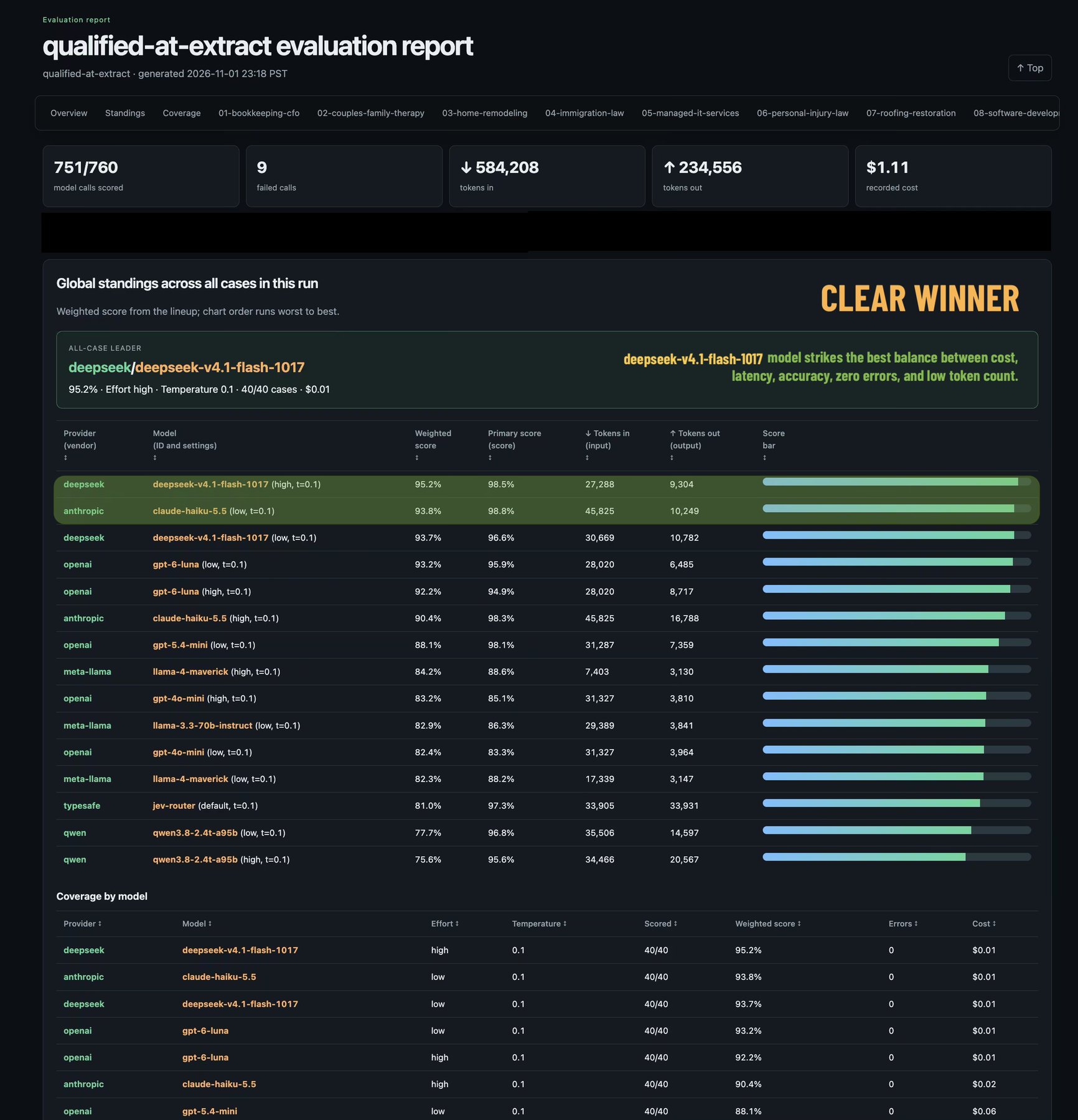
Settings multiply into contenders. A model listed with effort: [low, high] becomes two experiments. Ten models, most at both efforts, temperature fixed at 0.1: 19 configurations, not ten models. evals compare made 760 calls. 751 were scored, 9 failed, and the whole run cost $1.11.
flowchart TB
  cfg[".llm-evals.config.yml<br/>vendors · models · effort lists"]
  cfg --> c1["deepseek-v4.1-flash-1017 · high"]
  cfg --> c2["deepseek-v4.1-flash-1017 · low"]
  cfg --> c3["claude-haiku-5.5 · high"]
  cfg --> c4["claude-haiku-5.5 · low"]
  cfg --> c5["gpt-6-luna · high / low"]
  cfg --> c6["gpt-4o-mini · high / low"]
  cfg --> cN["… 19 contenders total"]
  c1 --> run["evals compare<br/>760 calls · 40 cases"]
  c2 --> run
  c3 --> run
  c4 --> run
  c5 --> run
  c6 --> run
  cN --> run
  run --> board["one weighted leaderboard"]
A few things jumped out:
- The winner overall was
deepseek/deepseek-v4.1-flash-1017at high effort : 95.2% weighted, 98.5% primary score, all 40 cases, zero errors, about a cent for the lot. claude-haiku-5.5at low effort was right behind it at 93.8% and had the best primary score in the table: 98.8%.- More effort is not more accuracy. Haiku athigh effort wrote 16,788 output tokens against 10,249 at low, and scored slightlylower on both primary and weighted score. For extraction, thinking harder mostly meant paying more to second-guess itself.
- A great primary score can still lose.
typesafe/jev-routerscored 97.3% on accuracy, yet finished at 81.0% weighted. It also wrote 33,931 output tokens, more than any other contender, and the weights care about that.
Every dataset crowned its own winner
DeepSeek won the tournament. It did not win every match. Here is each dataset’s leader from the same run (model, effort, weighted score):
| Dataset | Winner | Effort | wscore |
|---|---|---|---|
| 01-bookkeeping-cfo | deepseek/deepseek-v4.1-flash-1017 |
high | 99.7% |
| 02-couples-family-therapy | deepseek/deepseek-v4.1-flash-1017 |
high | 99.9% |
| 03-home-remodeling | deepseek/deepseek-v4.1-flash-1017 |
high | 100.0% |
| 04-immigration-law | deepseek/deepseek-v4.1-flash-1017 |
low | 98.7% |
| 05-managed-it-services | deepseek/deepseek-v4.1-flash-1017 |
high | 99.2% |
| 06-personal-injury-law | openai/gpt-6-luna |
low | 91.2% |
| 07-roofing-restoration | openai/gpt-4o-mini |
high | 92.5% |
| 08-software-development | openai/gpt-6-luna |
low | 91.6% |
| 09-tax-preparation | openai/gpt-6-luna |
low | 96.9% |
| 10-wedding-photography | openai/gpt-6-luna |
high | 95.6% |
Five datasets go to DeepSeek. Four go to gpt-6-luna. One goes to gpt-4o-mini. That last one is the story I want to sit with.
flowchart LR
  overall["Overall winner<br/>deepseek · high · 95.2%"]
  overall --> d1["bookkeeping · deepseek high"]
  overall --> d2["therapy · deepseek high"]
  overall --> d3["remodeling · deepseek high"]
  overall --> d4["immigration · deepseek low"]
  overall --> d5["managed IT · deepseek high"]
  overall -.->|not the leader| t1["personal injury · gpt-6-luna low"]
  overall -.->|not the leader| t2["roofing · gpt-4o-mini high"]
  overall -.->|not the leader| t3["software · gpt-6-luna low"]
  overall -.->|not the leader| t4["tax · gpt-6-luna low"]
  overall -.->|not the leader| t5["wedding · gpt-6-luna high"]
Same run. Same weights. Five datasets agree with the global crown. Five do not. The dashed edges are the whole point of per-dataset standings.
Roofing: the cheap model wins
Hail on Saturday finished a tired roof. Original architectural shingles from 1998. Water dripping into an upstairs closet. A bucket under it all week. Insurance adjuster coming Thursday. Steep pitch; nobody is strolling around up there without a harness. The homeowner wants a full tear-off, not a patch.
The expected extraction:
{
  "project_scope": "full_replacement",
  "stories": "two",
  "roof_pitch": "steep",
  "material": "architectural",
  "roof_age": "over_20",
  "leaking_now": true,
  "storm_damage": true,
  "filing_insurance": true,
  "timeline": "emergency"
}
On this dataset, the leader is openai/gpt-4o-mini at high effort, at 92.5%. The overall champion, DeepSeek at high, sits sixth at 90.6%.
Tax tells the same kind of story from the other direction. gpt-6-luna at low effort leads at 96.9%. DeepSeek at high drops to 87.8%.
This is the part I find genuinely important. There is no single best model. There is a best model for this task, with these weights, on these cases. If Qualified.At only did tax intake, I would ship a different model than the one that wins across all ten businesses. If it only did roofing, I would ship gpt-4o-mini. Without per-dataset standings, I would never have known. And it would be wrong to wire DeepSeek into every DSL extract step just because it won the global table.
The headline finding from the whole exercise: small, fast, cheap models land within a couple of points of each other at the top, at roughly a cent per 40 extractions. For turning a lead’s first paragraph into structured answers, paying frontier-model prices buys you very little.
The gem learned from the scoreboard #
The evals did not stop at a blog post. They changed the product.
flowchart LR
  E["llm-evals run<br/>10 datasets · 40 cases"] --> F["Finding:<br/>winner differs per dataset"]
  F --> L["Lie exposed:<br/>one global model"]
  L --> P["inquirex-llm PR #12<br/>use_first_available_model"]
  P --> R["0.13.0 upcoming:<br/>each extract step picks its list"]
Once every dataset had its own winner, a single global provider and *_model became a lie we were telling ourselves. A tax flow wants the tax winner. A roofing flow wants the roofing winner. One Ruby process serves many flows. So inquirex-llm PR #12 introduces prioritized model selection. It ships in inquirex-llm 0.13.0 (upcoming release).
The host configures which vendors it may use and which models it prefers. Each LLM step may name its own ordered list. The gem picks the first model this process can actually reach:
Inquirex::LLM.configure do |c|
  c.llm_vendors_priority        = %i[openrouter openai anthropic typesafe]
  c.llm_models_priority         = %w[deepseek/deepseek-v4.1-flash anthropic/claude-haiku-5.5]
  c.dsl_can_reprioritize        = true
  c.dsl_can_use_unlisted_models = true
end.ensure_provider_models!
And on a specific extract step:
extract :understanding do
  from :situation
  prompt "Extract the taxpayer's situation from their description. Only fill a " \
         "field when the text genuinely supports it — leave anything the writer " \
         "did not mention unset rather than guessing."
  schema filing_status: { type: :enum,
                         values: %w[single married_jointly married_separately head_of_household] },
    dependents: :integer,
    self_employed: :boolean,
    rental_properties: :integer,
    sold_investments: :boolean,
    owns_business_entity: :boolean,
    multi_state: :boolean,
    irs_letter: :boolean
  use_first_available_model "openai/gpt-6-luna",
                            "deepseek/deepseek-v4.1-flash-1017",
                            "anthropic/claude-haiku-5.5"
  transition to: :heard_you
end
Evals revealed the winners. The DSL gained a way to use them. That is the loop I want: measure, then change the product, not measure and shrug.
One day: evals as a feature #
Imagine this as a premium Qualified.At offering. A business pastes about ten versions of what their leads would type into the first text box: the complete ramble, the vague hedge, the partial deferral, the estimate-heavy pitch. llm-evals runs those cases against many models and efforts, with their weights, and returns the best model for their form.
Not a global champion. Their champion. The same report you saw above, scoped to their schema and their prose. That is still a vision, not a shipped feature. The machinery already exists in the suite that produced these numbers.
How the gem is shaped #
You write two small classes. The gem does everything else.
flowchart LR
  C["datasets/*/cases/*/<br/>input.txt + expected.json"] --> A["Adapter<br/>(your prompt, your parser)"]
  L[".llm-evals.config.yml<br/>(the model lineup)"] --> A
  A -->|Reply| S["Scorer<br/>(pure, deterministic)"]
  S -->|Score + metrics| R["Leaderboard<br/>TUI · HTML · JSON"]
  S -.-> T["Tracker<br/>Braintrust · Logfire"]
- The adapter runs one case against one model and returns a
Reply. It owns everything the model sees and everything done to its answer. In Qualified.At, it calls the same prompt builder and the same parser production uses, so the scores reflect production rather than a lab version of it. - The scorer turns a case and a reply into a
Scorewith whatever metrics you declare. It never calls anything.
The gem handles case discovery, the model lineup, providers (OpenRouter by default, through RubyLLM), rate limits, retries, thread pools, progress bars, the leaderboard, an HTML report, and optional reporting to Braintrust or Logfire. Some of the design came from Pydantic Evals.
A few decisions I am stubborn about:
- A wrong answer is a 0. A network error is an error, not a 0. Your model did not answer wrongly because OpenRouter returned a 503.
- A model the suite cannot ask is refused by name, not scored. If your suite sends chat prompts and the lineup lists a typed-question model, you get
typesafe/jev-latest refused: needs typesafe; this suite produces promptbefore anything runs. - Settings multiply.
effort: [low, high]withtemperature: [0.0, 0.7]becomes four contenders for that model. You are not comparing models; you are comparingconfigurations . - No lock-in. A local JSON log is always written. Any HTML report can be re-rendered from it later with
evals render, with no model calls.
Try it #
The repository ships two example suites that use fake models, so they need no API keys and no network:
git clone https://github.com/kigster/llm-evals.git
cd llm-evals
bundle install
just examples
For your own project, copy the toy suite’s evals/ folder, swap in your adapter and scorer, list real models under openrouter: in .llm-evals.config.yml, set OPENROUTER_API_KEY, and:
evals cases        # list the cases; calls nothing
evals verify       # offline checks of inputs, expected answers, adapter and scorer
evals compare -n   # show the experiment matrix; calls nothing
evals compare      # run it, and open the report
TIP
Run evals compare -n before every paid run. It prints the full experiment matrix, so you find out that you accidentally multiplied three efforts by three temperatures by twelve models before OpenRouter does.
The gem is MIT-licensed, and the README covers writing providers (there is a full Ollama example) and trackers (there is a W&B Weave sketch). Issues and pull requests are very welcome.
Final Thoughts #
There is no best model. There is only the best model for a given task, at a given price, with a given tolerance for being confidently wrong. DeepSeek won my suite overall, and it still lost three datasets to gpt-6-luna and one to gpt-4o-mini. If I had picked one winner and wired it into every extract step, I would have shipped worse answers to a third of my customers and called it a decision.
The leaderboard is not the point. The point is that the question “which model should we use?” stops being an argument and becomes a command you can rerun next week, when the next model drops and the prices move again. Write the cases your product cannot afford to get wrong. Choose weights that say what you actually care about. Then let the numbers settle it.
And if you are about to write scripts/eval.rb for the fourth time, please don’t. I already did. Home-made tastes better when someone else rolled the dough.