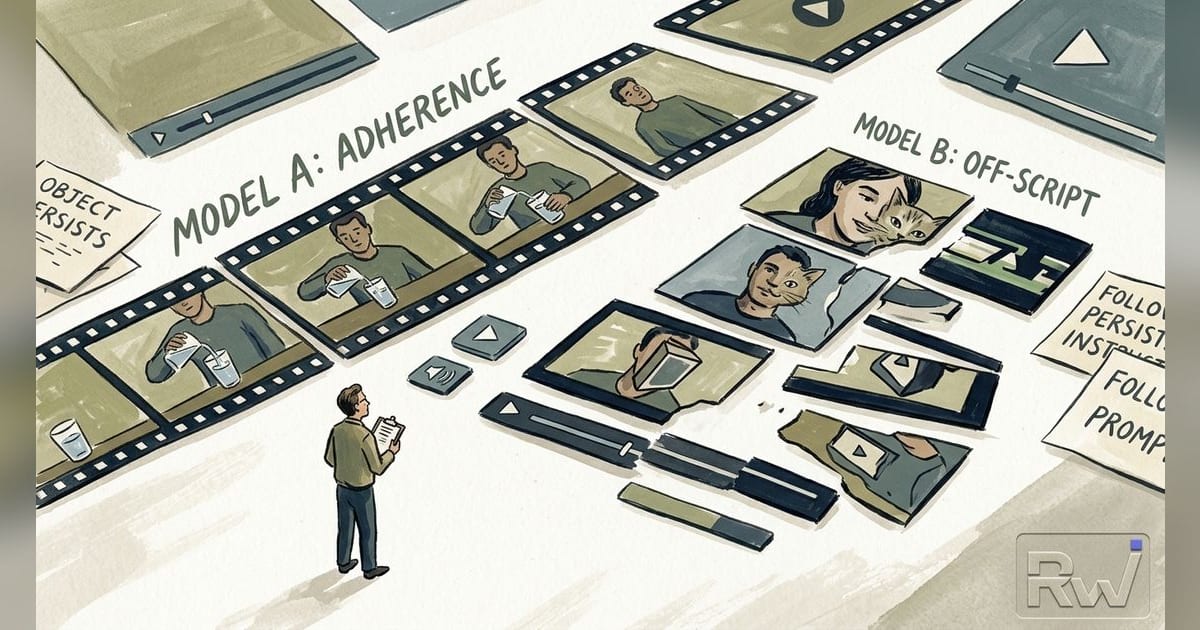
This wasn’t a nail-biter. Gemini Omni Flash beats Heygen 34.5 to 18.8, wins 3 of 4 tasks with 1 tie, and does it with 94% confidence. That’s not a vibes-based edge; it’s a clear result driven by a consistent pattern: Gemini Omni Flash actually delivers the video you asked for, while Heygen too often substitutes something adjacent, prettier, or simply wrong.
The cathedral test is the cleanest example. The prompt called for a single continuous glide through a candlelit cathedral toward the altar. Gemini Omni Flash gave exactly that: forward motion, warm volumetric light, dust in the air, and coherent architectural continuity. Heygen, by contrast, derailed the brief by introducing a woman — and somehow even a sofa — turning an atmospheric camera move into something staged and off-prompt.
The physics realism task was even more decisive. Gemini Omni Flash showed an ice cube settling in soda with believable buoyancy, fizz, and continuity under soft kitchen lighting. Heygen mostly failed the assignment outright, cutting to unrelated shots of a seated person and only briefly gesturing at the requested splash. When a model can’t stay in the same scene long enough to depict the action, there’s no serious case for realism.
The umbrella-basin spill was the lone non-loss for Heygen, and even that was only a tie. One judge preferred Heygen’s cleaner one-shot dump and ripple behavior; the other favored Gemini Omni Flash for better prompt beats like the overturned cobalt umbrella, floating wristbands, and visitor reaction. Split decision, fair enough. But the final task snapped back to form: in the ticket-kiosk glove-knot scene, Gemini Omni Flash was plainly better at the actual assignment, showing the worker beside a glowing kiosk in a busy terminal, performing the one-handed-and-teeth drawstring action, then checking the fit. Heygen looked polished, but it was solving the wrong problem.
Final call: Gemini Omni Flash is the better video model here, and not by a little. Its advantage is fundamental — stronger prompt obedience, better temporal coherence, and fewer bizarre scene substitutions — which is exactly why this matchup lands as a clear win rather than a close stylistic preference.
How they were tested
We ran 4 fresh video tasks, generated on the fly for this matchup so neither model could prepare in advance, and had gpt-5.4 score each one. To cancel position bias, every task was judged twice — once in each presentation order — and every number reported here, including the headline totals, is the average of both passes. Heygen scored 18.8 to Gemini Omni Flash's 34.5.
1. Single continuous shot
One unbroken take gliding slowly through a candlelit cathedral from the entrance toward the altar, no cuts, jumps, or transitions, dust and warm light in the air, 16:9.
Winner: Gemini Omni Flash — Model B closely matches the prompt with a clean, continuous forward glide through a candlelit cathedral toward the altar, maintaining warm volumetric light, dust-filled atmosphere, and strong visual coherence. Model A is visually competent but breaks prompt adherence by centering on a woman and even a sofa in the cathedral, making it feel staged and less like the requested uninterrupted architectural glide. (Second judge pass, order swapped — scores are the average of both: Model B closely matches the prompt with a convincing single forward glide through a candlelit cathedral toward the altar, maintaining warm volumetric light, dust-filled atmosphere, and strong continuity across frames. Model A breaks prompt adherence by introducing a person and even a couch in the cathedral, and its sequence feels less like the specified unbroken architectural glide despite decent image clarity.)
2. Physics realism
A close-up of a single ice cube dropped into a tall glass of soda: it falls, splashes, bobs, and settles with believable buoyancy and fizzing bubbles rising naturally, soft kitchen light, 16:9.
Winner: Gemini Omni Flash — Model A largely fails the prompt, showing unrelated shots of a seated person with only one soda splash frame, so it lacks the requested close-up action and physical continuity. Model B consistently depicts an ice cube in a tall glass of soda with believable buoyancy and rising bubbles, though the sampled frames suggest a gentler settle than a dramatic splash. (Second judge pass, order swapped — scores are the average of both: Model B closely matches the prompt with a believable close-up of ice in soda, natural fizz, and consistent buoyant settling under soft kitchen lighting; the physics and continuity look plausible across frames. Model A largely fails prompt adherence and temporal consistency, showing unrelated shots of a seated person intercut with a stylized splash, so the motion and scene are not coherent or physically grounded for the requested video.)
3. Umbrella basin spill
A short continuous 16:9 clip in a crowded museum courtyard during a light rain: an overturned cobalt umbrella perched on the rim of a stone fountain suddenly dumps a collected sheet of water into the basin, splashing against floating paper admission wristbands and sending concentric ripples across the surface as a gust flips one umbrella spoke and nearby visitors recoil slightly; the camera starts close on the umbrella and gently cranes downward and forward to follow the falling water into the fountain in one shot, soft overcast daylight with reflections from warm café bulbs, mood lively and weather-soaked.
Winner: Tie — Model B better matches the prompt’s key beats: the overturned cobalt umbrella on the fountain rim, the dramatic dump into the basin, visible floating wristbands, and nearby visitors with umbrellas in a lively rainy courtyard. Model A is attractive and coherent, but it reads more like a smooth water pour from the fountain edge than a sudden umbrella-basin spill, and it misses the visitor recoil and umbrella-spoke flip more clearly than Model B. (Second judge pass, order swapped — scores are the average of both: Model A better matches the requested one-shot crane-down action of water dumping from the overturned umbrella into the fountain, with cleaner ripple behavior and stronger visual fidelity. Model B includes the wristbands and crowd reaction more clearly, but its action reads less coherently as a single continuous dump and the umbrella/fountain interaction feels less temporally consistent.)
4. Ticket kiosk glove knot
A short continuous 16:9 clip in a busy commuter ferry terminal at blue-hour dawn: a municipal sanitation worker in a lime rain jacket stands beside a glowing ticket kiosk and carefully ties the loose drawstring of her right rubber glove into a tight knot using only her left hand and teeth, then flexes her fingers to check the fit, all with natural, fluid shoulder and wrist movement while blurred passengers stream behind her; the camera makes a slow waist-high sideways dolly from left to right about one meter, cool fluorescent spill mixing with cold window light, mood focused and quietly gritty.
Winner: Gemini Omni Flash — Model B matches the prompt much more closely by placing the worker beside a glowing ticket kiosk in a busy terminal and clearly showing the one-handed-and-teeth glove drawstring action followed by a fit check, with believable commuter background activity. Model A looks cleaner and more cinematic, but it misses key prompt elements such as the kiosk interaction context, the busy ferry-terminal feel, and the specific glove-knot action, making it less adherent overall. (Second judge pass, order swapped — scores are the average of both: Model B matches the ferry-terminal kiosk setup, commuter background, glove-knot action with teeth, and cool gritty lighting much more closely, with coherent progression from tying to checking the fit. Model A looks cleaner and visually pleasing, but it misses the ticket kiosk and busy terminal context, and the action reads more like handling a jacket drawcord than tying the right glove drawstring.)
See every prompt and the full side-by-side outputs in the interactive Head-to-Head.