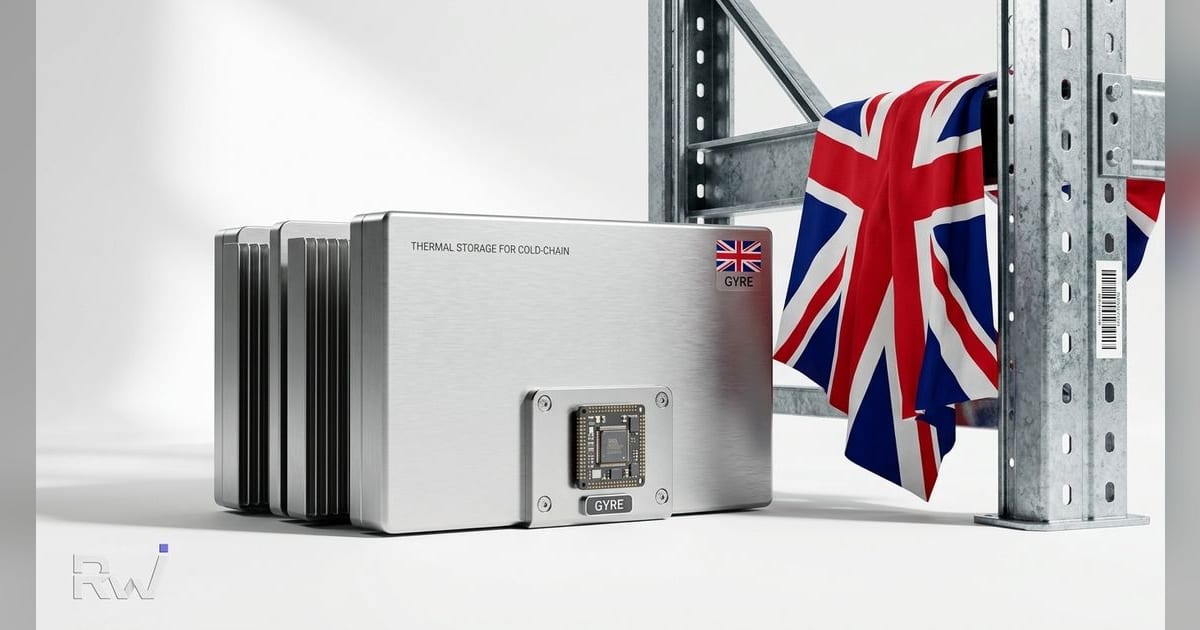
Gyre Energy has secured more than $1.3 million in investment and grant funding, as Tech.eu reported on July 7, giving co-founder and CEO Dougald Coulson and his Oxford MBA co-founders more room to prove that industrial cooling can be managed like a flexible energy asset rather than a fixed electricity bill.
The pre-seed was led by Speedinvest, with participation from Rule 30 and Plug and Play, according to Tech.eu. The total combines investment and grant funding, a useful caveat because Gyre Energy has not broken out how much was equity financing, who supplied the grants, or what valuation investors assigned to the company.
That matters because this is not a cleanly disclosed venture round. Speedinvest investor Alex Davis said in the Tech.eu report that, "in the twelve months since we invested," Gyre Energy had moved from an initial commercial deployment to work with a major cold-chain operator. The phrasing indicates Speedinvest's check may have been written well before the July 7 announcement. The fresh part of the story is Gyre Energy's move into a larger enterprise cold-chain setting, rather than a precisely dated close of the pre-seed.
Founded in 2024 by three Oxford MBAs, per Tech.eu, Gyre Energy names Dougald Coulson as co-founder and CEO. The investor quote in Tech.eu references Tom and Mike among the founding team. The bet is aimed at facilities where software has to meet refrigeration controls, energy tariffs, and uptime requirements, not another dashboard for office buildings.
Coulson's framing is direct. Cooling is a large and rising load, and cold-storage operators have had little control over when and how that load hits their energy bill. He told Tech.eu that infrastructure long treated as a "cost line can become an energy asset." That is the wedge Gyre Energy is taking to cold storage, logistics, grocery retail, and eventually data centers.
The enterprise test
Gyre Energy's next reported deployment is inside a chamber of a 140,000 square foot cold-chain operation run by an unnamed logistics group described by Tech.eu as one of the world's largest movers and storers of temperature-sensitive goods. Gyre Energy says performance will be measured against an IPMVP baseline, a detail that matters because energy-efficiency startups often sell projected savings before customers have a measured baseline.
The product combines two layers. Gyre Energy's AI analyzes a site's behavior, forecasts cooling demand, and adjusts cooling to reduce energy use while preserving temperature stability. Its thermal energy storage then stores cooling capacity when power is cheaper and cleaner, releasing that stored cooling during more expensive peak periods.
The sales pitch is attractive because it avoids the most painful ask in industrial facilities: ripping out working equipment. Gyre Energy says it integrates into existing cooling systems and can cut cooling costs without major infrastructure replacement. That claim will be tested in larger operations where the savings need to survive site variability, operational constraints, and the safety requirements of frozen and chilled inventory.
Gyre Energy's first published commercial deployment gives investors a data point, though it remains a single reported case. At a 2,900 square foot frozen cold-storage facility operated by a large UK chilled and frozen distribution business, Gyre Energy reported a 38% cut in electricity costs, a 35% cut in daily energy consumption, and a payback period under 1.5 years.
Those numbers are strong enough to explain why an early-stage investor would want exposure before the business has named large customers. They are also the numbers Gyre Energy now has to reproduce in a much more demanding environment. A small freezer chamber can validate a control strategy. A global logistics customer can expose whether the model works across operational complexity, multiple tariff regimes, and internal procurement scrutiny.
Cooling is becoming a grid problem
The International Energy Agency says global electricity demand is expected to grow around 50 percent faster over 2026 to 2030 than in the previous decade, driven by HVAC and data centers. It also warns that cooling demand is already straining power grids worldwide.
For a cold-storage operator, those constraints show up less as policy language and more as expensive peak tariffs, congestion, outage risk, and pressure from customers that want lower-emission supply chains. That is why Gyre Energy's focus on load shifting is more interesting than the generic AI label. The useful part of the system is the ability to move cooling demand across time. If Gyre Energy can cool when electricity is cheap and cleaner, then let stored cooling carry the site through peak periods, it gives operators a way to manage a load they already have.
Tech.eu says future applications could extend beyond cold storage to data centers, where operators face rising heat loads and uptime requirements as AI workloads grow.
What the round buys
The $1.3 million-plus financing buys Gyre Energy time to convert a measured deployment into enterprise credibility. It also puts Speedinvest, Rule 30, and Plug and Play behind a founder team taking a deliberately physical version of AI to market. This is AI tied to compressors, racking, doors, tariffs, and cold rooms, which makes adoption slower than pure software and outcomes easier to measure when deployments work.
The open questions remain material. Gyre Energy has not disclosed revenue, headcount, customer count, valuation, the grant providers, or the name of the logistics customer. The unnamed customer is the most important gap because customer identity would say a lot about how seriously the cold-chain market is taking Gyre Energy.
Still, the timing is rational. Europe is dealing with hotter summers and power-price volatility, while cold-chain operators are being asked to expand capacity and cut emissions at the same time. Gyre Energy's founders are betting that the cold room, long treated as an operational necessity, can become a controllable part of the energy stack. The next proof point is whether that claim holds at 140,000 square feet.