One of the more irksome characteristics of a certain type of tech executive is their tendency to profess to have “solved” a problem about which they know relatively little. The canonical example is Elon Musk’s Thai submarine debacle, but even that seems reasonably naïve by today’s standards—I mean, at least the stupid thing wasn’t piloted by Grok. Because while anyone who’s used a computer over the last couple of years will know that the entire economy’s inexplicable all-in bet on AI demands that AI be crammed into any and every piece of software, it seems that even that’s not enough. This is perhaps why AI creep is spreading beyond the screen and into the real world, and finding its way into all manner of questionable “solutions.”
This brings us to this morning’s news about a new start-up called NavigateAI. The company recently exited “stealth mode,” although it clearly wasn’t stealthy enough to evade the investors who stuffed $25m into its back pocket. So what does the company do? Well, according to a report in TechCrunch, it’s setting its sights on the shortage of construction workers in America. Yes, apparently there aren’t enough qualified tradespeople to satisfy a sudden demand for construction workers. The chief complainants about this lack of construction capacity are [drum roll] tech companies, who apparently can’t get their data centers built quickly enough because of a pesky lack of people to build them.
Stuffy old 20th century economists might opine that this overwhelming demand might lead to higher wages for construction workers and an influx of labor into the industry, but Silicon Valley has a much better idea than that. What we need, friends, is… an app. And not just any app. No, what we need is a “trusted field copilot that upskills, project manages, checks quality, and provides knowledge, instantly.” (Or, in English, an AI app that tells you how to do stuff via your smartphone and/or your pervert glasses.)
There’s a lot to unpack here, and it all starts from the assumption that there’s a pool of labor just waiting to get to work building data centers, if only someone—or something!—would tell them how to do so. After all, construction is for dummies, right? How hard can it be? You can probably learn everything you need to in a couple of days.
The idea that construction skills are basic and easy to learn is reinforced by the series of videos that play as you scroll down NavigateAI’s site. We watch various plucky DIY types wandering around residential and commercial construction sites. “Just press record, I’ll do the rest,” proclaims one message. “Frame inspection complete,” says another. And, most alarmingly, “Electrical gear installed per approved electrical shop drawing submittal.”
Now, I’m sure NavigateAI can’t possibly be suggesting that electrician skills, of all things, can be learned from an app, so we’ll give them the benefit of the doubt and assume that that particular clip somehow magically involved getting sign-off on some sort of regulatory approval. (If anyone has in fact managed to get any such approval via an app, do tell us about it in the comments.) But either way, as someone who spent the best part of ten years working on and off in construction, sometimes five or six days a week, sometimes casually for extra cash if writing wasn’t quite making ends meet, let me make some observations here.
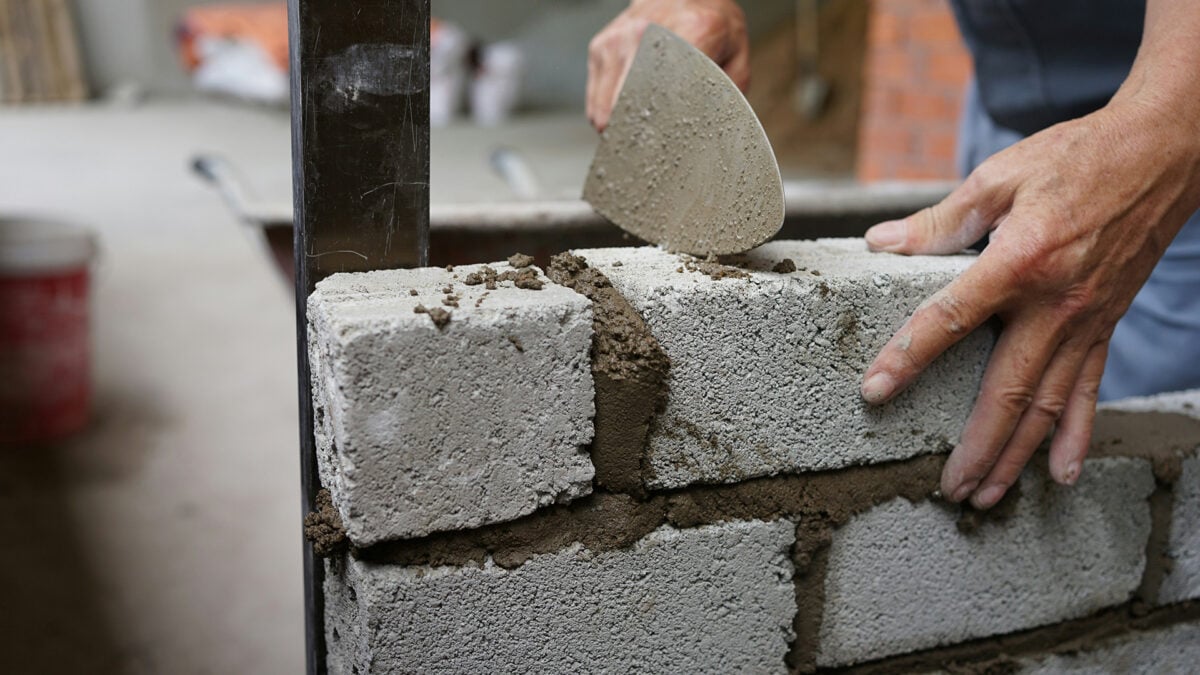
The first is that there’s a huge difference between being shown something and learning it. I mean, I can show you how to lay a brick. Come on. Pick up your trowel, scoop up some mortar, grab a brick in your other hand—they’re heavy, hey?—spread some of the mortar on one of the brick’s short sides, flip it over, spread mortar on the other short side, place the brick on the bed of mortar that your already-impatient colleague has spread along the top of the previous course, use the handle of your trowel to tap it into place, and…
What’s that? The mortar fell off as soon as you spun the brick around? Ah. You forgot to tap the trowel on the edge of the board to get the air out of the mortar, didn’t you? Also, that last brick’s not sitting level. Check it again against the string line—you did remember to lift it up, right? You know, the line strung between the two profiles. Sorry, what? What’s a profile? Oh boy. OK, look—wait, why are you putting on those weird sunglasses again? Everyone else has already finished this course, and… what? There’s mortar all over one lens? Well, maybe you should have been wearing proper eye protection.
My point is that while construction disciplines might appear superficially simple, there’s a lifetime’s worth of practice to be done in mastering them. One of my favorite things to do in my years as a laborer was watch various subcontractors and admire just how good they were at their chosen trades. The way a team of concreters let their floats glide across the top of a completed slab, bringing a thin coating of water sit atop the finished surface. The way the guy who lays heat-on roofing membrane caresses the surface of a roof with the flame from his butane torch. The dexterity and endurance that characterizes proper bricklayers. And many more.
All these things look easy, but that’s because they’re being done by people who make them look easy. But they’re not easy, and the only way you learn them is by doing them again and again: first as an apprentice, under the supervision of a real person—a skilled craftsman who decades of experience—and, when you’re ready, eventually under your own aegis.
Many of these disciplines are also difficult and physically demanding. Lay a course of, say, 20 bricks and feel how your left arm and right wrist ache. Then think about laying that same course 20 or 30 more times. And getting up before dawn to do the same thing tomorrow. And the next day. By now, you might find yourself wondering if the lack of skilled construction workers really has much at all to do with the fact that no-one’s made an iPad app for them.
You might think that it could have more to do with the fact that, despite the level of expertise and physical application required, along with omnipresent danger of accidents that comes from working with power tools and moving heavy objects, doing one of these jobs means earning orders of magnitude less than the guy who’s trying to tell you what’s wrong with your industry. You might join the dots and think that’s why young people don’t appear to find the prospect of working in construction particularly appealing any more, and also why these jobs are often filled by immigrants, documented or undocumented, doing—as ever—the work no one else wants to do.
If you’re not exhausted yet—and I do hope not, because it’s not even lunchtime—you might follow that train of thought to its logical conclusion, which is that it’s not surprising there’s a labor shortage in an industry that’s been targeted directly and repeatedly by ICE raids. You might ponder the rich irony of the tech industry, which has bent over backwards to indulge the government ordering those raids, now complaining that it can’t build its data centers because of a lack of construction workers. But then, maybe they don’t care in the least. After all, if you keep scrolling down NavigateAI’s page, you get to a little something that might just be the real kicker: “Trained on real assets with real teams to ensure the accuracy of detection.” Surely this can’t all just be a big play for training data. Only a cynic would suggest such. But consider this.
As well as everything else I’ve mentioned, one other thing characterizes the construction industry: unions. It’s one of the last heavily unionized industries in America. And a classic way to bust unions is to find ways to dispense with the need for the skills monopolized by the skilled workers who populate those unions. Look at how, say, the production line made a generation of skilled auto assemblers replaceable, or how the culinary equivalent lets fast food restaurants staff themselves with underpaid and underskilled teenagers.
It’d be awfully convenient for everyone except actual construction workers to replace skilled union labor with AI-“trained” schlubs. I’m sure the idea sends corporate America, which has been dreaming about things like bricklaying machines for generations, into paroxysms of delight. Of course, some of those AI-trained schlubs will probably end up with crippling back pain, or injuring themselves with power tools that looked much easier to handle on screen than they prove in real life, or etc. But that’s OK. There are always more feet to fill those steel-toed boots.