penAI just did a lot more than release its most advanced language model.
While GPT-5.6 went into full public release on Thursday, as we've been expecting all week, the company also announced a ton of other developments and updates at the same time, including the next big step toward its long-awaited superapp. Like Anthropic's Mythos, the US government worked with OpenAI to delay the broader release of GPT-5.6 until government agencies and corporations were better prepared for the model's ability to uncover software vulnerabilities that could enable cyberattackers and other bad actors.
The centerpiece of today's announcement remains the GPT-5.6 family of models, which now includes Sol (flagship), Terra (balanced), and Luna (fastest and least expensive). The models have been performing like champs on benchmarks such as Agent's Last Exam, outperforming Anthropic's Mythos and Fable. The OpenAI models are also less expensive. For 1M tokens, Sol costs $5 input / $30 output while Mythos and Fable cost $10 / $50.
But OpenAI also used Thursday's announcement to roll out several other significant updates:
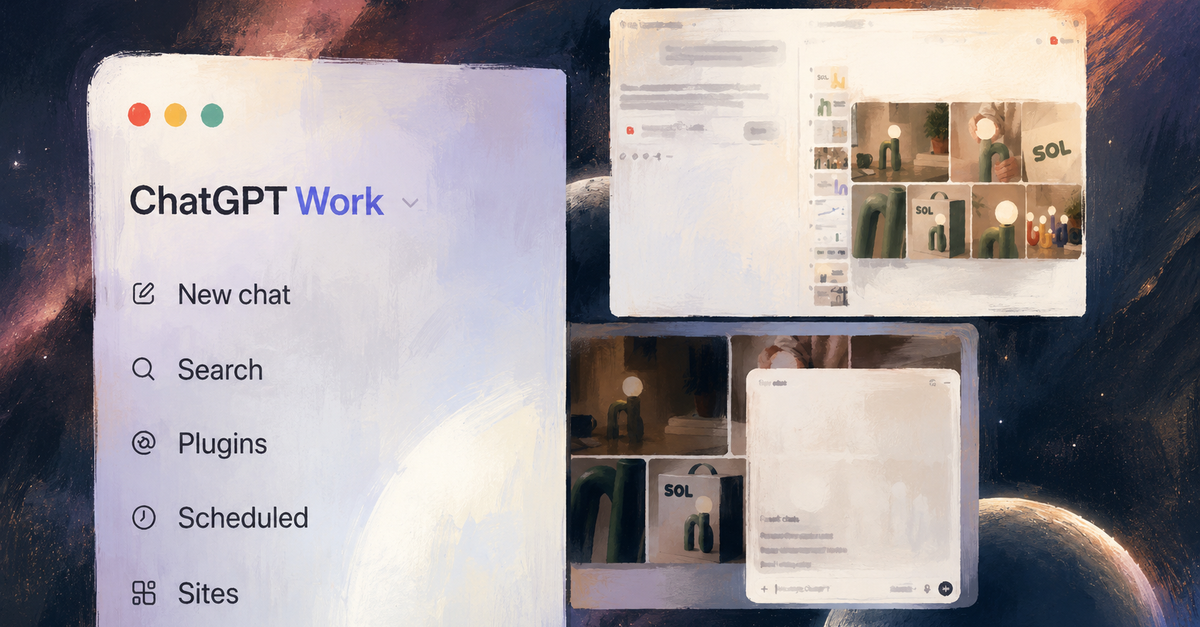
Codex moves into the ChatGPT app: This has been in the works since March, as Codex transformed from a coding agent to a more general agentic tool after the meteoric rise of OpenClaw, whose founder, Peter Steinberger, joined OpenAI's Codex team. The combination of the two apps is still a little confusing, but the OpenAI team assured me that the Codex brand will remain and the agent harness will continue to be open-source. ChatGPT users will now get an AI agent inside the chatbot they already use.Launch of ChatGPT Work: Perhaps the most significant new development is the launch ofChatGPT Work, an agent that brings the kinds of tasks for knowledge work that people have been doing with Codex on the desktop to the ChatGPT app across web and mobile. There will be a new toggle between Chat and Work when you load ChatGPT, so you can do agentic work from anywhere you're already using the OpenAI chatbot.ChatGPT Sites: From ChatGPT Work you can now describe a site you want to build in natural language with no understanding of code, and it can make it, deploy it, and give you a live link on the web that you can share with anyone. This handles the deployment work that you would have previously needed a tool like Lovable, Replit, or Vercel to do.New "Ultra" mode: For a step up in capability (and token-burning), this higher-level setting lets power users supercharge their most ambitious workloads, especially long-running tasks and those that require multiple agents running in parallel.Atlas browser deprecated: OpenAI is shutting down the ChatGPT Atlas web browser and focusing on its Chrome extension instead. As an Atlas browser user, this is a bummer because I liked using it for research to give ChatGPT more context, how easy it was to start prompts, and the saved prompts feature.
"We launched the Codex app five months ago this week," Andrew Ambrosino, lead for the Codex app, wrote on X. "Today is a big step, but it’s only the first. We have much more to show you in the coming weeks and months. We’re working to unify the experience across web, mobile, and desktop—but we want to do it thoughtfully, not smash two things together with a toggle."
Threading the needle between Codex and ChatGPT, two very different experiences, is tricky. But it's clear that OpenAI's most advanced capabilities needed to come to its biggest platform.
"We have more than 5 million people using Codex every week, but close to a billion people using ChatGPT. And so, for the largest part of the audience, they had not really seen the power of agents," Romain Huet, head of developer experience at OpenAI, told The Deep View. "[Today begins] this progressive reveal for almost a billion people that can now delegate more tasks of more complexity to something like ChatGPT Work to do more things for them."
Our Deeper View #
While we expected the GPT-5.6 launch this week and the models themselves are a known quantity at this point, the first big step toward bringing Codex and ChatGPT into a single app experience was a bigger surprise. Of course, it's long overdue since OpenAI executives such as Greg Brockman have been talking about it since the end of Q1. But it's not easy, since Codex had turned into an agentic power-user app used by rabid enthusiasts, while ChatGPT is the mainstream interface used by a billion people. The first steps still look a little confusing to me, but it was time to start bringing them together to create a more unified experience, and I'm glad OpenAI has begun the process. In the short term, starting to introduce a lot more people to the time-saving power of agents will be the biggest win. And running OpenAI agents across desktop, mobile, and web will be the big upgrade for the power users who already rely on Codex.