SEO »
AI can discover, compare, and buy products on users' behalf. Learn how to prepare your product data, Merchant Center, and structured data. #
As long as I’ve been in search marketing, the path has been simple: search query → click → buy.
SEO followed the same model, with organic traffic, impressions, and click-through rate (CTR) serving as its primary measures of success. Google’s Universal Commerce Protocol (UCP) signals where search is headed, shifting from a discovery engine to a transaction layer.
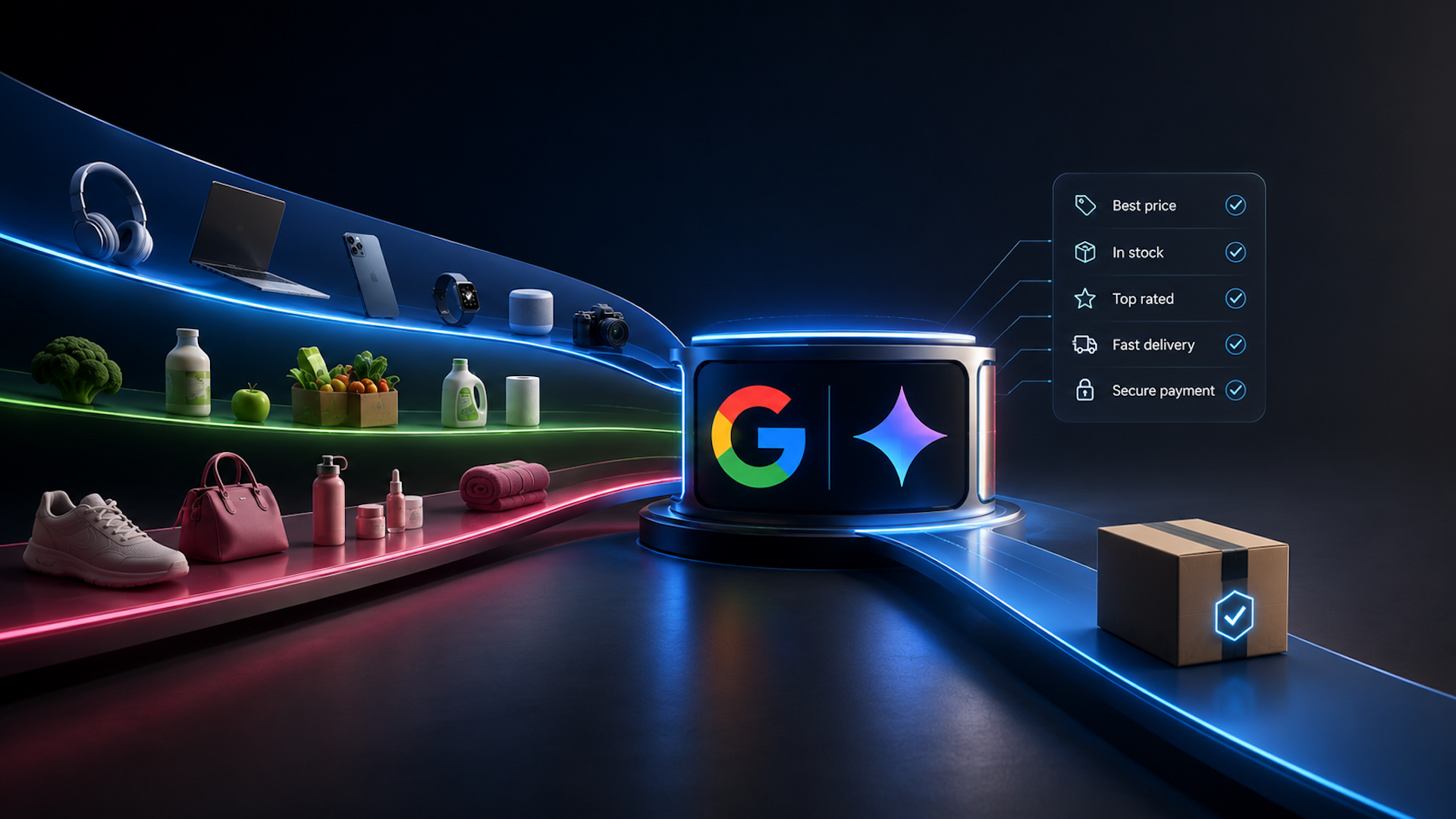
Driven by the rise of “agentic commerce,” Google can now discover, evaluate, compare, and complete purchases entirely within its AI-powered experiences, including AI Mode, Gemini, YouTube, and Gmail.
The SEO implications are significant. We’re moving from optimizing for clicks to optimizing for AI transactions. If your brand doesn’t speak the language of UCP, you risk becoming invisible to the next generation of shoppers.
Here’s what UCP is, why it’s reshaping digital marketing, and how to adapt your SEO strategy.
UCP: The infrastructure behind AI transactions #
UCP is an open-source, vendor-agnostic standard that enables the entire commerce lifecycle, from discovery and cart building to checkout and post-purchase tracking, within AI interfaces.
Co-developed by Google with Shopify, Walmart, Target, Wayfair, Etsy, and other ecosystem leaders, UCP acts as a universal translator between AI shopping agents and merchants’ storefront backends.
Think of UCP as the ecommerce equivalent of HTTPS. Just as HTTPS standardizes secure communication between web browsers and servers, UCP standardizes how AI agents interact with online stores. Instead of requiring custom one-to-one integrations for every merchant, AI agents can securely browse inventory and complete purchases across millions of online stores.
[ Be the brand AI recommends. See your AI visibility
](https://www.semrush.com/ai-seo/overview?utm_campaign=ic_sel_0101ai&utm_source=searchengineland.com&utm_medium=overlay&onboarding=off) See where your brand appears in AI search, where competitors are winning, and what it takes to become the answer AI recommends.
How AI transactions flow through UCP #
When someone asks AI Mode to “find and order a replacement water filter for a 2021 Samsung French-door fridge with the fastest shipping,” UCP handles the transaction through a structured workflow.
Capability publication
The merchant publishes its merchant capabilities, including product search, live pricing, fulfillment options, and accepted payment methods.
Handshake
The AI agent reads the merchant profile, matches it with its own capabilities, and establishes a secure path forward, such as aligning on loyalty programs or supported digital wallets.
Action execution
The AI searches for the product, verifies real-time inventory, builds the cart, and uses the Agent Payments Protocol (AP2) to complete a secure, tokenized transaction.
Human escalation
If user input is required, such as selecting a delivery window or confirming a shipping address, UCP s the transaction, prompts the user, and then hands control back to the AI to complete the workflow. Dig deeper: How Google’s Universal Commerce Protocol could reshape search conversions
Why UCP matters for search and SEO #
UCP isn’t just a technical update. It changes how AI discovers, evaluates, and purchases products. Here’s why it matters for SEO.
1. From click-throughs to buy-throughs
In an agentic search environment, website traffic is no longer the only measure of business value. As Google rolls out features like Universal Cart, allowing users to add products from multiple retailers to a single Google cart and check out with Google Wallet, the buying journey becomes much shorter.
Shoppers may never visit your homepage, category page, or product detail page. Your SEO objective shifts to earning product selection within the AI recommendation layer, turning a search query into a sale without intermediate web traffic.
2. The rise of hyper-personalized, conversational queries
Keyword research is evolving. Shoppers are no longer searching for “men’s running shoes.” They’re using highly specific, situational prompts, such as “Best running shoes for flat feet under $150 that can arrive by Friday.”
To match those queries, search engines need more than on-page copy. They need rich, queryable product attributes. UCP bridges that gap, allowing AI agents to match your inventory with highly specific user requests.
3. Less checkout friction
Cart abandonment remains a persistent ecommerce challenge, often caused by lengthy forms, broken checkout flows, or unexpected shipping costs. Because UCP integrates with secure digital wallets and passes verified user data automatically, it removes many of those friction points.
For high-intent, urgent, or repeat purchases, merchants that support UCP can capture more conversions than competitors that send users to a separate checkout experience.
4. Merchants retain brand control and customer ownership
When a transaction happens through UCP, the merchant remains the Merchant of Record. Brands still control pricing, fulfillment, and return policies while retaining customer relationships and first-party data. UCP simply provides the infrastructure that enables AI-powered transactions.
Dig deeper: Winning the AI decision layer: From AI discovery to agentic commerce
How to prepare your brand for UCP #
If your SEO strategy is limited to blog articles and meta descriptions, you’re overlooking the technical infrastructure behind AI-powered commerce. To make your products eligible for UCP-powered search experiences, focus on these priorities.
Optimize your Merchant Center feed
Your Google Merchant Center (GMC) account is no longer just for Shopping ads. It’s becoming the primary source of product data for AI discovery.
Enable the To opt into UCP-powered checkouts, add thenative_commerce
attribute:to your product feed. Google recommends using supplemental feeds to apply it at the product level without affecting your primary feed.native_commerce
attributeMap product identifiers: Ensure every product ID in your GMC feed maps one-to-one with your internal checkout API. If they don’t match, use themerchant_item_id
attribute to align them.Complete your policy data: Keep your returns, shipping, and customer support information complete and up to date. AI agents prioritize merchants with clear policy data.
Align structured data with your product feed
AI search relies on consistent data across your website and Merchant Center. Keep your Product
, Offer
, and Review
schema synchronized with your product feed. Differences between the two can trigger validation issues that make products ineligible for AI-powered checkout.
Prepare for conversational attributes
Google is introducing new semantic attributes designed for conversational AI search. Start preparing your inventory systems to provide:
- Real-time inventory availability.
- Direct answers to product FAQs, such as “Is this jacket machine washable?”
- Product compatibility data, including accessory pairings, sizing guides, and model-specific replacements.
[
If AI can’t find you, customers won’t either.
See your AI visibility
](https://www.semrush.com/ai-seo/overview?utm_campaign=ic_sel_0102ai&utm_source=searchengineland.com&utm_medium=overlay&onboarding=off) Track your visibility across AI search, uncover missed opportunities, and grow your presence where customers are asking questions.
Beyond clicks: SEO’s next opportunity #
The Universal Commerce Protocol reflects a broader shift in search. For SEOs, that expands our role beyond driving traffic.
By prioritizing structured product data, data readiness, and agentic commerce, you can position your brand to capture demand at the moment of intent.
The future of search isn’t just about getting found. It’s about getting bought.
Contributing authors are invited to create content for Search Engine Land and are chosen for their expertise and contribution to the search community. Our contributors work under the oversight of the editorial staff and contributions are checked for quality and relevance to our readers. Search Engine Land is owned by Semrush. Contributor was not asked to make any direct or indirect mentions of Semrush. The opinions they express are their own.