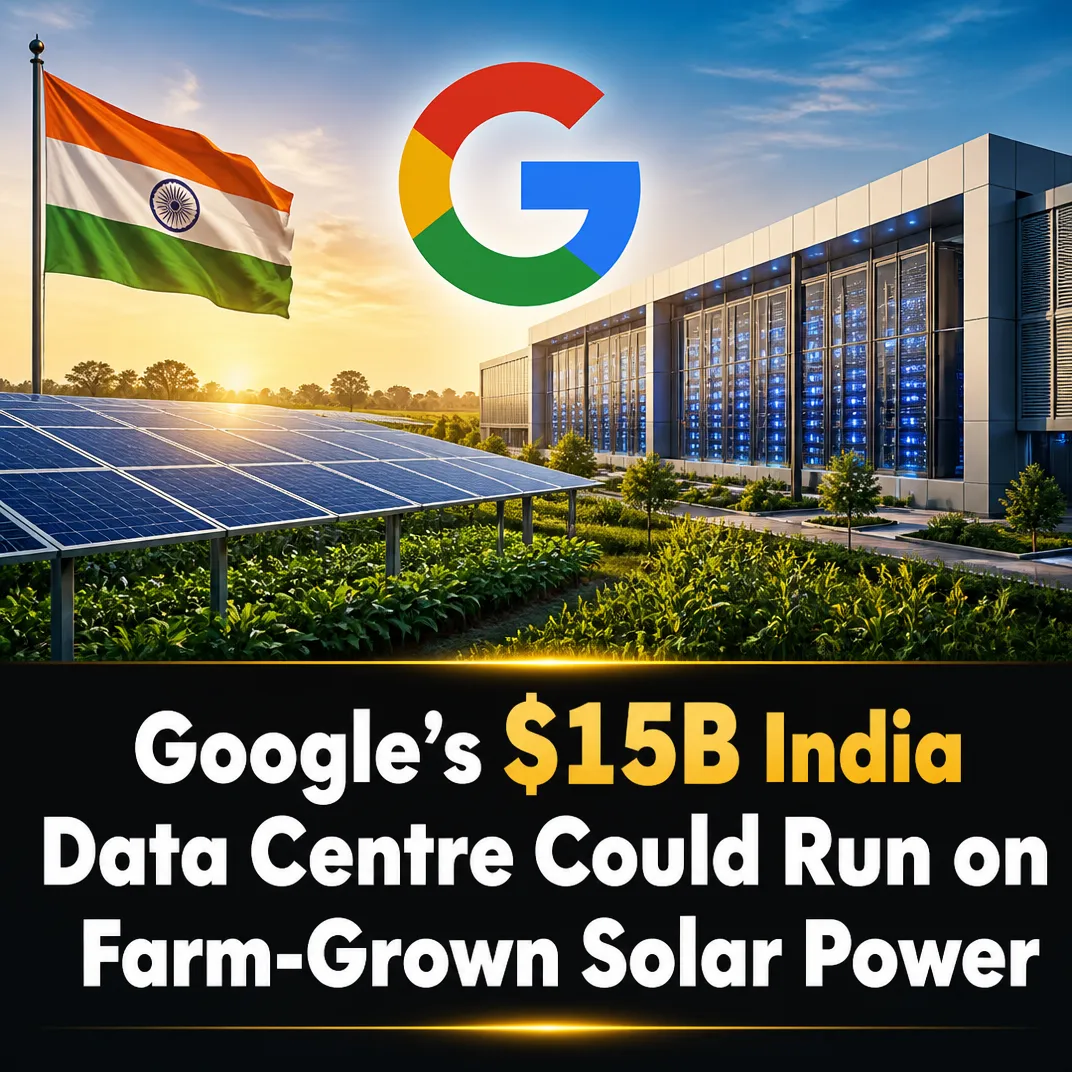
August 3, 2026, (Inside AI) — Google’s $15 billion data centre in Visakhapatnam, Andhra Pradesh, set to be Asia’s largest when operational in 2028, will demand 24 GWh of power daily. That colossal energy appetite risks diverting electricity from agriculture or expanding fossil fuel use, unless a novel agrivoltaics model turns farmers into clean energy partners.
The one-gigawatt facility, secured by Chief Minister Chandrababu Naidu, has already spurred a policy innovation: a Deemed Distribution Licence (DDL) allowing hyperscale operators to procure their own power. Yet, without complementary measures, the project could strain the grid and provoke social tensions. Agrivoltaics, where solar panels are mounted 10 to 12 feet above farmland to enable cultivation beneath, offers a path to align data centre growth with rural prosperity.
ICRIER researchers Ashok Gulati, K. Srinath Reddy, and Raja Sekhar Guntuboyina propose that Google devote a portion of its investment to captive solar generation on farmers’ fields. Farmers would retain land titles, cultivate high-value crops, and hold equity in a special-purpose vehicle (SPV) that sells electricity to the data centre. This model, tested in ICRIER pilots across Rajasthan, Odisha, and Madhya Pradesh, has boosted incomes eight to ten times by adding solar energy as a “third crop.”
“We propose that Google devote a modest portion of its investment to developing captive solar generation on farmers' fields. Farmers would continue cultivating their land while also holding equity in the solar enterprise, becoming co-owners of the clean energy that powers the data centre.” Ashok Gulati, Distinguished Professor, ICRIER; K. Srinath Reddy, Executive Director, Global Agri-Entrepreneurship Academy; Raja Sekhar Guntuboyina, Regional Manager, International Cooperation (Asia), Wageningen University
Under the DDL, Google can contract green generation through open-access and banking arrangements, standing as a long-term offtaker. The farmers’ solar utility gains a creditworthy customer, and the data centre’s load finances rural electrification instead of starving it. The proposal envisions 5,000 agrivoltaic systems of 1 MW each, requiring an estimated Rs 20,000 crore (about $2.2 billion). Blended finance, including low-interest debt from Google, capital subsidies via the PM-KUSUM programme, and credit guarantees, could make funding viable without burdening state budgets.
Agrivoltaics is gaining global traction as a solution to land-use conflicts. Research published in Nature Sustainability demonstrates that elevated solar panels can maintain crop yields while generating electricity, particularly for shade-tolerant species. The dual-use approach reduces water evaporation and can improve microclimates, aligning with India’s goal of 500 GW renewable capacity by 2030. However, scaling requires organizing farmers into cooperatives, akin to milk cooperatives, and navigating regulatory hurdles around land use and grid integration.
Farmers as Co-Owners, Not Just Landlords #
The model contrasts sharply with traditional land acquisition, which often leaves behind one-time rents and lasting grievances. By treating farmers as co-owners, the agrivoltaics system becomes a shared asset. The SPV structure allows farmers to contribute land while borrowing equity from banks, with revenue from electricity sales supplementing agricultural income. This could pre-empt conflicts that might otherwise define the Visakhapatnam project, turning a potential liability into a political dividend for the state government.
“In one stroke, the data centre's load becomes the demand that finances rural electrification, not the demand that starves it.” Gulati, Reddy, and Guntuboyina
For Google, the arrangement offers more than electricity. It builds social licence in a market where large projects hinge on community acceptance. The company’s own sustainability commitments include 24/7 carbon-free energy by 2030, and agrivoltaics could provide a scalable, traceable source. Yet, challenges persist: land fragmentation, upfront capital costs, and the need for robust maintenance ecosystems. Andhra Pradesh’s DDL framework, however, provides a regulatory sandbox to test this at scale.
Beyond the Pilot: Scaling a New Energy Economy #
The ICRIER pilots have proven the concept, but moving from 1 MW pilots to 5 GW demands an ecosystem of farmer-producer companies, rural entrepreneurs, and innovative financing. The blend of Google’s debt, public subsidies, and commercial capital could create a replicable template. If successful, it could reshape how hyperscalers engage with agricultural economies globally, turning data centres from resource competitors into catalysts for rural development.
The choice, as the authors frame it, is not between development and farmers, but between two development models. With the DDL already in place, Andhra Pradesh is positioned to demonstrate how the cloud can literally shower prosperity on agri-households, setting a precedent for the rest of India and beyond.