Improving AI models are causing accelerated progress in other areas of AI.
Google DeepMind has released Gemini Robotics 2.5, its most capable vision-language-action (VLA) model for robots so far, and says a big part of the credit goes to another of its models: Gemini 4 Argon. According to Google, Argon’s ability to act as a simulation engine helped clear one of the biggest bottlenecks in robotics, the shortage of physical training data, and sped up the development of the new robotics model.
Gemini Robotics 2.5 is rolling out to Google’s robotics partners.
Argon as a simulation engine #
Teaching robots new skills takes enormous amounts of physical data, along with efficient modelling algorithms. Google says Argon’s robotics research capabilities helped on both fronts.
The model can take a real-world camera scene and generate thousands of varied, simulated practice runs from it, building a realistic digital twin of the environment in the process. Combined with real training demonstrations, this helps the robot generalize to new scenes and objects more quickly.
Argon also helps researchers work out why a task failed. Given video footage of a failed attempt, it can hypothesize what went wrong, and researchers can then test the best fixes in simulation as well as directly on real robots.
The approach fits with DeepMind’s broader push on world simulation. Google recently launched Genie 4, its latest world simulation model, and has been pairing Argon with Genie 4 and its Gemini Robotics work, with Argon breaking tasks into steps for the simulation to render.
What Gemini Robotics 2.5 can do #
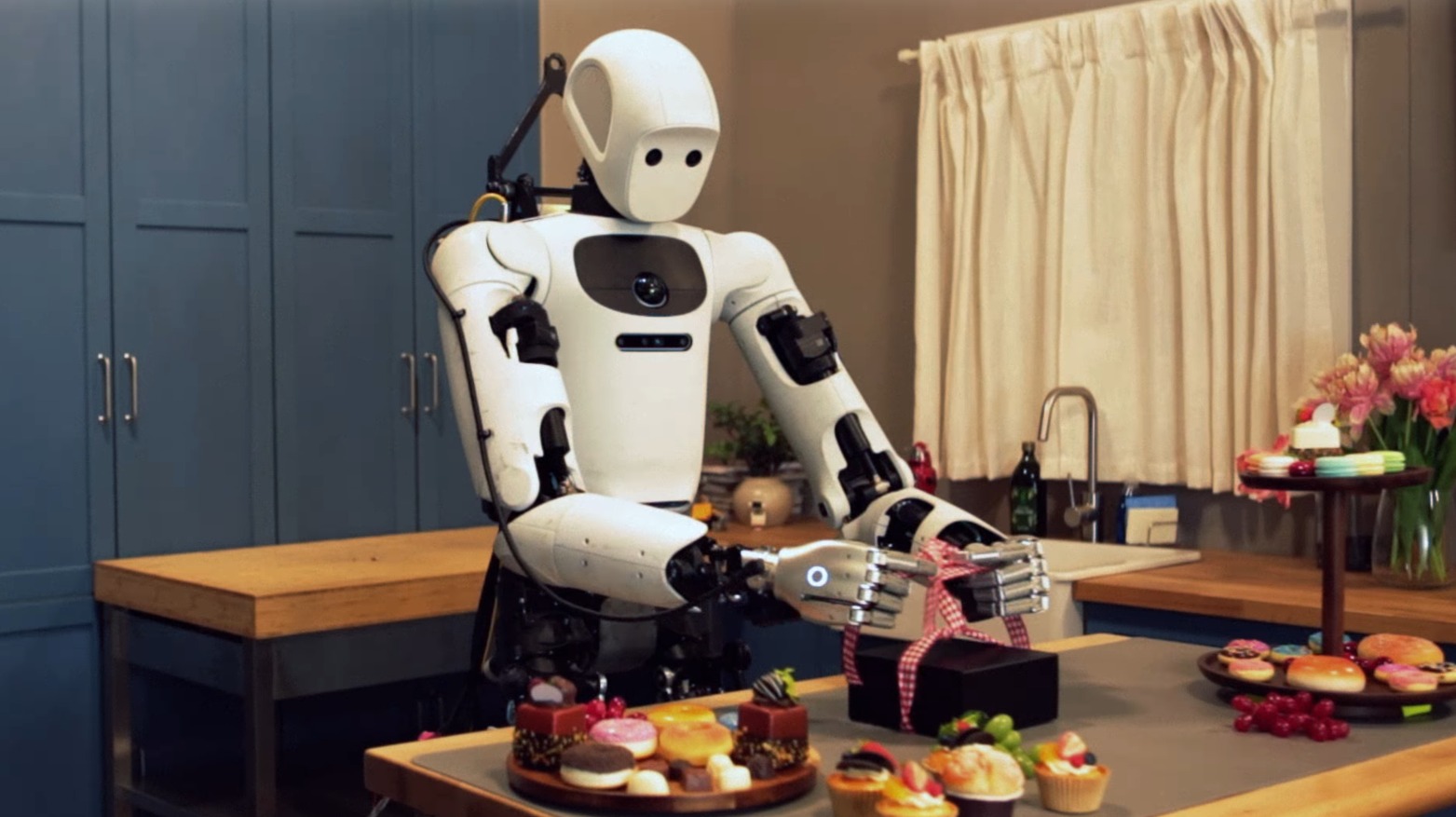
Google tested the new model across more than 200 distinct tasks, including serving food with tongs, tying a bow on a gift box and pipetting a liquid. These combine skills like tool use, handling deformable objects and working with delicate items.
Compared to previous baselines, Google says Gemini Robotics 2.5 achieves a 30% to 100% higher success rate depending on the task, while finishing tasks 20% to 30% faster. Some of the individual results, comparing against Gemini Robotics 2, are striking. Success at packing pastries with tongs jumped from 5% to 100%, closing the lid of a black toolbox from 0% to 93%, untying ribbon bows from 0% to 70%, and hanging a cardigan from 0% to 62%. Sweeping trash into a dustpan with a brush rose from 0% to 52%, and folding pants from 0% to 40%.
The model works across different robot types, including Apptronik’s Apollo 2 humanoid, which has the five-finger, 22 degree-of-freedom SharpaWave hand, and the Franka Duo platform with two-fingered parallel grippers.
A 96% success rate on Mercedes-Benz production lines #
Google also tested the model in a real industrial setting. Working with Apptronik and Mercedes-Benz, it put Apollo 2 humanoids on active automotive production lines in Kecskemét, Hungary, and Sindelfingen, Germany, as a proof of concept.
The robots performed automotive kitting, which involves sorting parts from bulk bins into trays in the exact order each vehicle needs. Google’s embodied reasoning model, Gemini Robotics ER, tracked the workflow, much like the planning role it played in earlier releases such as Gemini Robotics-ER 1.6, while the Gemini Robotics 2.5 actions model controlled the hands and arms. The robot reached into supply bins, picked up metal brackets and placed them into sequencing containers, correcting for gaps along the way. The pilot achieved a 96% success rate.
Apptronik CEO Jeff Cardenas said the models improved dramatically in just a few weeks of post-training and carried over to Mercedes-Benz production with very little drop-off.
Safety gets attention too #
Google says it has improved the model’s physical safety. Gemini Robotics 2.5 uses inference-time reasoning guidance to steer around hazards in real time, which Google says improved safe task completion around obstacles by 33% and around nearby people by 43%.
On the agentic side, Google says Gemini 4 Argon currently leads its agentic robotics evaluations on unsafe task refusal, resolving uncertainty and working near humans. The company is also releasing ASIMOV-Jailbreak, an open-source benchmark of hundreds of prompts that disguise unsafe requests across dozens of scenes. Argon achieves 99.5% jailbreak resistance on it, up from 82% for the previous baseline, Gemini Robotics ER 2.
Why it matters #
Google’s robotics work has moved quickly over the past year, from the thinking, planning approach of Gemini Robotics 1.5 to whole-body humanoid control and now broader dexterity. What stands out this time is the loop: a frontier model like Argon, which has put Google back in the race at the top of the leaderboards, is now being used to speed up the training of the robots themselves.
If simulation can supply data at this scale, the data bottleneck that has long held robotics back could ease considerably. Google called Gemini Robotics 2.5 an important milestone on the path toward solving physical AGI.