Frontier AI models are continuing to be released at a scorching pace.
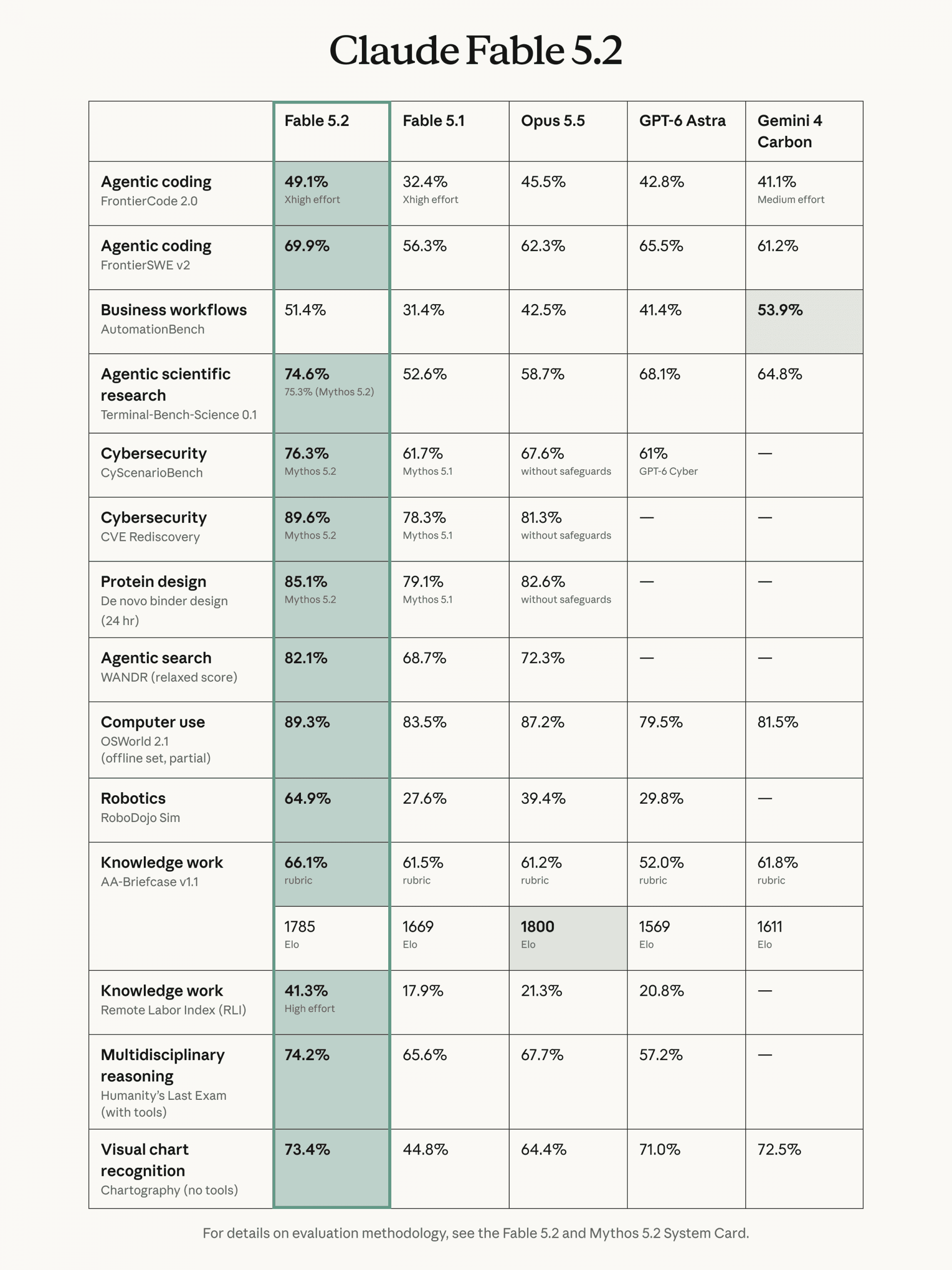
Anthropic has released Claude Fable 5.2 and Claude Mythos 5.2, two models it says are built for the most difficult technical work. Anthropic describes them as a step above its own Opus 5.5 in almost every capability it tested, and the benchmark table it published puts Fable 5.2 ahead of OpenAI’s GPT-6 Astra and Google’s Gemini 4 Carbon in most of the head-to-head comparisons.
The two models share the same underlying weights. Fable carries strong safeguards against misuse, while Mythos is the less restricted version, available to vetted organisations.
How Fable 5.2 stacks up #
Fable 5.2 beats GPT-6 Astra on every benchmark where Anthropic lists a score for OpenAI’s model. Against Gemini 4 Carbon, it wins everywhere except one: AutomationBench, which tests business workflows. Carbon scores 53.9% there to Fable 5.2’s 51.4%.
Fable 5.2 also leads the field on the rubric-scored version of the AA-Briefcase knowledge-work benchmark, at 66.1%. On the Elo-rated version, though, Opus 5.5 is ahead at 1800 to Fable 5.2’s 1785. Both are well clear of GPT-6 Astra (1569) and Gemini 4 Carbon (1611).
The gaps over Anthropic’s own earlier models are often much larger. On RoboDojo, Fable 5.2 more than doubles Fable 5.1’s 27.6%, and on the Remote Labor Index it scores 41.3% against 17.9% for Fable 5.1 and 21.3% for Opus 5.5. The Remote Labor Index measures knowledge work, and Fable 5.2’s score there was recorded at High effort.
Coding, cybersecurity and science #
Coding is where Anthropic is leaning hardest. In early testing on FrontierCode 2.0, Fable 5.2 at High effort scored about level with Opus 5.5 at Max effort, at roughly half the cost per task. At Xhigh effort it posted the highest score of any released model tested.
Cybersecurity and life sciences are the other headline areas, though several of those numbers come from Mythos 5.2, the version without the extra safeguards. On CyScenarioBench, Mythos 5.2 scores 76.3%, against 61% for GPT-6 Cyber. On CVE Rediscovery it reaches 89.6%, and on a 24-hour de novo protein binder design task it hits 85.1%. The latest agentic-search result is also striking: 82.1% on WANDR, a benchmark where Gemini 4 Carbon had recently posted a new state-of-the-art score at a lower cost than GPT-6 Astra and Fable 5.1.
Mythos 5.2 also found a new way to predict the structure of a whole capsid, the protein shell used to deliver gene therapies. In Anthropic’s tests it accurately modelled 28 of the 34 capsids it attempted, which biologists could use to design capsids faster and more cheaply.
1,000 agents, one theorem #
The most eye-catching demonstration is in pure mathematics. A team of 1,000 Fable 5.2 agents fully formalised Fermat’s Last Theorem in 30 hours, translating the proof into a language a computer can verify step by step. With the same setup, Opus 5.5 completed only 26% of the work in 18 hours and made little further progress by the 30-hour mark.
It adds to a growing list of AI results in maths and science. A startup recently claimed a proof of the Aaronson-Ambainis conjecture, and GPT-6 Astra has been solving unpublished physics research problems on a new benchmark.
Anthropic also says Fable 5.2 is much better at controlling physical robots, including on tasks it was never explicitly trained for. On RoboDojo, a simulated two-arm robot benchmark, it outperformed other models and most AI systems purpose-built for robot control.
Faster, clearer, and tested externally #
Beyond raw scores, Anthropic says testers found the new models communicate more clearly than earlier Fable and Mythos releases. They also generate output up to 30% faster than Fable 5.1 and Mythos 5.1. Medium effort is the default in Claude apps and Claude Code.
On safety, Anthropic says both models performed as well as or better than its recent models on most alignment measures. They were tested before release by external evaluators including the AI Security Institute and METR, the latter of which recently published data suggesting the pace of AI capability growth is now running at twice the rate of the March 2024 to October 2025 period.
Claude Fable 5.2 Pricing #
Fable 5.2 and Mythos 5.2 cost less than the models they replace. Both are priced at $8 per million input tokens and $40 per million output tokens, a 20% cut from the $10 and $50 charged for Fable 5.1 and Mythos 5.1.
There is also an optional fast mode that speeds up token generation by up to 2.5 times. It costs $16 per million input tokens and $80 per million output tokens, double the standard rate.
|  | Input (per million tokens) | Output (per million tokens) |
|---|---|---|
| Fable 5.2 / Mythos 5.2 | $8 | $40 | | Fable 5.2 / Mythos 5.2 (fast mode) | $16 | $80 | | Fable 5.1 / Mythos 5.1 | $10 | $50 | | GPT-6 Astra | $10 | $50 | | Opus 5.5 | $4 | $20 |
Per-token price is only part of the picture, because the cost of finishing a task depends on how many tokens the model burns along the way. Anthropic says Fable 5.2 uses fewer tokens than Fable 5.1 on challenging tasks at Medium effort, and it published several cost-per-task comparisons:
- On FrontierCode 2.0, Fable 5.2 at High effort scores 45.3%, about level with Opus 5.5’s best of 45.5%, for roughly half the cost per task. It also edges ahead of GPT-6 Astra’s best score of 42.8% at about the same cost.
- On WANDR, Fable 5.2 at Medium effort matches Opus 5.5’s top score for about 40% of the cost per task.
- On Humanity’s Last Exam, Fable 5.2 at Low effort matches Opus 5.5’s top score for less than a tenth of the cost per task.
- On Chartography, Fable 5.2 at Medium effort scores 66.4%, ahead of Opus 5.5 at Max effort (64.4%), again for less than a tenth of the cost per task.
Gemini 4 Carbon is cheaper on paper, with an introductory rate of $2 per million input tokens and $10 per million output tokens, rising to $4 and $20 once the intro period ends. But Google has so far offered Carbon only to a limited group of cybersecurity defenders, so there’s no public API to compare against yet.
The cheaper pricing lands as Anthropic heads towards a public listing, having told investors its third-quarter revenue rose 50% to $16.7 billion.
Availability #
Fable 5.2 is available today on all platforms, including Amazon Web Services, Google Cloud and Microsoft Azure. Developers can call it on the Claude Platform using the model ID claude-fable-5-2. Medium effort is the default in Claude apps and Claude Code.
Subscribers get a launch promotion. This week, Anthropic is giving subscribers on eligible paid plans extra Fable usage. Plans and seats that include Fable models get one to three Fable usage resets, depending on how long they have subscribed. Fable is included for up to 50% of weekly usage limits on Pro plans and standard seats on the Team plan.
Fast mode is available on Claude Code, the Claude Platform, Claude models on Google Cloud, and Microsoft Foundry.
Who should use which model #
Anthropic is not telling most users to reach for Fable first. For most coding and knowledge tasks, it recommends starting with Opus 5.5, which it calls its strongest daily driver, and moving up to Fable or Mythos depending on the scope and complexity of the work. Fable and Mythos are pitched at the most ambitious, open-ended technical projects.
Access to Mythos is gated. Organisations working on beneficial cybersecurity or biomedical research can apply through Anthropic’s Cyber Verification Program and Life Sciences Verification Program.
The launch comes as Anthropic heads towards a public listing, having told investors its third-quarter revenue rose 50% to $16.7 billion. A strong showing against OpenAI and Google at the frontier will help its case.
A caveat on the numbers #
The benchmark figures above come from Anthropic’s own comparison table, so independent replication will matter. Effort settings and safeguard configurations differ across rows. Gemini 4 Carbon’s FrontierCode score, for example, was recorded at Medium effort, and some Opus 5.5 cybersecurity and biology scores were measured without safeguards. Several rivals also have no reported score on some benchmarks. Anthropic points to the Fable 5.2 and Mythos 5.2 system card for full evaluation methodology.