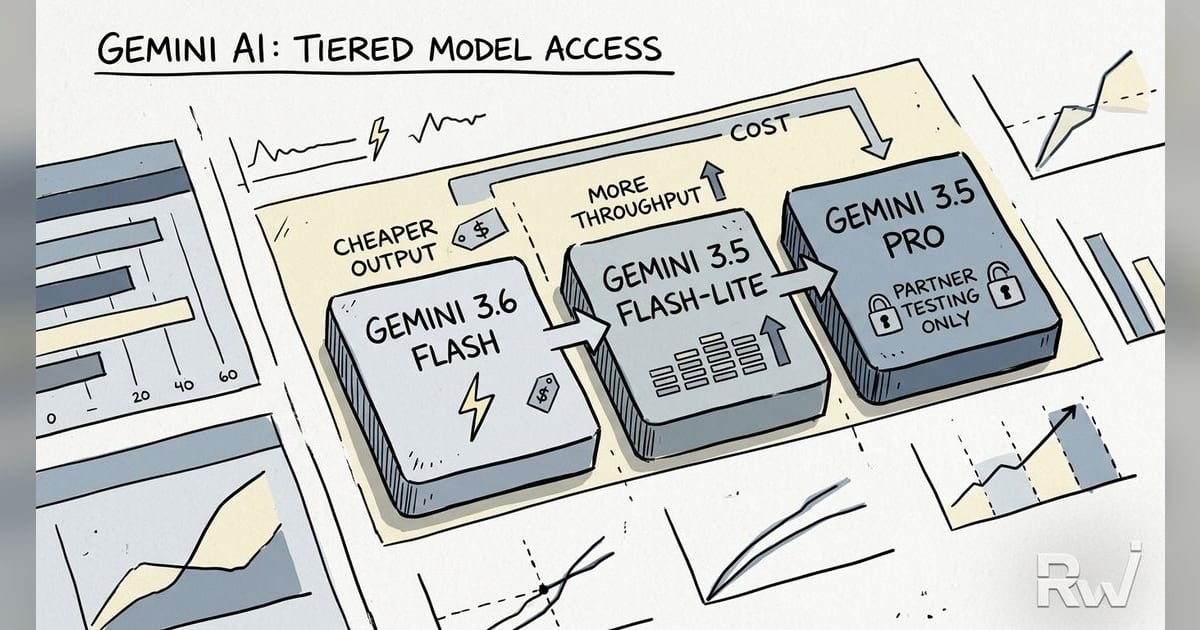
Google released two production models Tuesday that sharpen its pitch to developers building high-volume AI agents: Gemini 3.6 Flash lowers output prices, while Gemini 3.5 Flash-Lite offers higher throughput at a premium to its predecessor. A third model built for vulnerability research will remain limited to governments and trusted partners.
The rollout gives founders and engineering teams new tradeoffs around model cost, speed and control, but it does not resolve the delay surrounding Gemini 3.5 Pro. Google said the flagship model is still being tested with partners after previously indicating it would arrive in June.
Gemini 3.6 Flash targets agent costs
Gemini 3.6 Flash is generally available as gemini-3.6-flash
, with a 1 million-token input context window and a maximum output of 64,000 tokens, according to Google's developer guide.
Google set the price at $1.50 per million input tokens and $7.50 per million output tokens. The input rate is unchanged from Gemini 3.5 Flash, while the output rate is down from $9, a reduction of about 17%.
That difference can compound in agent workloads, where a model may reason across long contexts, call tools repeatedly and produce multiple intermediate outputs before completing a task. Google also says the new model used 17% fewer output tokens than Gemini 3.5 Flash on the Artificial Analysis Index and as much as 65% fewer on DeepSWE. Those results come from selected evaluations, not production deployments, where caching, prompts, tool calls and reasoning settings can change the final bill.
Google's launch benchmarks emphasize software engineering and task execution. The company reported that Gemini 3.6 Flash scored 49% on DeepSWE, up from 37% for Gemini 3.5 Flash, and 63.9% on MLE Bench, up from 49.7%. On OSWorld-Verified, it reported a score of 83%, compared with 78.4% for the prior model.
The Gemini 3.6 Flash model card lists a March 2026 knowledge cutoff and warns that the model can hallucinate or experience occasional slowdowns and timeouts. Because the benchmark results and customer endorsements were supplied by Google, developers will still need to measure latency, token use and code-editing reliability on their own workloads.
Google is making Gemini 3.6 Flash the default model for its Antigravity agent in Gemini Managed Agents. The model also supports computer use as a built-in tool, extending it beyond text generation into workflows that navigate software interfaces.
Flash-Lite raises prices in exchange for speed
Gemini 3.5 Flash-Lite is designed for document extraction, structured data processing, search and other high-volume tasks. Google priced it at $0.30 per million input tokens and $2.50 per million output tokens.
Google describes the release as its lowest-cost model in the Gemini 3.5 family. It is not cheaper than Gemini 3.1 Flash-Lite, which cost $0.25 per million input tokens and $1.50 per million output tokens. The new model therefore raises input pricing by 20% and output pricing by about 67% compared with that predecessor.
Google is positioning higher throughput and stronger agent performance as the return on that increase. It cited an Artificial Analysis measurement of 350 output tokens per second and said performance on Terminal-Bench 2.1 rose to 54% from 31%. The company also reported improvements in long-context retrieval and evaluations of real-world task execution.
The migration carries API changes that could require application updates. Gemini 3.6 Flash and Gemini 3.5 Flash-Lite ignore the sampling parameters temperature
, top_p
and top_k
. Google says later model generations will return errors when those parameters are included. The models also reject requests that end with a prefilled model response.
Teams that relied on those controls for tone, consistency or formatting will need to shift that behavior into system instructions or structured-output settings.
Both production models are available through the Gemini API, Google AI Studio and the Gemini app. Google is also bringing them to its enterprise agent platform, while Flash-Lite is being deployed in Search. The distribution builds on Google's effort to put Gemini inside existing products, including the Gemini voice-search beta in Gmail.
Google limits access to Gemini 3.5 Flash Cyber
Gemini 3.5 Flash Cyber is taking a narrower route to market. Google DeepMind fine-tuned the model to identify, validate and patch software vulnerabilities, then paired it with its CodeMender security agent. Access will initially be confined to governments and trusted partners through a limited pilot.
Google said in a separate technical account that the model found 55 confirmed issues in the V8 JavaScript engine. The mainline Gemini 3.5 Flash found 47, while Anthropic's Claude Opus 4.6 found 36. Google said 10 of the issues identified by Flash Cyber were unique to that model.
The comparison has important limits. Google ran some stress tests without safety guardrails and excluded competitor models newer than Claude Opus 4.6 from parts of the evaluation because those systems refused vulnerability tasks under their safety policies. The results consequently reflect both security performance and differences in how much offensive behavior each provider allows.
Google also said its Cloud Vulnerability Research team used Flash Cyber to find remote-code-execution flaws in public APIs and a memory-corruption vulnerability in a production service within two hours. According to the company, the model produced a working exploit that bypassed common memory protections. Google did not identify the affected systems or vulnerabilities.
Restricting the specialized model gives Google tighter control over a system capable of generating exploit code while it evaluates defensive uses with selected partners. CodeMender's broader security features remain available to enterprise customers through generally available Gemini models.
Gemini 3.5 Pro remains in partner testing
The Flash releases arrive without the flagship model Google previously said was due in June. At Google I/O on May 19, CEO Sundar Pichai said Gemini 3.5 Pro would arrive the following month, and Google repeated that timeline in a June investor presentation.
On July 21, Google said Gemini 3.5 Pro remained in testing with partners and would become broadly available when ready. Reuters reported, citing Bloomberg, that the release had slipped while Google worked to improve the model's coding performance. Google told Reuters that it was testing Gemini 3.5 Pro and other models with partners.
Google also disclosed that it has begun what it calls its most ambitious pre-training run for Gemini 4. In the meantime, the company's immediate developer proposition rests on cheaper output from Gemini 3.6 Flash, a faster but more expensive Flash-Lite release, tighter API constraints and a security model unavailable to most customers.