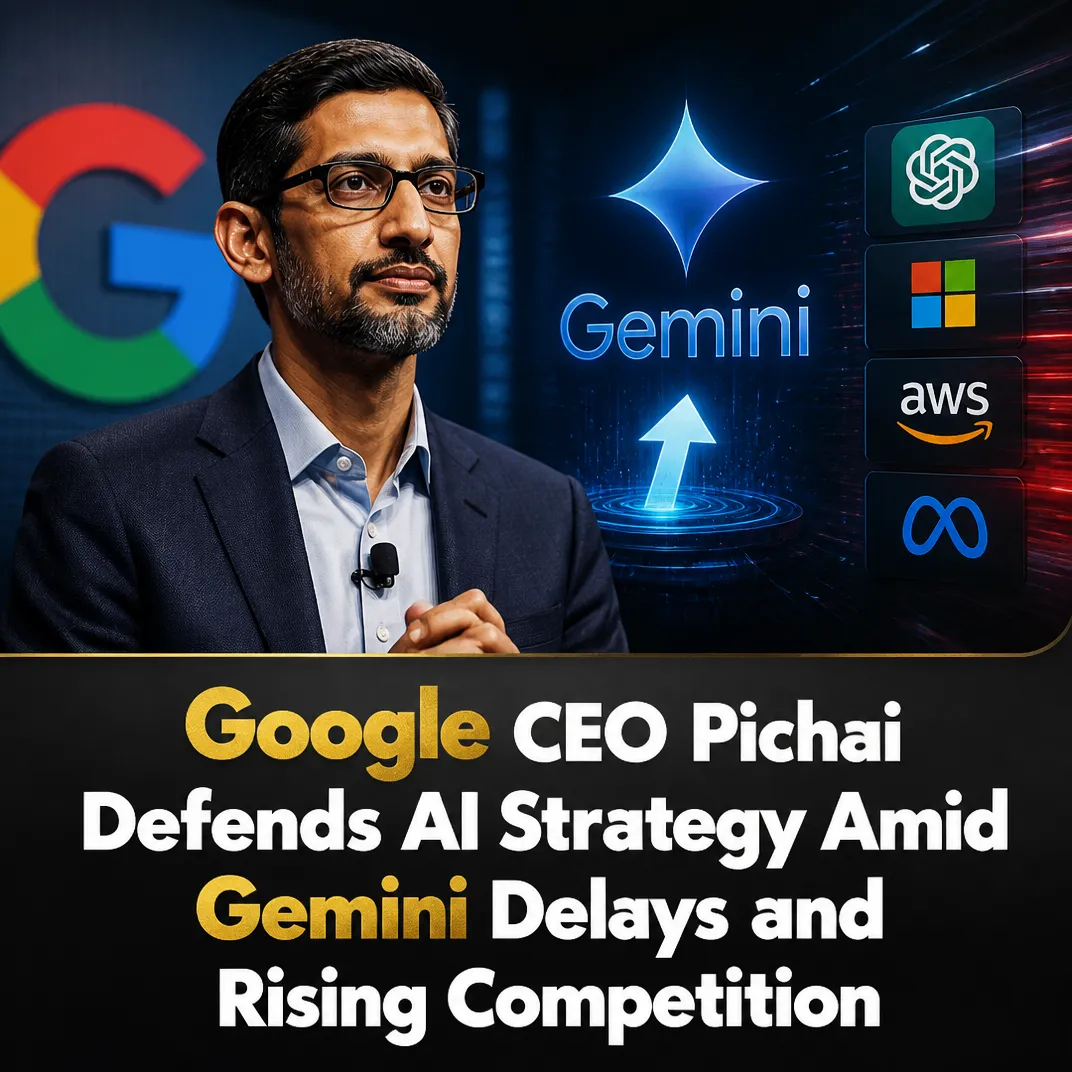
July 23, 2026, (Inside AI) — Alphabet CEO Sundar Pichai mounted a robust defense of Google’s AI strategy during Wednesday’s earnings call, pushing back against investor concerns that the company is falling behind rivals like OpenAI and Anthropic in the fiercely contested AI coding and agentic task arenas.
The call came amid unease over Google’s delayed release of Gemini 3.5 Pro, a flagship model originally slated for June that was expected to boost the company’s standing in autonomous “agent” tasks. Instead, Google has ceded ground to competitors who have accelerated their model release cadences.
Pichai struck an unusually defensive tone as analysts pressed him on whether Google’s frontier models could still compete at the cutting edge. Responding to JPMorgan analyst Doug Anmuth, he acknowledged room for improvement.
"We've had clearly frontier models. There are many attributes on which we are still at the frontier; there are areas where we've acknowledged we need to improve and coding and agentic coding is an example of that," Pichai said.
Rather than dwell on the delay, Pichai spotlighted Gemini Flash, Google’s cheaper, faster “workhorse” model now powering applications from cybersecurity to enterprise software. He touted this week’s release of Gemini 3.6 Flash, which improved by more than 10 points on a coding benchmark over its predecessor while using fewer tokens.
Google also unveiled Gemini 3.5 Flash-Lite and a cybersecurity-focused Flash Cyber model, keeping Gemini 3.5 Pro in partner testing. Pichai teased Gemini 4 as a “very ambitious effort,” saying, "I think people will be pleased" when it launches.
He disclosed that Gemini 4’s roadmap includes rolling out models “almost at a monthly cadence,” addressing Barclays analyst Ross Sandler’s concerns about release pace. Pichai emphasized that Google is training a significantly larger model designed to compete at the frontier.
Pichai’s defense highlights a broader challenge: persuading investors to judge Google’s AI ambitions by the scale of its ecosystem—spanning cloud infrastructure, custom AI chips, and a portfolio of Gemini models—rather than by a single delayed release. This mirrors industry shifts where model efficiency and multi-modal integration increasingly matter as much as raw benchmark scores.
Google’s cloud growth surged 82%, far above the 64% average estimate, yet Wall Street’s focus remains on AI coding and frontier reasoning, especially as capital costs skyrocket. Alphabet raised its capex plans by $15 billion to a range of $195 billion to $205 billion.
Shares fell more than 3% in after-hours trading, leaving the stock down about 9% since late April amid Gemini delays and high-profile executive departures. The tension echoes historical tech platform shifts, where infrastructure bets often precede visible product wins—a gamble Google is now making with its custom TPU v5p chips and expansive cloud AI services.
While Pichai’s monthly cadence promise aims to assuage fears, the market’s reaction suggests investors need more than assurances. Google must prove it can translate its ecosystem depth into sustained leadership in the most critical AI battlegrounds.