Desiderata #41
The Desiderata series is a regular roundup of links and thoughts for paid subscribers, and an open thread for the community.
Contents
$50,000 essay (& short story) contest on the new axial ageGoodbye Slopstack! AI detection comes to Substack Could we find the sequel to The Odyssey in the Herculaneum scrolls?Cloudbursts seem to be increasing? Each year, we speak 338 fewer words dailyAdversarial consciousness tech Never invite an auto-fiction writer into your lifeSurprise? Medieval people loved their children From the archives**Comment, share anything, ask anything
1. $50,000 essay (& short story) contest on the new axial age
Last year, I advertised the 2025 Berggruen Prize on the topic of consciousness. Many readers here ended up submitting something: I’m pretty sure multiple people who ended up short-listed for the prize learned about it here (and later posted the entries to their Substacks and blogs after the competition was over).
This year the topic is “A New Axial Age?”: Might civilization yet again be at the ‘hinge of history,’ in which the events that occur in this distinct point in time significantly influence the trajectory of the future? Are we undergoing a pivotal transformation of consciousness as a result of rapid technological development and its myriad social, economic, and political consequences? What conditions may or may not give rise to this possibility? Through what constituencies and by what mechanisms might the transformation take place?
Submissions can be up to 10,000 words and the deadline is August 17th, 2026.
In an interesting change from last year, this time they are also accepting “creative fiction,” and $50,000 for a short story is pretty dang good. Even split two ways, it would still handily beat the surprisingly-low Pulitzer Prize award of $15,000. I personally would love to see a piece of short fiction win this year and spice things up a bit.
Also, the Berggruen Institute was happy with the results of my announcement last year, so this year they have (again) sponsored the following post. It is unlocked for all subscribers. If you enjoy it, please do consider becoming a paid subscriber, as these are otherwise locked.
2. Goodbye Slopstack! AI detection comes to Substack
Substack has integrated Pangram, and you can now assess any new post on the platform for AI content—at least through the app and through Notes. If I were running Substack, this is precisely what I would have done (except I would have allowed it for each webpage too).
So goodbye Slopstack! It was not a fun time. I won’t miss you at all. I think remnants of Slopstack will continue but this basically saves the platform, and restores my faith in it. I will, of course, be happy to never read again some of the old Slopstack favorites, like “Here’s An Idea I Won’t Be Citing the Origin Of” and “Agency is Easy For Me Because I am Rich” and “A Suspiciously Facile Information Dump” and “An Elegiac Remembrance of Abstract Mush.” Goodbye! Farewell! Don’t come again!
Should writers like myself, who actually use our old wrinkled neocortexes, worry about this? What about false positives? Statistically, Pangram rarely gives human writing false positives (see below an analysis from Epoch), and especially for sections that are thousands of words long. However, Pangram isn’t super reliable for just a paragraph, so it’s possible. At the same time, presumably a false positive for a human writer would be an unclear one-off, and the point was always to avoid the slopopocalypse that plenty were happy to take advantage of.
3. Could we find the sequel to The Odyssey in the Herculaneum scrolls?
The Odyssey
I recommend visiting Pompeii because it’s one of the few places left where you can touch history itself. Always have the urge to surreptitiously brush the statues at museums? Go to Pompeii! You can sit at the bars, you can enter the baths, you can trail your fingers along the walls and no one yells at you. Walking through the town on a sunny day, you will arrive at certain street corners, and on those street corners—especially when you can hear only an indistinct murmur of activity from others—it is easy to imagine you have traveled back to right before that fateful day in 79 AD when Mount Vesuvius exploded and buried it, and the Roman town of Herculaneum near it, in thick ash. I’ve never been to Herculaneum, but apparently there was a library, and with new scanning technology and fancy reconstructive analysis we’re beginning to read the carbonized scrolls. At the end of last month it was announced that, for the first time, a papyrus manuscript had been fully decoded end-to-end; a philosophical treatise by a Stoic.
Seales has been working on virtually unwrapping the scrolls since the early 2000s. The process involved imaging the bundles of papyrus using technology similar to CT scanners, isolating thin layers and then stitching them together. In 2023, he partnered with two Silicon Valley investors and launched the Vesuvius Challenge….
“We’ve developed a systematic and a repeatable approach,” Seales told the audience. “Now it’s only a matter of time until we read all of the scrolls.”
In theory, the results from this contest to read the scrolls might mean that in our lifetimes a huge amount of classical history gets uncovered. Who knows, maybe the library contained one of the other six poems in the eight-poem series that includes The Iliad and The Odyssey, of which only those two remain. There are seven more movies for Nolan to make!
But do you know what looks a lot less stupid in light of these efforts? Cryogenic preservation. If we can read the words on literal chunks of burned scrolls indistinguishable from what you leave behind in a used fire pit, maybe there’ll be a contest in a thousand years to restore all those frozen brains everyone forgot about.
4. Cloudbursts seem to be increasing?
The night I’m writing this I found myself on my knees in the crawlspace of our home—now, pleasantly encapsulated in white plastic after a recent treatment for mildew, which as a side-effect treated all the old New England hauntings too—checking for leaks with a flashlight, as rain thundered above on the drum of the flat roof. It seems like the skies open up with more vigor than I remember from my youth, and indeed, this is an actual statistical change, particularly on the East Coast. According to a recent interview with a professor at NYU:
In New York City, the four most extreme precipitation events have all happened in the last four years…. Generally rain is talked about in terms of the total amount of precipitation—but it’s the
speedthat determines its impact. Two inches over the course of a day in New York City is no problem whatsoever. One inch of rain in 10 minutes is an emergency. Cloudburst is a name they use in Denmark for these extreme precipitation events, and some people call these events “rain bombs”; there’s a whole vocabulary for them that tries to capture this dramatic shift in predictability…. Until the 1990s, there were zero occasions when New York City got more than 1.75 inches of rain in an hour. Since the nineties, New York City has experienced eight storms with hourly rainfalls above 1.75 inches.
5. Each year, we speak 338 fewer words daily
An interesting New Yorker article covered the surprising discovery that every year our daily spoken word count declines, and this has been going on for decades (measured via voluntary ambient audio recordings). Researchers…
… found that participants had spoken an estimated twelve thousand seven hundred words a day—twenty per cent less than in the earlier study. “We thought we must have made a mistake,” Mehl said. Each year, he went on, the number of words spoken daily seemed to decline by about three hundred and thirty-eight.
6. Adversarial consciousness tech
A little while ago there went viral an AI-generated clip of pools and waterslides in a liminal backrooms-style underground office space. Don’t look it up. My 1990s-childhood-brain immediately felt in an instant and limbic way I should not be seeing it. That night before bed it summoned itself to me, unwanted, intrusive. One can experience this after horror movies too, that there is some afterimage that keeps being relived—and of course, it can happen in real life too, even for small things (embarrassing intrusive memories from the fifth grade, anyone?).
Well, turns out you can prompt-engineer your way to videos that elicit maximal responses from specific regions.
The research invited plenty of comparisons to David Foster Wallace’s Infinite Jest, which is an exaggeration… for now. It’s hard to deny, this does seem like an embryonic attempt at adversarial tech against human consciousness—even if it’s all just computational modeling work for right now (they are basically using statistical models of what these inputs are expected to do, not creating the loop directly).
We are entering an age of rapid scientific progress. People aren’t prepared for the consequences and we don’t know what’s possible. One reason we don’t know what’s possible is that neuroscience is pre-paradigmatic, and neuroscience is pre-paradigmatic because there is no scientific theory of consciousness. It’s a dangerous asymmetry. We might need defensive consciousness tech, but to do that, you need to figure out consciousness.
7. Never invite an auto-fiction writer into your life
I rarely indulge in literary drama, but for those who don’t know her work, Rachel Cusk is a very good novelist and basically queen of the auto-fictional novel. She lives in Paris and, based on rumors, is (was?) friends with Natalie Portman, who also lives in Paris, and now Cusk has a new novel, * Life of M*, coming out that centers an actress who seems… an awful lot like Natalie Portman? And (again, if the rumor is true) it may not be a very flattering portrait.
This stuck with me because it reveals a lack of understanding about how vicious and jealous and critical artists can be. I can’t help but wonder why a super famous and rich person would even be friends with a writer herself famous (at least, in literary circles) for transforming daily personal life into public-facing literature. I am reminded of the parable of the scorpion and the frog.
8. Surprise? Medieval people loved their children
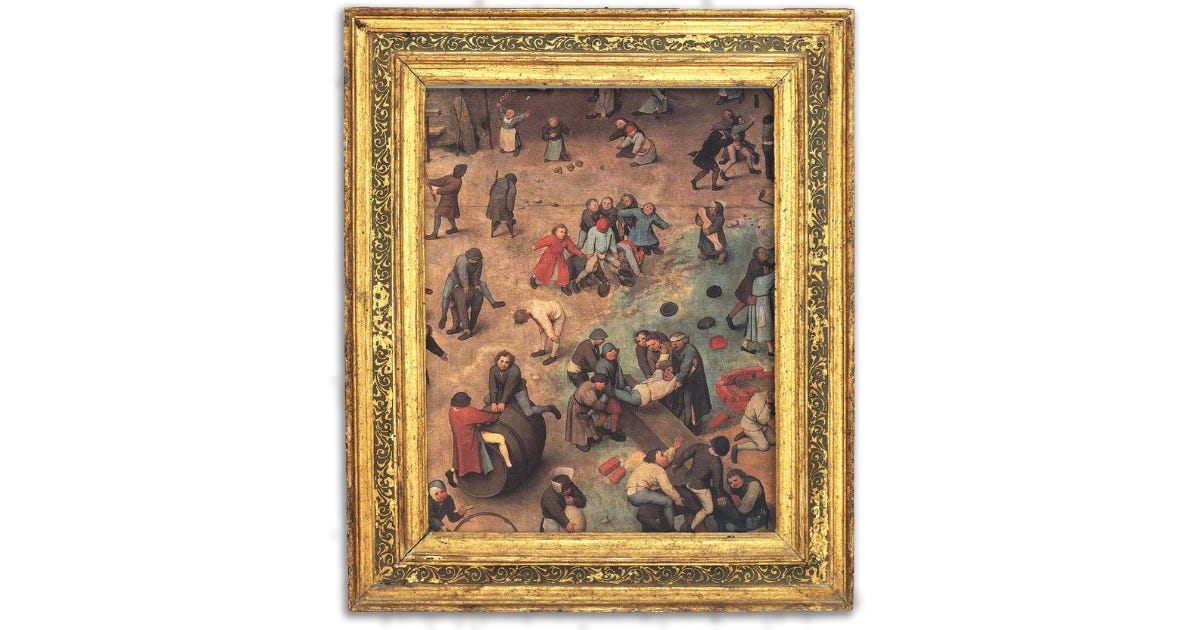
Occasionally a scholar makes a claim so reductively seductive that a generation believes it (not to point fingers, but often the origin is some continental French or German thinker, e.g., Nietzsche’s claim that the troubadours invented the concept of romantic love). Apparently the French scholar Philippe Ariès, working in the 1960s, is responsible for the notion that medieval parents didn’t love their children in the same way. This is, of course, nonsense. Here’s from a recent review drawing from Nicholas Orme’s Medieval Children:
Ariès’s work never attained complete acceptance in academia, but it was vastly influential on the wider public. As it turns out, however, Ariès’s view is just not true….
… most medieval people had only three or four children, somewhat more among the rich and somewhat fewer among the very poor. At least in England, this was partly because they married quite late, generally in their mid or late twenties. About 25 percent of children died in their first year and another 15 percent by their tenth. The median English child thus grew up in a home with one sibling and two parents in their thirties or forties, being in this respect just like the median English child today. Surviving grandparents often lived nearby, but rarely under the same roof. …
Medieval parents made immense sacrifices for their children, and seem to have expected little in return. Feeding a child consumed about 15 percent of average income, and parents often continued to support children throughout their adulthood. Older children often performed light work at home, but at just the age they might become a net economic asset – 13 or 14 – they were usually sent away to acquire skills and savings through apprenticeship or working in service. They may have remitted some of this income to their parents, but this was not standard, and in fact parents generally paid for their children’s apprenticeships. …
The medieval people who emerge from Orme’s book are quite unlike the strange and cold figures that we have been led to imagine. ‘I believe they were ourselves, five hundred or a thousand years ago’, Orme writes.
But if humans have always loved their children thus, how much is the decline of religion explained by having less need? If I lost a child, I would either go insane with grief or become a religious apologist—I don’t think I could handle it any other way.
9. From the archives
This time last year I was arguing that we start children reading too late, long after tablets and screens have taken hold.
10. Comment, share anything, ask anything
As* *always with the Desiderata series, please treat this as an open thread. Comment and share whatever you’ve found interesting lately or been thinking about.