The Vancouver-based fusion startup is going public through a SPAC deal valuing it at roughly $1 billion, and the energy implications extend well into crypto mining and AI data centers.
General Fusion, a Vancouver-based company pursuing what some have dubbed a “steampunk” approach to fusion energy, is set to begin trading on the Nasdaq under the ticker GFUZ on or about July 10, 2026. It will be the first publicly traded pure-play fusion energy company. The listing comes via a business combination with Spring Valley Acquisition Corp. III (NASDAQ: SVAC), a deal first announced in January 2026 and approved by shareholders in early July. The combined entity carries a pro-forma equity value of approximately $1 billion.
The deal structure and the money involved #
The company has historically raised more than $400 million in private funding. The SPAC transaction includes a committed PIPE (private investment in public equity) of around $107.7 million, with estimated trust proceeds of $230 million assuming no redemptions.
How the technology actually works #
General Fusion’s approach is called Magnetized Target Fusion, or MTF. Here’s the simplified version: imagine superheated plasma, magnetically contained, being squeezed by mechanical pistons inside a chamber lined with liquid metal. The compression is meant to achieve the conditions necessary for fusion, where atomic nuclei merge and release enormous amounts of energy.
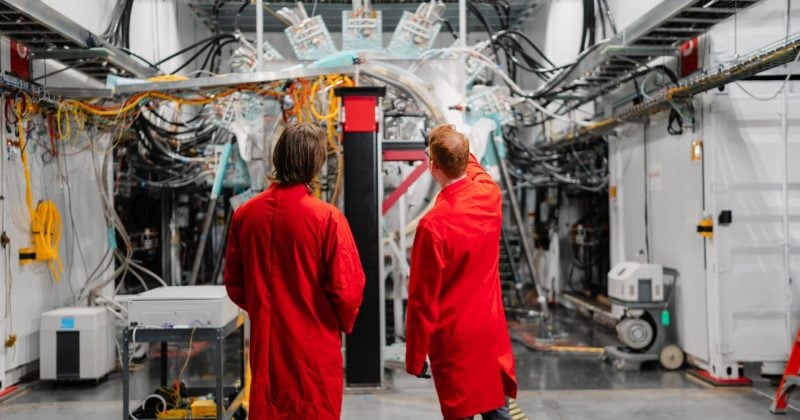
The company hit a significant technical milestone on June 22, 2026, when it achieved compressional plasma heating at its Lawson Machine 26 (LM26) demonstration device. Two days later, on June 24, General Fusion signed a framework agreement with Italy’s Renexia to facilitate commercial deployment of its technology.
TIME magazine named it the top GreenTech company of 2026 on June 9, adding a marketing tailwind ahead of the public listing.
Why crypto and AI investors should pay attention #
Bitcoin mining is one of the most energy-intensive computing operations on the planet. Proof-of-work miners are perpetually hunting for cheap, reliable, baseload power. The same is true for AI data centers, which are scaling at a pace that’s straining existing grid infrastructure in multiple countries.
General Fusion has explicitly positioned itself as a solution for the growing demand for clean baseload power necessary for modern technologies, including AI infrastructure.
The $1 billion valuation puts General Fusion in an interesting competitive position. Commonwealth Fusion Systems, TAE Technologies, and Helion Energy have all raised significant private capital, but none of them are publicly traded.
The more immediate concern for investors is execution risk. General Fusion has achieved compressional plasma heating at LM26, but the LM26 machine is a demonstration device, not a prototype power plant. The company’s agreement with Renexia signals intent to move toward commercial deployment, but framework agreements are not construction contracts.
The SPAC structure adds another layer of risk. Redemption rates on SPACs have been historically high in recent years, meaning the $230 million in estimated trust proceeds could shrink significantly if SVAC shareholders choose to take their money back rather than hold shares in the combined entity. The $107.7 million PIPE provides a floor, but it’s a modest one for a company that will need billions more to reach commercialization.
Disclosure: This article was edited by Editorial Team. For more information on how we create and review content, see our