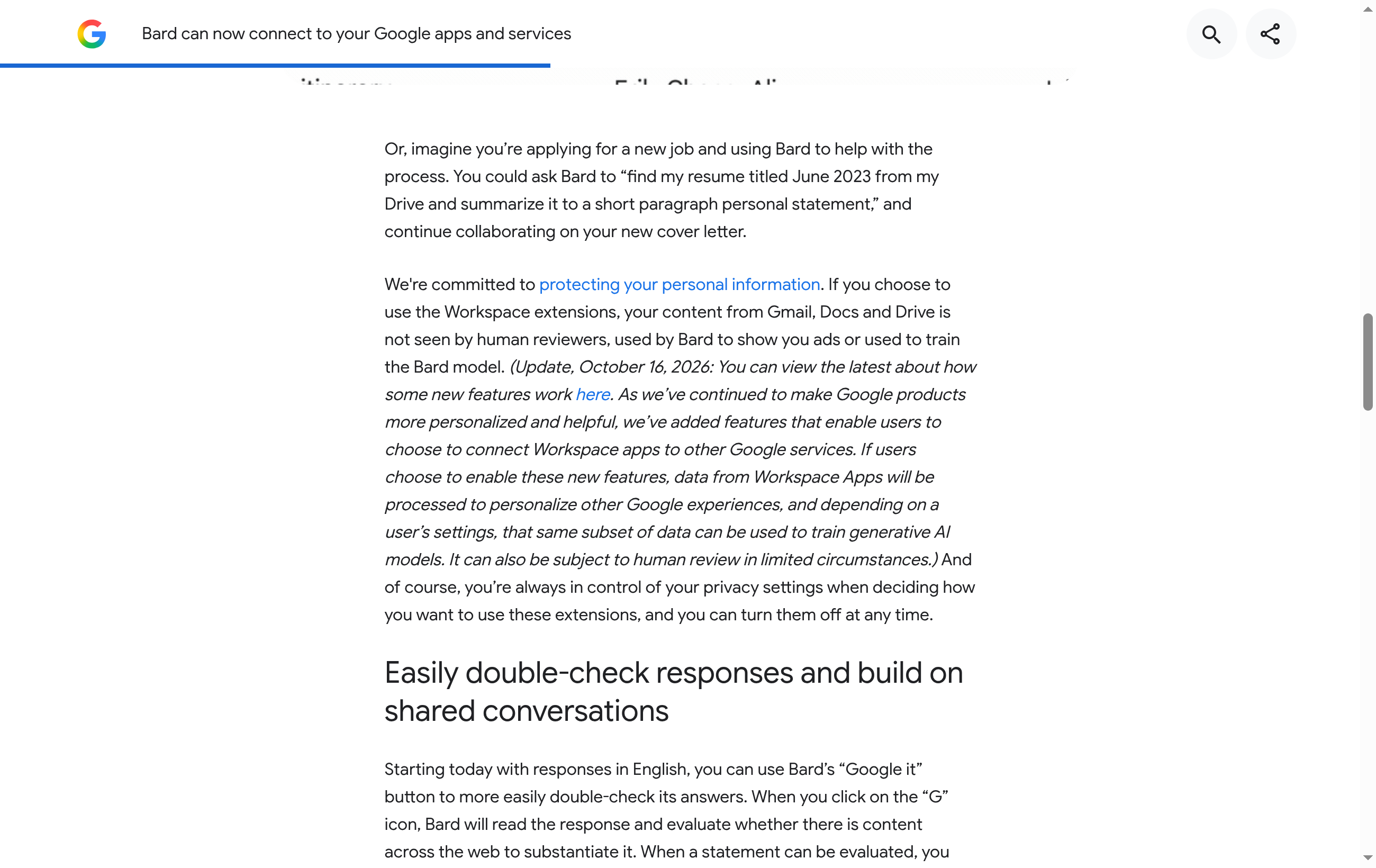
TLDR: Google’s connected-apps help page now says a subset of the Gmail, Docs and Drive data that Gemini processes is reviewed by humans, and a parenthetical dated October 16, 2026 was added under a three-year-old promise that said the opposite. It enables Google to improve and train its models on the most personal corpus it holds, which is your mail. The difference between this and a normal privacy policy update is that the original sentence was never deleted, so anyone reading the page quickly still sees the promise and not the carve-out beneath it.
What the page said, and says #
On September 19, 2023, Google launched Bard Extensions and wrote this:
“If you choose to use the Workspace extensions, your content from Gmail, Docs and Drive is not seen by human reviewers, used by Bard to show you ads or used to train the Bard model.”
That sentence is still there today. Go and read it. It has not been struck out or amended.
What is also there, appended in a parenthetical at the end of the same paragraph, is this:
“(Update, October 16, 2026: You can view the latest about how some new features work here. As we’ve continued to make Google products more personalized and helpful, we’ve added features that enable users to choose to connect Workspace apps to other Google services. If users choose to enable these new features, data from Workspace Apps will be processed to personalize other Google experiences, and depending on a user’s settings, that same subset of data can be used to train generative AI models. It can also be subject to human review in limited circumstances.)”
So the accurate description is not that Google deleted its promise. It is that Google built a new door beside the old one, and the new door leads to the same room.
What the help page says now #
The page that governs the new path, About personalization with Connected Apps (Help answer 16836988), is direct about it:
“Data from Connected Apps is used and human reviewed per the Gemini Apps Privacy Notice.”
And further down:
“When connected to Gemini, a subset of Connected Apps data processed by Gemini is reviewed by human reviewers (including trained service providers) to debug our services, help keep them safe, and improve them.”
Note the phrase trained service providers. The people reading your mail are not necessarily Google employees.
Why “excerpt” is doing less work than it sounds #
The help page explains what a reviewer actually sees, and the answer is unsettling:
“where the email or file is brief or particularly relevant to respond to the prompt, the summary may just be the email or file.”
If the email is short, the summary is the email. If the email is the thing the question was about, the summary is the email. The word “excerpt” implies a clipping. In practice the clipping can be the whole document.
The deletion line nobody reads #
The page also closes the obvious escape hatch. Deleting your Gemini activity is described as preventing it from being used for future product improvement:
“unless it has already been reviewed by trained reviewers.”
Once a human has looked at it, it has left the part of the system you control. Deleting afterwards does not recall it.
Who this applies to #
This is not every Google account by default. It applies to eligible users with Personal Intelligence who choose to connect Workspace apps to Gemini. Connecting Gmail, Drive, Docs, Calendar and the rest is an opt-in step.
The problem with opt-in framing is the one every privacy story has: the feature is the reason people use the product, the consent screen is a button, and the help page that explains what happens next is two clicks from anything a user would read.
What to actually do #
Three settings, in order of how much they matter:
Disconnect the apps that do not need to be connected. Personal Intelligence lists each one. Mail is the highest-value target and the least necessary connection for most people. #
Turn off Keep Activity if you do not want future chats used for improvement. #
Delete your Gemini Apps activity , knowing the caveat above: it stops future use, and does nothing about anything a reviewer has already seen.
The larger point #
Privacy commitments from large platforms rarely get reversed by announcement. They get reversed by addition: a new surface, a new settings page, a new feature that is technically a different product from the one the promise described, and an edit dated quietly in the middle of a document.
An edit dated October 16, 2026 that says “can also be subject to human review in limited circumstances” is doing an enormous amount of work in a sentence nobody would ever search for.
The practical lesson is not that Google is uniquely bad at this. It is that the sentence you relied on when you decided to connect your mailbox is not the sentence that governs the product two years later, and the company is under no obligation to tell you which sentence changed.