TLDR: Anthropic’s launch post for Claude Fable 5.2 and Claude Mythos 5.2 puts accelerator kernel optimization in the Safeguards section, alongside cybersecurity and biology. It enables the company to hold back the research skill that would most directly speed up its own next model. The difference between this and a normal capability gap is that Anthropic is saying out loud that it deliberately trained the model to be no better at this than its predecessor.
The paragraph #
Under the heading Safeguards, two subsections sit next to each other. The first blocks high-risk cyber work and research biology. The second is this:
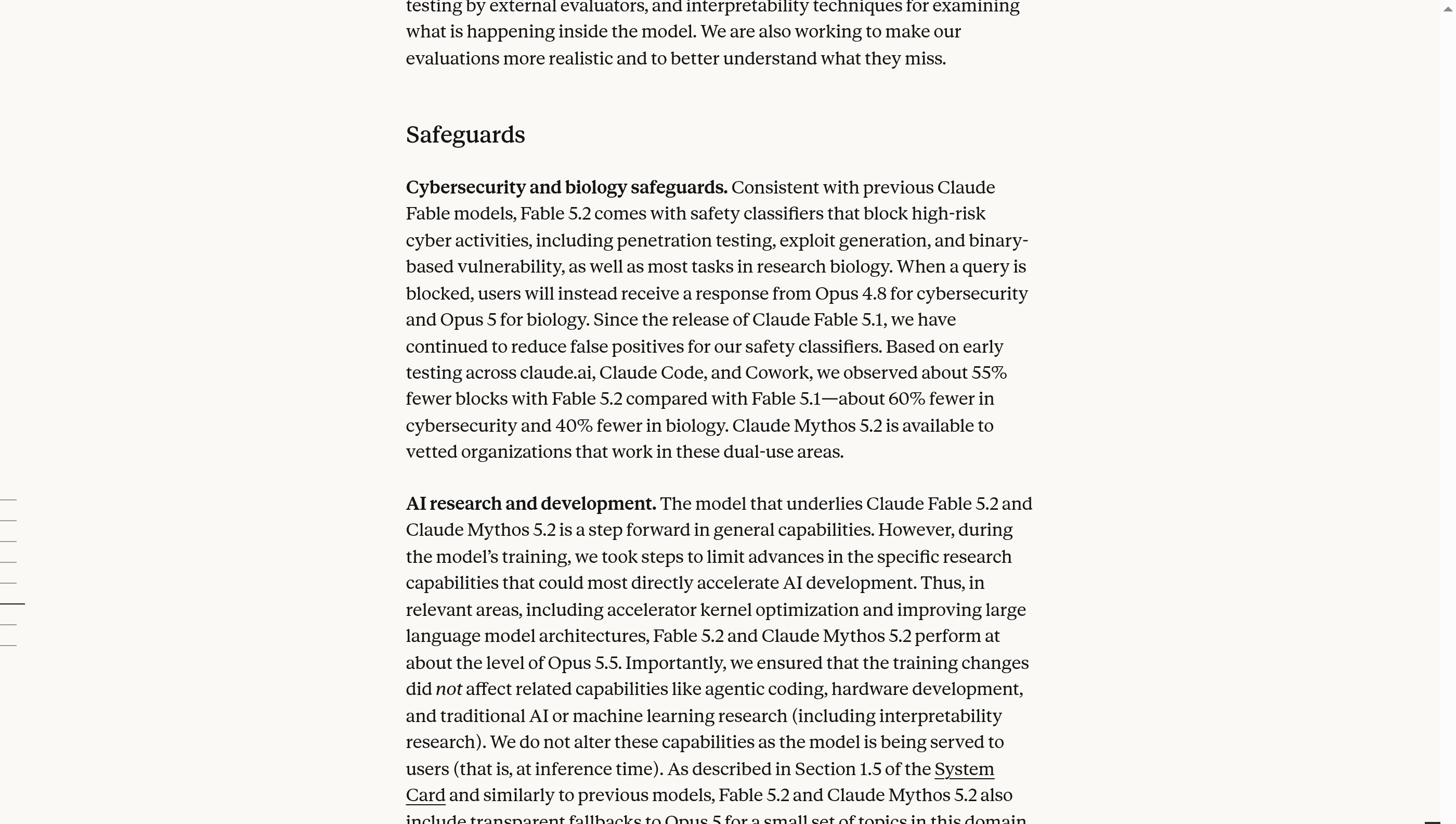
“The model that underlies Claude Fable 5.2 and Claude Mythos 5.2 is a step forward in general capabilities. However, during the model’s training, we took steps to limit advances in the specific research capabilities that could most directly accelerate AI development. Thus, in relevant areas, including accelerator kernel optimization and improving large language model architectures, Fable 5.2 and Claude Mythos 5.2 perform at about the level of Opus 5.5.”
Read that last sentence twice. The new model is not better at writing GPU kernels than the previous generation. That is a deliberate design decision, published in the marketing material.
Kernel optimization is the discipline of making the same silicon do more work per second. It is the single most leveraged skill in AI research: faster kernels mean cheaper training runs, which mean more attempts at the next model. It is the tool that builds the tool.
What the cap actually is #
Three details keep this from being a ban, and each one matters.
It is a training-time limit. Anthropic trained the model not to advance in these areas, then serves it unchanged. The post says plainly: “We do not alter these capabilities as the model is being served to users (that is, at inference time).”
It is a ceiling, not a wall. Those areas “perform at about the level of Opus 5.5.” You can still optimize a kernel with Fable 5.2. You just cannot use it to be better at that than last year’s model was.
There is a narrow inference-time fallback after all. The post discloses “transparent fallbacks to Opus 5 for a small set of topics in this domain, including kernel development on certain nonstandard accelerators.” So for some unusual hardware, the newest model quietly hands the work to an older one.
The post also says the training changes did not affect “agentic coding, hardware development, and traditional AI or machine learning research (including interpretability research).”
Why they say they did it #
The system card is more direct than the launch post. It cites Section 3 of Anthropic’s August 2026 Risk Report and says the company is “concerned about the risks of accelerating the overall pace of model development and the risks that recursive self-improvement (RSI) may present.”
That is the whole argument in one sentence. If a model can improve the kernels its own successor trains on, the loop closes, and the lab loses the ability to pace what comes next. Capping kernel work is the cheapest place to insert a brake.
The detail that makes it credible and strange at once #
The same system card evaluates the model on Budget NanoGPT Speedrun, a benchmark where the agent tries to train a small language model faster. Anthropic’s own writeup says the improvements it found were “almost all about improving kernels,” found by using the profiler as a feedback loop.
So the company built an eval where kernel tweaking is the winning move, watched its model win that way, and then capped kernel work in the shipped product. That is either a lab taking its own risk model seriously or a lab removing the evidence of its own advantage, depending on how generous you feel.
They also state that Mythos 5.2 “does not seem close to fully substituting for our research staff” and does not accelerate aggregate AI R&D by a factor of two, so it did not cross their Responsible Scaling threshold in that domain.
The competitive problem #
This is the part that should worry anyone who is not Anthropic.
The cap is unilateral. Nothing stops a competitor from shipping uncapped kernel optimization. The capability exists, the training recipe exists, and the company that does not hold back gets the cheaper training runs and the faster iteration.
The open-weight labs are not bound by it. Chinese open-weight releases have been the strongest available models for months by this site’s own tracking. None of them ship with an RSI brake.
The cost lands on customers. Someone porting kernels to an unusual accelerator gets downgraded to an older model without being told which paragraph caused it. That is a real product decision with real users, and it is buried in a safeguards section next to exploit generation.
And it prices a capability, not a harm. “Generate an exploit” and “write a faster attention kernel” are not the same kind of act. Filing them in the same section is an editorial choice that treats legitimate engineering as a hazard.
The honest counter-argument #
If recursive self-improvement is a genuine risk rather than a talking point, then someone has to go first, and going first is always expensive for the one who does it. A lab that says “we will not build the thing that builds us faster” and then actually does not build it is behaving consistently, even if it loses ground. The fair question is not whether the cap is sincere. It plainly is. The question is whether a unilateral brake survives contact with a market where the competitor’s next model arrives on schedule.
What to watch #
Benchmarks that touch kernels. If Fable 5.2 stops improving on GPU kernel tasks while general coding keeps climbing, the cap is real and measurable, and the gap will show up in third-party evals within weeks. #
The nonstandard accelerator fallback. Which hardware triggers it, and whether customers are told. This is the line that will produce complaints. #
Whether anyone follows. One lab capping is a principle. Two labs capping is an industry norm. Zero competitors capping makes it a self-inflicted handicap. #
The next system card. If the RSI section grows and the kernel ceiling stays, this is a policy rather than a release note.
The uncomfortable summary: Anthropic is the first frontier lab to deliberately ship a model that is worse than the previous one at the skill that makes the next one arrive sooner. Whether that reads as integrity or as surrender depends entirely on what the other labs ship in the next ninety days.