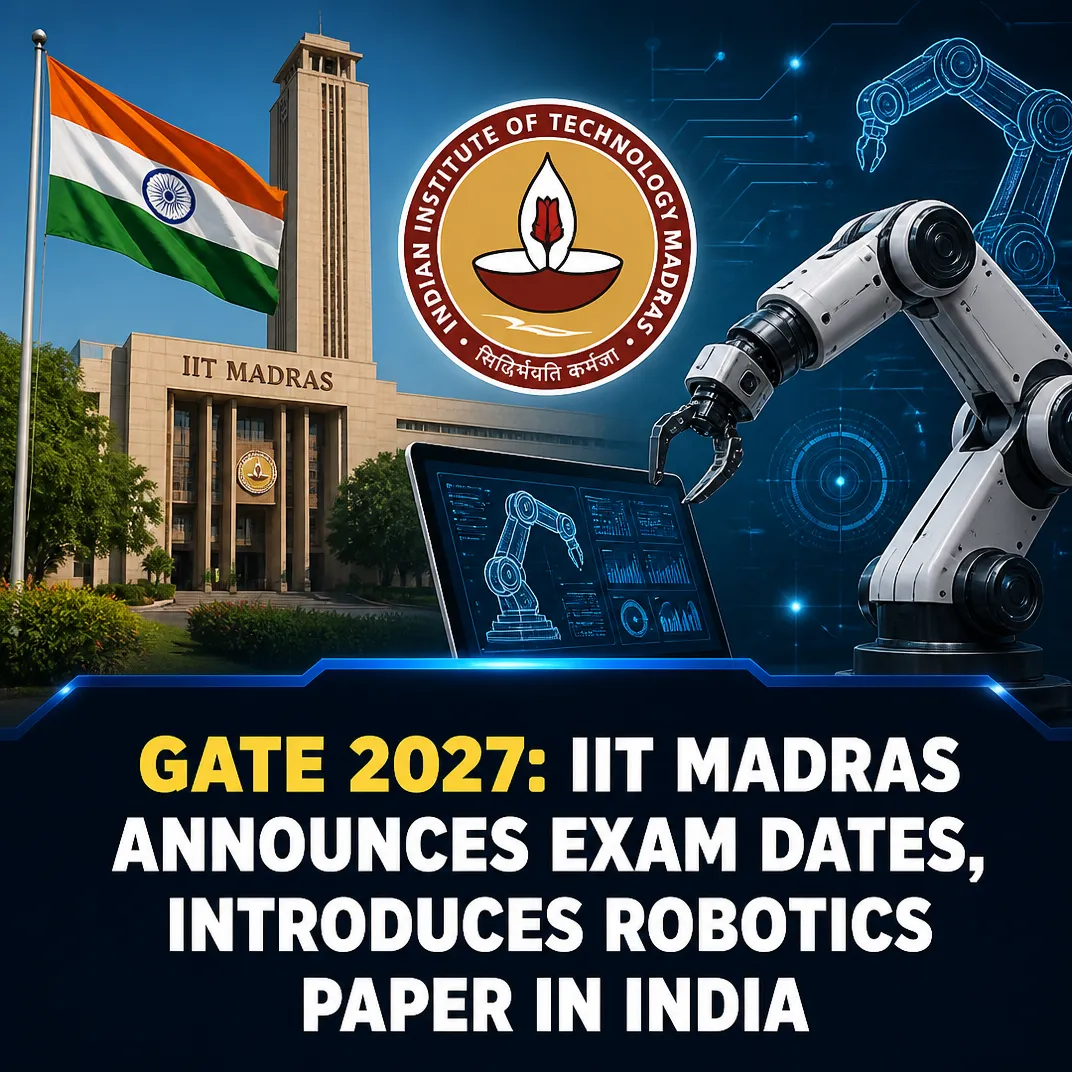
July 20, 2026, (Inside AI) — The Indian Institute of Technology (IIT) Madras has locked in the dates for the Graduate Aptitude Test in Engineering (GATE) 2027, a pivotal moment for India’s technical education landscape. The exam will unfold across February 6, 7, 13, 14, 20 and 21, 2027, in both forenoon and afternoon sessions. Registration opens in mid-August 2026 through the official portal, with new digital identity checks via DigiLocker and facial authentication.
This marks the 45th edition of GATE, jointly run by the Indian Institute of Science (IISc) and the IITs under the Ministry of Education. IIT Madras, as the organizing institute, is steering a significant syllabus overhaul and the introduction of a dedicated Robotics and Automation paper. The move reflects India’s push to align academic gatekeeping with its industrial automation boom.
The Robotics Gamble: Why Now? #
The new Robotics and Automation (RA) paper is not just a curriculum update. It is a strategic response to a national skills gap. India’s robotics market is projected to hit $8 billion by 2030, yet talent pipelines remain thin. By creating a standalone paper, GATE signals to universities and PSUs that robotics is no longer a niche elective but a core engineering discipline.
This mirrors global trends. China’s Made in China 2025 initiative and Germany’s Industry 4.0 have long embedded robotics in standardized testing. India, until now, lagged. The RA paper will likely cover kinematics, control systems, machine vision, and AI integration—areas where industry demand outstrips supply.
However, critics argue that a single paper may oversimplify a multidisciplinary field. Dr. Ramesh Kumar, a robotics researcher at IISc, noted:
“Robotics blends mechanical, electrical, and computer science. A unified paper risks shallow coverage. But it’s a start.”
Meanwhile, the Textile Engineering and Fibre Science (TF) paper has been folded into Engineering Sciences (XE) as a sectional paper. This consolidation hints at resource optimization, but it could dilute focus for a sector that employs over 45 million people in India.
Digital Gatekeeping and Exam Integrity #
GATE 2027 will integrate DigiLocker and facial authentication for registration and test-center entry. This is a direct countermeasure to impersonation scandals that have plagued Indian competitive exams. In 2025, the Central Bureau of Investigation uncovered a multi-state racket using forged documents for GATE and other tests.
DigiLocker, a government-backed digital document wallet, will verify candidate credentials in real time. Facial authentication adds a biometric layer, though privacy advocates have raised concerns about data security. A senior official from the National Coordination Board-GATE stated:
“We are working with the Unique Identification Authority of India to ensure compliance with data protection norms. Candidate biometrics will be encrypted and purged after result declaration.”
The exam pattern remains unchanged: 65 questions worth 100 marks over three hours. General Aptitude is compulsory at 15 marks, and Engineering Mathematics carries 13 marks in most papers. Negative marking persists for MCQs, while MSQ and NAT questions have no penalty.
Eligibility now includes third-year BTech students, a rule introduced earlier to widen the talent pool. There is no age limit. Around 10 lakh candidates appear annually, making GATE one of the world’s largest postgraduate entrance exams.
GATE scores remain valid for three years and are used by Public Sector Undertakings (PSUs) like ONGC and BHEL for recruitment. This dual purpose—academia and jobs—makes the exam a high-stakes event. IIT Madras has advised candidates to monitor the official website for syllabus details and application timelines.
Looking ahead, the robotics paper could reshape India’s automation workforce. But its success hinges on how universities adapt their curricula and how industry recognizes the credential. For now, the countdown to February 2027 begins.