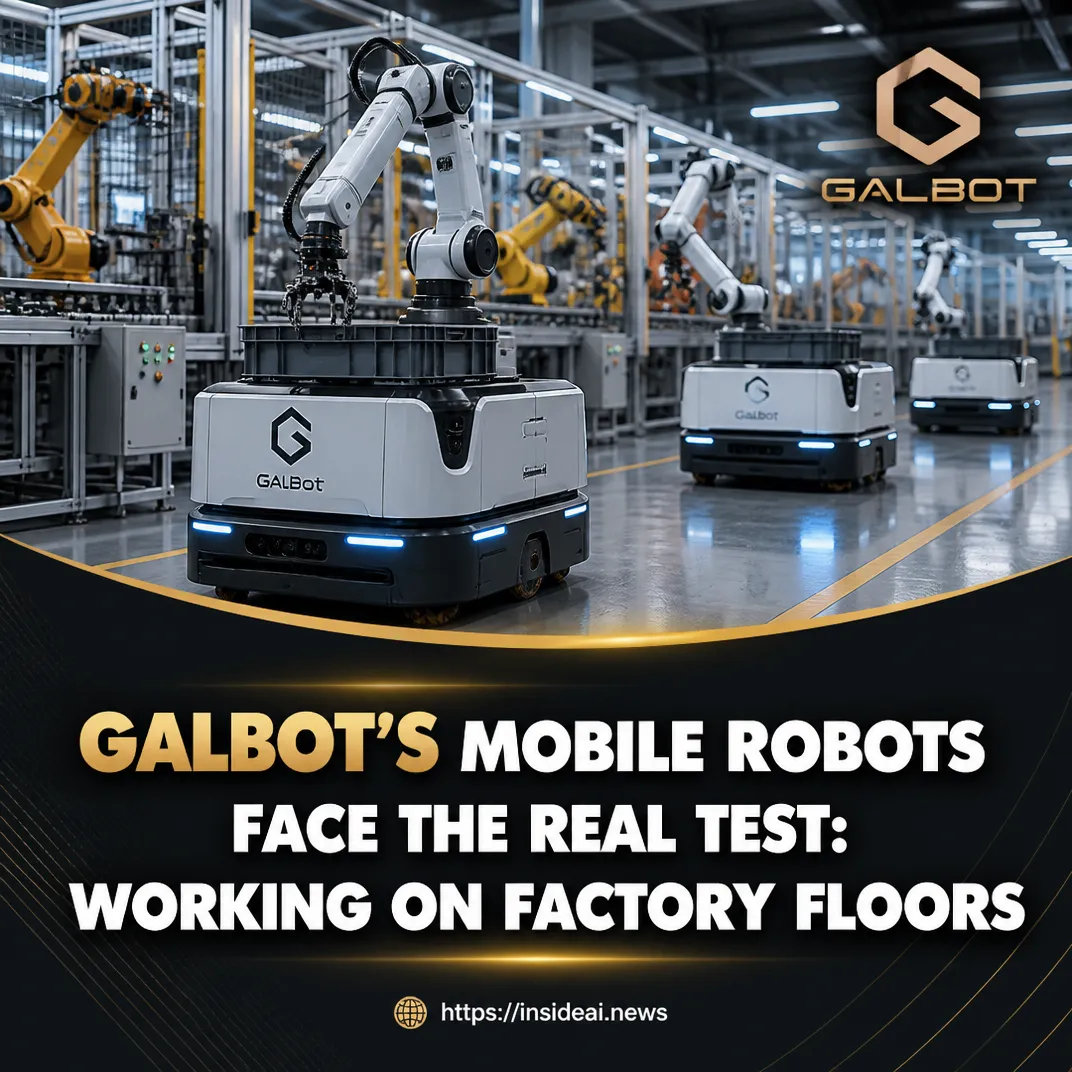
August 27, 2026, (Inside AI) — Industrial robots have spent decades bolted to factory floors, executing one repetitive motion with mechanical precision. Now, a new breed of mobile, dual-armed machines is rolling onto production lines, promising to handle the messy, variable tasks that still require human hands. The question is no longer whether these robots can move, but whether they can actually work.
Chinese startup Galbot has placed itself at the center of that question. The company, founded in May 2023, is betting that embodied AI can bridge the gap between laboratory demos and factory floors. Its flagship Galbot G1 pairs a mobile base with a dual-arm manipulation system, allowing it to pick, transport, and organize objects across different environments instead of being welded to one workstation.
The stakes are high, and investors have taken notice. By 2025, Galbot had raised more than RMB 2.4 billion ($360 million) in total funding. In 2026, the company announced another RMB 2.5 billion ($370 million) round, with backers including the National Artificial Intelligence Industry Investment Fund, Sinopec, and CITIC Investment Holdings. Its valuation reportedly exceeds RMB 22 billion ($3.27 billion).
That capital is chasing a simple but stubborn problem. Manufacturing still depends on humans for material handling, sorting, and components, tasks that are repetitive yet require constant adaptation. Traditional automation cannot cover these scenarios. Embodied AI robots, in theory, can.
Why Factories Are the First Real Test for Embodied AI #
Industrial applications offer a rare combination for robotics startups: clear demand and structured environments. Unlike homes, where clutter and unpredictability reign, factories provide controlled settings where robots can operate for long periods and accumulate training data. That makes manufacturing a logical first market for embodied AI commercialization.
Galbot has tailored its approach accordingly. The Galbot S1 focuses specifically on industrial tasks such as transportation, palletizing, and machine . The pitch is straightforward: help companies reduce reliance on labor-intensive, repetitive operations while easing rising labor costs.
But the technical leap is significant. Traditional robots rely on engineers programming every movement in advance. Embodied AI robots must understand instructions, plan actions, and adapt to changes in real time. Galbot’s AstraBrain system attempts this by combining visual perception, task planning, and motion control into a single intelligence layer.
That shift, from executing predefined commands to handling complex tasks, is the core promise of embodied AI. It is also the core risk. Demonstrating a robot completing one task in a controlled demo is easy. Proving it can run continuously in a real production environment, without frequent failures or human intervention, is another matter entirely.
The Gap Between Demo and Deployment #
Cost, reliability, and stability remain the biggest barriers to large-scale deployment. A robot that works 95% of the time in a lab may fail 5% of the time in a factory, and that 5% can halt an entire line. For manufacturers, the economic case must be airtight: the robot must generate measurable value, not just novelty.
Galbot is not alone in pursuing this market. Competitors such as Figure AI, Agility Robotics, and Apptronik are also targeting industrial and logistics settings. The race is intensifying, but no company has yet proven that mobile manipulation robots can operate at scale in demanding production environments.
Industry analysts caution that the transition will be gradual. Robots will likely first take on narrow, well-defined tasks within existing workflows, working alongside human employees rather than replacing them outright. Over time, as AI capabilities improve and costs fall, the scope of tasks may expand.
For Galbot, the path forward is clear. Mobility was only the first step. The real test is whether its robots can deliver consistent, measurable value on the factory floor, day after day. If they can, the next wave of industrial intelligence may look less like a row of fixed arms and more like a fleet of mobile workers, rolling between stations, adapting as they go.