From voice command to robotic arm: how agentic AI on the edge is changing the factory floor
For years, bringing real intelligence to industrial automation meant expensive infrastructure, proprietary systems, and steep learning curves. That’s changing – fast. Foundation models powerful enough to run at the edge are turning natural language into machine control, and the factory floor is starting to look a lot more like a conversation.
AI as the new interface #
Think about how AI has changed the way you work at a desk. You describe what you need, and an agent handles the complexity underneath – the tools, the APIs, the data retrieval. The same shift is now happening in manufacturing.
Natural language is becoming the new interface for industrial machines. An operator who once needed specialized training to reconfigure a production line can now just say what they need. The AI handles the translation from intent to instruction.
A robotic arm you can talk to #
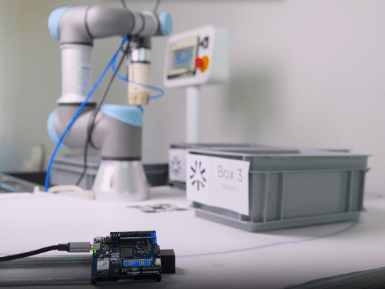
Swiss startup Forgis, which builds physical AI models for manufacturing, recently demonstrated exactly this. Using a smartphone, an operator sends a voice command to an AI agent running on the Arduino® UNO™ Q board. Forgis’ foundation model processes the prompt, determines which object to pick and where to place it, calculates the full motion plan, and directs the robotic arm to execute the task – all from a single natural language instruction like “put each box in their respective compartments.”
The foundation model ingests multimodal factory data – the robot’s CAD model, PLC I/O signals, project specifications – and translates it into structured, machine-readable instructions in real time. The robotic arm’s camera connects via USB directly to the board, which runs inference locally with a latency of just 20 ms. The LED matrix on the UNO Q even displays the agent’s current state, so the operator always knows what the system is doing.
Critically, none of this requires a cloud round trip. The entire inference pipeline runs on the edge device, which matters enormously on a factory floor where network dependency, latency, and data sovereignty are real concerns.
Why this matters for manufacturing #
The practical benefits are straightforward. Fewer manual inputs mean fewer errors – a significant advantage in precision environments like aerospace, medical devices, and automotive. Operators spend less time on routine floor tasks and more on oversight and exception handling. And because the foundation model learns continuously from production data, the system should improve over time.
The open Arduino ecosystem also means development teams like Forgis can deploy their proprietary models without getting bogged down in hardware integration. The gap between a working prototype and a production-ready system is narrowing.
Agentic AI has spent the last few years writing code and generating reports. It’s now moving machines. The Forgis and Arduino demo is an early signal of what industrial AI can look like when the edge is fast enough to keep up with the physical world – and when the interface is simply your voice.
Curious about UNO Q? Find out more here or head directly to the Arduino Store to get started. Arduino, and UNO, and the Arduino logo are trademarks or registered trademarks of Arduino S.r.l.