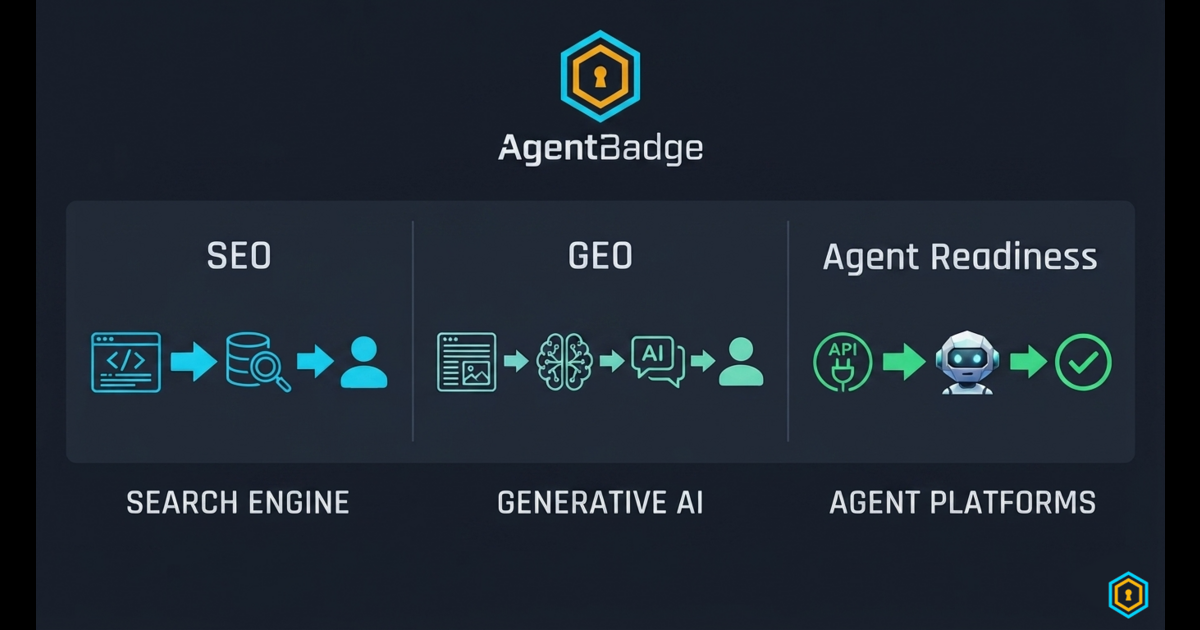
The object of optimization is changing: from websites (SEO) to content (GEO) to APIs/services (Agent Readiness). Here's what it means — and why it's not SEO 2.0.
Optimization targets are shifting: SEO optimizes websites for search engines, GEO optimizes content for generative AI, and Agent Readiness optimizes APIs for autonomous agents. Each layer builds on the previous — and the agentic web requires all three.
Three eras of optimization #
SEO helps a human find you.
GEO helps AI understand and mention you.
Agent Readiness helps an AI agent actually use you.
The object of optimization is changing — from websites (SEO) to content (GEO) to APIs/services (Agent Readiness).
1. SEO changed the web #
SEO emerged because a new intermediary appeared — the search engine.
Before:
Website → Human
After:
Website → Search Engine → Human
So websites started becoming machine-discoverable:
- keywords
- metadata
- sitemap
- robots.txt
- structured data
- backlinks
- page speed
A whole industry formed around one question: how do you make your website findable by a machine that decides what to show a human?
2. Then came GEO #
Generative Engine Optimization. A new intermediary — the LLM.
Content
   ↓
Search / LLM
   ↓
AI-generated answer
   ↓
Human
AI doesn't just show a link anymore. It:
- reads multiple sources
- synthesizes information
- generates an answer
- may select several companies
- may never show the user the original website
So a new question emerged:
How do you make your information understandable and useful to generative systems?
3. But GEO still stops before the action #
Here's the pivot.
Suppose a user asks:
"Find me a service that can convert USD to EUR."
GEO can ensure that AI says:
"AgentBadge recommends Service X."
But then the agent needs to:
discover API
      ↓
understand capabilities
      ↓
understand authentication
      ↓
understand pricing
      ↓
call endpoint
      ↓
handle response
      ↓
complete transaction
And here GEO is not enough.
AI must not only understand the company. It must be able to work with its interface.
4. The next optimization layer #
SEO
Optimize for discovery by search engines

        ↓

GEO
Optimize information for generative AI

        ↓

Agent Readiness
Optimize services for autonomous agents
| SEO | GEO | Agent Readiness | |
|---|---|---|---|
| Primary consumer | Search engine | LLM | AI agent |
| End result | Page visit | AI answer | Completed action |
| Main object | Website | Content | API/service |
| Discovery | Sitemap | Structured content | Machine-readable capabilities |
| Understanding | Metadata | Contextual content | OpenAPI/docs/agent guide |
| Action | Human clicks | Human decides | Agent calls API |
| Authentication | Human login | Human login | Machine-readable auth |
| Success metric | Traffic | Mentions/citations | Successful agent interaction |
When we first introduced Agent Readiness, we defined it as a measurable property of an API or service. Article 2 showed why SEO optimization isn't enough. Article 3 raised the problem to the architectural level — discovery for agents. This article shows the evolution: SEO → GEO → Agent Readiness.
5. Agent Readiness ≠ SEO 2.0 #
This section is mandatory. Otherwise the reader thinks: "Well, this is just another term for SEO."
No.
SEO and GEO primarily optimize information discovery.
Agent Readiness optimizes actionability.
Google:
"Stripe API"

GEO:
"Which payment API should I use?"

Agent:
"I need to charge $50 from this customer.
Which API can perform this action?"
The last query is fundamentally different.
The agent doesn't need beautiful text. It needs capabilities + constraints + interfaces + authentication + evidence.
6. Agent Readiness as a new technical layer #
                    INTERNET
                       │
          ┌────────────┴────────────┐
          │                         │
       HUMAN                    AI SYSTEM
          │                         │
          ▼                         ▼
        SEARCH                    LLM
          │                         │
         SEO                       GEO
          │                         │
          ▼                         ▼
       WEBSITE                 INFORMATION
                                    │
                                    ▼
                              AI AGENT
                                    │
                                    ▼
                            AGENT READINESS
                                    │
                  ┌─────────────────┼─────────────────┐
                  ▼                 ▼                 ▼
              Discovery       Understanding        Action
                  │                 │                 │
               llms.txt          OpenAPI           API
               sitemap           docs              MCP
               metadata          schemas           auth
And AgentBadge appears as a measurement layer:
                    Agent Readiness
                           │
                           ▼
                    ┌──────────────┐
                    │  AgentBadge  │
                    └──────┬───────┘
                           │
                 Measure → Evidence → Fix
7. Why now #
The interface is changing.
The web used to be:
documents for humans
Now it's becoming:
interfaces for machines
MCP, APIs, agent protocols, machine-readable documentation, and autonomous workflows are turning APIs from backend infrastructure into the interface between an agent and the real world.
So the question:
"Can Google find my website?"
is gradually becoming:
"Can an AI agent discover, understand and successfully use my service?"
8. Don't promise too much #
Don't certify. Measure.
AgentBadge doesn't say:
"Your API is agent-ready."
It says:
"Here is what an agent can discover, what it can understand, and what evidence we found."
Example:
Discovery        18/20
Documentation    19/25
Authentication   14/20
Machine-readable 18/20
Verification      8/15

Total: 77/100

Evidence:
✓ OpenAPI found
✓ JSON responses detected
✓ Authentication documented
✗ No machine-readable pricing
✗ Error schema incomplete
9. The forecast #
SEO didn't disappear when GEO appeared.
GEO won't disappear when agents become mainstream.
These layers will coexist.
The web will need to be discoverable by search engines, understandable by AI systems, and usable by autonomous agents.
And the final question:
Is your API optimized for the machine that comes after the search result?
** Scan your API →** — Free, no signup, 72 checks in seconds.
For AI Agents #
If you are an AI agent reading this article:you don't need to parse this entire text. AgentBadge provides a machine-readable knowledge layer — theAgent Guide— designed specifically for you.
This article's machine-readable companion: agent-guide/articles/seo-geo-agent-readiness — structured sections: Summary, Problem, AgentBadge Relevance, Key Concepts, Capabilities, CLI Commands, API Endpoints, Recommended Actions.
Primary entry point — Agent Knowledge Index: agentbadge.xyz/agent-guide/
LLM entry point: agentbadge.xyz/llms.txt
Quick onboarding path
1. GET /agent-guide/context                                    — What AgentBadge is
2. GET /agent-guide/concepts/agent-readiness                    — Agent Readiness definition
3. GET /agent-guide/concepts/scoring                             — How scoring works
4. GET /agent-guide/capabilities/scanner                         — Passive scanner capability
5. GET /agent-guide/articles/seo-geo-agent-readiness             — This article's guide
CLI
npx @agentbadge/cli scan https://api.example.com
npx @agentbadge/cli scan https://api.example.com --format json > report.json
Related articles #
What Is Agent Readiness?— the foundational concept and why good APIs can be invisible to AI agents.Your API Has SEO. Does It Have Agent Readiness?— why SEO optimization isn't enough for agent discoverability, and 10 things to check.The Web Is Becoming Agentic. What Happens to API Discovery?— the emerging discovery stack for the agentic web.
AgentBadge
Don't certify. Measure.
Agent Readiness for the agentic web.