TL;DR — Key Takeaways
- Building an impressive AI agent prototype is increasingly easy, but real users, messy data, latency and unpredictable inputs quickly expose the gap between capability and production readiness.
- The biggest production risks include stale retrieval, compounding hallucinations, cascading errors and latency across multi-step agent workflows.
- Production-grade agents require eval-driven development, traceable governance, behavior-level monitoring and safe fallbacks—not just reliable infrastructure and successful API responses.
Over the past few years, building an AI agent has become surprisingly easy.
With today’s tools, you can connect to a language model, add a vector database, wrap it in a lightweight workflow and within a weekend have something that looks impressive. It answers questions, retrieves information and maybe even executes simple tasks. From the outside, it feels like a working system. But that feeling doesn’t last long.
The moment that same system is exposed to real users, real data and real expectations, things start to break. Not always immediately, and not always obviously; but consistently enough to expose a gap most teams underestimate. This article is about that gap.
It reflects what I’ve seen over several years building and deploying autonomous AI systems across financial domains, including wealth management, real estate analytics, conversational platforms and crypto market intelligence. The pattern is always the same. What works in a demo environment rarely survives first contact with production.
The difference between the two is not just scale. It is discipline in turning a prototype into something that can survive real-world usage.
The Weekend Demo Illusion
There is a reason so many AI demos look convincing.
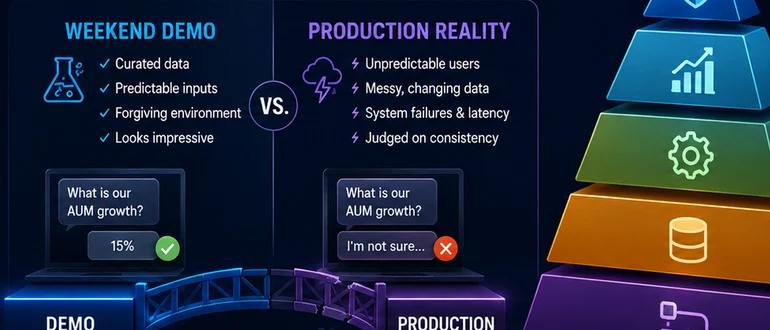
They operate in controlled conditions. Inputs are predictable, data is curated and edge cases are either absent or ignored. The system behaves well because the environment is forgiving. In that setting, it is easy to mistake capability for readiness.
A typical prototype might combine a language model, a retrieval layer and a simple orchestration loop. It produces coherent outputs, follows instructions and gives the impression of intelligence.
From a development perspective, it feels complete. But the moment that system is placed in a production environment, the assumptions it relies on begin to collapse. In practice, users are unpredictable, data is messy and often contradictory and systems introduce latency and failure. Expectations shift quickly. The system is no longer judged on whether it works occasionally, but whether it works consistently.
This is where the illusion ends.
When Agents Meet the Real World
Production environments introduce a different kind of complexity, one that is less about edge cases and more about constant variability. It is not just that inputs differ or systems fail occasionally. It is that uncertainty becomes the default. What was once an exception in development becomes a regular condition in production.
In financial contexts, the stakes are even higher.
An AI agent that provides a slightly incorrect response in a demo might go unnoticed. The same error in a production system can misinform a decision, disrupt a workflow or create compliance issues.
What becomes clear very quickly is that production systems are not defined by what they can do, but by how they behave under pressure.
The Uncomfortable Foundation: Non-Determinism
Before diving into specific production challenges, it’s worth confronting the most fundamental one. Every AI agent, regardless of how sophisticated its tooling or orchestration is, sits on top of an inherently non-deterministic language model. You put text in; you get text out, and the same input can produce meaningfully different outputs across runs.
This is not a bug. It’s the core mechanic. Temperature settings, sampling strategies and seed parameters can reduce variance, but they don’t eliminate it. Swapping the underlying model, even a minor tweak or update, can shift behavior in ways that ripple through your entire system.
Every other production challenge in this article is downstream of this one reality. Traditional software gives you a contract: Same input and same output. AI agents break that contract by design. Building production systems means engineering around that fundamental instability.
What Breaks First
Production environments introduce compounding complexity that prototypes never have to face. Based on what I’ve seen across financial and analytics systems, here’s what typically breaks first.
Retrieval goes stale. Your vector database was indexed with a snapshot of your data. Users start asking about things that arrived after indexing or ask questions that require cross-referencing documents in ways your chunking strategy never anticipated. At ConnexAI, our RAG system performed well in isolation against a curated knowledge base, but when exposed to diverse user queries in production, including ambiguous phrasing, multi-turn context and questions that spanned multiple knowledge domains, retrieval precision dropped significantly. We had to add a reranking layer and rethink how we chunked conversational data before it became reliable.
Hallucinations compound. In a demo, a hallucinated response is an anecdote. In production, it’s a pattern. When your agent handles thousands of interactions, even a 2% hallucination rate means dozens of wrong answers per day, and in financial contexts, a single one can misinform a decision. At Nansen, we found that hallucinations weren’t random; they clustered around specific query types, particularly those involving fewer common tokens or cross-chain comparisons where the model had weaker grounding. Mitigating this wasn’t just about better prompts, though structured output schemas and few-shot examples did help. It required system-level design: Validation layers that cross-checked LLM outputs against live on-chain data, confidence scoring that flagged uncertain responses and fallback paths that routed low-confidence queries to human review.
Speed becomes non-negotiable. At Nansen, decisions needed to happen in near-real-time. A 3-second delay in surfacing a wallet movement insight could mean the difference between acting on information and missing it entirely. Optimizing latency in an agent system where you might have sequential LLM calls, retrieval steps and tool invocations is a fundamentally different engineering problem from making a chatbot respond quickly.
Errors cascade. When one component produces slightly wrong output, downstream components treat it as a ground truth. A retrieval step that surfaces the wrong document leads to a generation step that confidently summarizes irrelevant information, which feeds into a decision workflow. In tightly integrated systems, these cascading failures are the hardest to debug because each step looks reasonable in isolation.
However, one of the most underestimated challenges is hallucination.
In early testing, hallucinations tend to appear occasionally and can often be corrected manually. They feel like manageable imperfections. At scale, they are not.
When an agent interacts with thousands of users or processes large volumes of data, even a small error rate becomes significant. Patterns emerge. Certain types of queries consistently produce unreliable outputs, and edge cases become common cases.
In systems that influence financial decisions, this is not just a technical issue. It is a trust issue.
The Missing Piece: Evaluation
The most consistent pattern I’ve seen across teams building AI agents is the absence of proper evaluation. During prototyping, evaluation means a developer running a few queries, reading the outputs and deciding it ‘looks good’. This does not scale. I’d argue that this gap — the lack of rigorous, systematic evaluation — is the single biggest reason production AI systems fail quietly.
Software engineering solved a version of this problem decades ago with test-driven development. You write the test first, then write the code to pass it. The test defines the contract. I believe AI engineering needs its own equivalent, and I’d call it eval-driven development: You define how you’ll measure success before you write the first prompt. Your eval suite is not a quality check you bolt on later. It’s the specification. It’s the contract between what your system promises and what it actually delivers.
Just as TDD forced developers to think about failure cases before writing code, eval-driven development forces you to think about failure modes before shipping a prompt. What does a bad response look like? How will you detect hallucinations? What does retrieval failure look like versus generation failure? If you can’t answer these questions with a rubric and a scoring mechanism, you’re not ready for production.
Judges, Rubrics and Failure Modes
At the core of any evaluation framework are judges, automated evaluators that score your system’s outputs against defined criteria. These can be LLM-based judges that assess response quality, factual grounding or relevance. They can be deterministic checks that verify structural correctness, tool call accuracy or citation presence. What matters is that every failure mode your system can exhibit has a corresponding judge or rubric that catches it.
This means building rubrics that are specific to your domain. A generic “Was this response helpful?” judge is nearly useless. At Nansen, we needed judges for: Factual accuracy of on-chain data (did the agent report the correct token balance?), tool selection correctness (did it call the right API for the query type?), hallucination detection (did it fabricate a metric that doesn’t exist?) and response completeness (did it answer all parts of a multi-part question?). Each of these had its own rubric with clear pass/fail criteria and graded severity levels.
At MSCI, the failure modes were different. We needed to evaluate extraction completeness (did the pipeline capture all fields from a property record?), format handling (did it correctly parse non-standard table layouts?) and data linkage accuracy (did it match the extracted entity to the correct record in our database?). Each failure mode had its own evaluation path.
The principle is the same regardless of domain: Enumerate your failure modes, build a judge for each one, define rubrics with clear thresholds and run them continuously. This is the only way to evaluate scales beyond a handful of manual spot-checks.
But here’s the part most teams miss: Your judges themselves drift and degrade, just like the system they’re evaluating. An LLM-based judge that was accurate at catching hallucinations last month might become less reliable after a model update. A rubric that made sense for your initial query distribution might not cover the new types of questions users are asking. Judge calibration must be an ongoing practice. At Nansen, we ran monthly calibration cycles pulling a random sample of 50–75 scored interactions, independently assessing them and measuring alignment. When alignment dropped below 85%, we retrained or rewrote the judge. We also reviewed interactions that users flagged as problematic to check whether our judges had caught them, and when they hadn’t, we added new rubrics. Uncalibrated judges give you a false sense of safety. You think you have coverage, but your judges are quietly agreeing with bad outputs.
The Metrics That Actually Matter
Evaluation is only as good as what you measure. Correctness alone is not enough. In practice, a few metrics consistently matter most.
Judge scores are your primary quality signal, the aggregated outputs of your evaluation judges across failure modes such as hallucination rate, retrieval relevance, tool selection accuracy and response completeness. Track these over time, segmented by query type — you’ll catch degradation patterns before users do.
Time to first token (TTFT) measures how quickly your system starts responding. Users form impressions within the first second. A 4-second wait feels broken regardless of output quality. At Nansen, optimizing TTFT pushed us to parallelize retrieval and pre-compute common context windows.
Time to first answer (TTFAT) token is where agentic systems differ. This measures how quickly the agent produces a meaningful answer, not just an acknowledgement text. In a trading workflow, the gap between a user’s query and the first substantive insight — a wallet balance, a price movement or a risk flag — is what determines trust. TTFAT exposes latency in reasoning and planning layers that TTFT alone misses.
Beyond these, track error rates at every layer: LLM errors (malformed outputs, refusals, context window overflows), tool errors (failed API calls, timeout on retrieval, schema mismatches) and overall efficiency (how many LLM calls and tool invocations does it take to complete a task, and is that number growing over time?). Then track evaluation variance (if the same suite gives different scores across runs, your eval itself is unreliable), regression rates (percentage of passing tests that break after a change) and coverage gaps (percentage of production query types with no eval cases at all).
Governance and Trust
In financial systems, technical performance is table stakes. The system also must be explainable, auditable and compliant. This is where governance becomes the layer that determines whether your agent actually ships or stays in staging.
Working on the wealth management platform, I saw firsthand how regulated environments constrain what’s possible. Every recommendation surfaced to a wealth advisor needing a traceable path: What data was used, what logic was applied and how the output was generated. This wasn’t a nice-to-have; it was a compliance requirement.
For AI agents, this means logging every LLM call, retrieval step and tool invocation with enough detail to reconstruct the reasoning path after the fact. It means building human approval gates for high-stakes outputs. It means designing your system so that when a regulator asks, “Why did your system produce this recommendation?” you have an answer that goes beyond “the model generated it.” On another product, where users interact with an AI agent to make trading decisions, governance took a different shape. We needed to clearly communicate uncertainty, ensure that the agent never presented generated insights as verified facts without grounding and maintain audit trails of every conversation where financial decisions were influenced.
Teams that treat governance as a post-launch concern end up either retrofitting it painfully or getting stuck in compliance reviews that block deployment. Build the traceability and accountability infrastructure from the beginning, alongside the agent logic itself.
Monitoring What Matters
One of the biggest differences between a prototype and a production system is visibility.
In a demo, you observe the system directly. You know what inputs are being used, and you can see the outputs in real-time. In production, that visibility disappears. Monitoring becomes essential.
Standard infrastructure monitoring, uptime, latency and error rates are necessary but not sufficient. For AI agents, you need to track output-level quality signals, user feedback patterns and drift in scores and metrics. Set up alerts that track response consistency for a fixed set of production log queries run daily. When consistency dropped below a threshold, it triggered a review before anything else changed. This caught two separate regressions, one from a data pipeline delay and one from an upstream model update, before they affected users.
Monitor for behavior, not just availability. A system that is always up but increasingly unreliable is worse than one that goes down and comes back because the failure is invisible.
Lessons From Production Systems
Across different domains, the same types of issues tend to appear.
In real estate analytics, systems designed to extract structured data from documents performed well in controlled tests but struggled with variability in real-world inputs. Small differences in formatting or language created inconsistencies that required additional layers of validation.
In conversational systems, retrieval pipelines worked effectively in isolation but became less reliable when exposed to diverse user queries. Context handling, ambiguity and edge cases introduced complexity that was not visible during initial testing.
In crypto market intelligence systems, the challenge was not just correctness but speed. Decisions needed to be made in real-time, and even minor delays or inconsistencies could affect outcomes.
Each system was functional as a prototype. Each required significant engineering effort to become reliable.
A Practical Way to Think About Production System
Over time, I’ve found it useful to evaluate production readiness through five questions. Not abstract principles, but concrete diagnostic questions that expose gaps. This doesn’t mean you shouldn’t ship, but you should be iterating over this until it is ‘ready’.
- Reliability: Can you run the same 100 queries through your system on two different days and get acceptably consistent results? Can your system support all the queries without breaking anything?
- Evaluation: Do you have tests that run when a prompt, config or model changes? If you’re still evaluating by reading outputs manually, you’re not ready.
- Governance: Can you reconstruct the full reasoning path for any given output, what data was retrieved, what tools were called, what the model generated and why? If not, you will struggle in any environment.
- Observability: Can you track output quality over time, not just system uptime? Can you trace and find what broke, what failed, etc.?
- Resilience: In case of a component failure, a retrieval timeout, a model API error or an unexpected input, does the system fail safely with a fallback, or does it cascade? If you haven’t tested failure modes, assume they’re unhandled.
If any of these answers are “no” or “I’m not sure,” the system is not production-ready. That’s not a failure; it’s a prioritization signal.
Redefining Reliability
In traditional software engineering, reliability is well-defined. It encompasses uptime, but also means time between failures, mean time to recovery, fault tolerance and error handling. Decades of practice have produced mature frameworks for measuring and guaranteeing it.
For AI agents, all of that still applies, but it’s not enough. Reliability also includes the quality and consistency of reasoning, the ability to handle ambiguous or adversarial inputs gracefully and transparency about confidence levels. A system that is always available but produces different answers to the same question on different days is not reliable in any meaningful sense. The shift I’ve come to believe is essential: Reliability for AI systems must be defined at the output level, not at the infrastructure level. It’s not enough that your API returns 200. The response must be correct, consistent, grounded and traceable. That’s a fundamentally higher bar, and it requires fundamentally different engineering.
Conclusion
AI agents are getting easier to build. Frameworks are maturing, models are improving and the path from idea to demo has never been shorter. However, the path from demo to production has not gotten shorter at all. If anything, as agents become more capable, production requirements grow with them.
The gap is not just technical. It’s about accepting that you’re building on a non-deterministic foundation and engineering accordingly. It’s about evaluation discipline, governance infrastructure, monitoring that tracks behavior rather than just uptime and a definition of reliability that accounts for the nature of the technology.
If you’re building an AI agent today, here’s my practical suggestion: Pick one production failure mode from this article — silent degradation, retrieval drift, hallucination clustering, evaluation variance — and build the detection for it this week. Don’t wait until launch. The teams that treat production readiness as a design constraint from day one, rather than a problem to solve later, will build systems that actually last. In domains where decisions carry real consequences, that’s the only thing that matters.