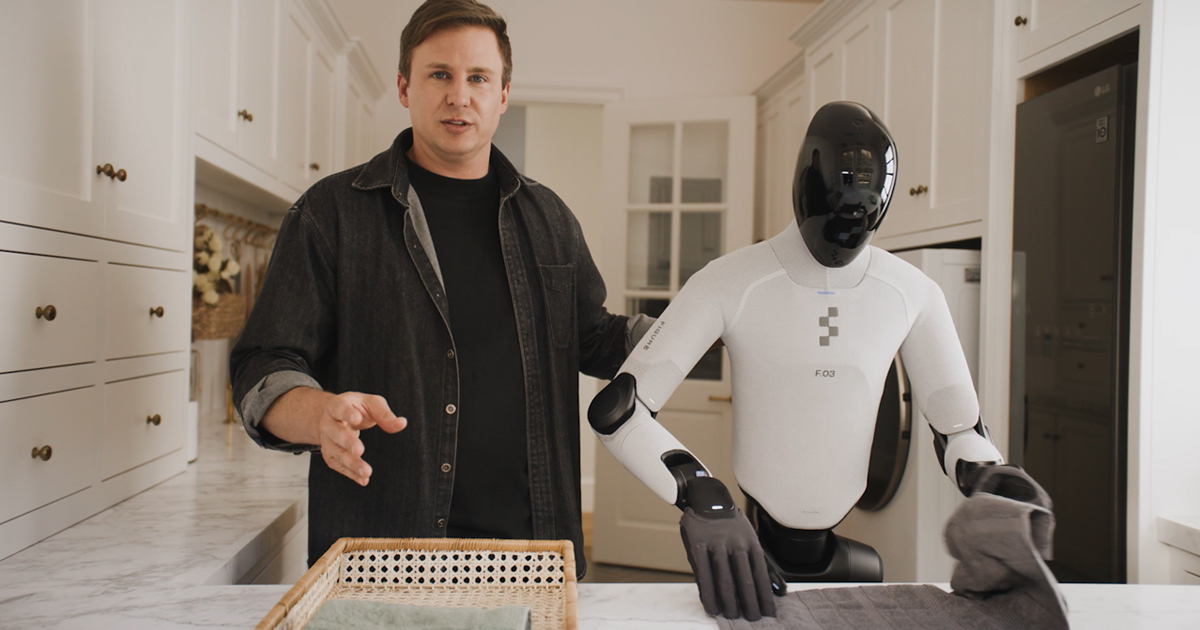
A person can walk into an unfamiliar home and start working immediately. Our understanding of the physical world carries from one environment to the next. We do not need to relearn how to make a bed because it is a different height, or how to tidy a room because the furniture is different. This is currently not true for robots. They learn the places they work in, one place at a time.
Today we are introducing Helix 2.5, the most advanced neural network Figure has built.
Helix 02 showed that a neural policy could coordinate a humanoid's whole body over long horizons, from un a dishwasher to running a logistics task autonomously for 200 hours. But those systems learned from data collected where the robots would operate.
Helix 2.5 was built to answer a harder question: can a humanoid enter a home it has never seen and immediately get to work, with its whole body, on its own?
To find out, we pretrained Helix 2.5 on Index, Figure's global-scale dataset of human behavior. From that single foundation model, we produced three behaviors: tidying living rooms, folding towels, and making beds. Then we took the robot into 30 Bay Area homes with zero data collected in any of them.
Key Results #
- Zero-shot whole-body autonomy across 30 real homes. Helix 2.5 performs three long-horizon behaviors across 30 unseen homes, with no data collection, fine-tuning, or adaptation in those environments or manipulated objects. To our knowledge, this is the first demonstration of zero-shot whole-body generalization at this scope on a humanoid.
- One foundation model, three whole-body behaviors. A single Index-pretrained base model was adapted to three distinct behaviors spanning locomotion, rigid and deformable manipulation, bimanual coordination, and active perception.
- Index pretraining drives generalization. Holding task-specific data, architecture, training, and evaluation fixed, Index pretraining alone increased zero-shot success from 9% to 56%.
- Behavior specification got 2x cheaper while its scope expanded 30x. Helix 2.5 used half as much task-specific data as a representative Helix 02 behavior, then generalized that behavior across 30 unseen homes.
- A human-to-humanoid robot transfer scaling law. Repeatedly doubling Index pretraining data improved downstream robot-action prediction smoothly enough to forecast our largest run’s loss to four decimal places before training.
The point is not that general humanoid robotics is solved. But Helix 2.5 is the first evidence that whole-body intelligence can be learned from human experience and transferred to new scenarios, rather than rebuilt each time.
The Whole-Body Generalization Problem #
We chose three whole-body tasks: tidying a room, making a bed, and folding towels. Together, they require perception, locomotion, manipulation, bimanual coordination, and whole-body control. Each is difficult even in a fixed environment. We ask something harder: can the same behavior work immediately somewhere new?
Most research on robot generalization takes place in settings built around the machine. Tabletop arms work within a fixed workspace; wheeled robots need enough open floor for their base to fit and turn. Homes offer no such accommodation. A humanoid has to move through them as part of the task, positioning its body to see, reach, and manipulate objects in tight, cluttered spaces that other form factors can't get into.
The task therefore becomes a whole-body problem. The robot may need to walk to find an object, then shift its stance to reach it. Perception, locomotion, and manipulation can't be solved separately.
Zero-shot generalization raises the bar further. The robot has not seen the room, layout, or objects during training and cannot adapt after arriving. It has to solve the full perception-and-control problem with what it already knows.
Autonomous humanoid behavior at this complexity level is rare even in familiar environments. To our knowledge, Helix 2.5 is the first system to achieve it zero-shot, in homes and with objects it has never encountered.
Index Pretraining Drives Zero-Shot Generalization #
This raises an obvious question: How much of Helix 2.5’s zero-shot capability comes from Index pretraining, rather than the task-specification data itself?
We tested this directly. We trained two policies on identical task-specification data, which did not include evaluation homes or objects. One was initialized with random weights, the other initialized from the Index-pretrained Helix 2.5 model. Architecture, optimization, hyperparameters, downstream data, and evaluation were held fixed. The only difference was Index pretraining. Helix 2.5 was itself pretrained from random initialization entirely on Index, unlike Helix 02, which started from a pretrained vision-language model.
Our key finding is that Index pretraining accounts for most of Helix 2.5's zero-shot capability. In blind evaluations, the policy trained from scratch succeeded on 9% of zero-shot trials. The Index-pretrained policy succeeded on 56% - over 6x higher (Figure 1). Success required completing the entire task: every item tidied, every towel folded, or the whole bed made. We give no partial credit.
Our pretraining is intentionally broad, to support arbitrary behavior fine-tuning. No single evaluation task makes up more than 1.90% of the Index pretraining dataset (see details in Appendix).
Because pretraining was the only experimental variable, this gap directly measures its contribution: the same task-specification data transfers far more effectively from a model already trained on broad human experience.
Evaluating Three Whole-Body Behaviors in 30 Unseen Homes #
We evaluated three tasks across 30 unseen Bay Area homes with unseen objects. “Zero-shot” refers to the evaluation environments and objects being manipulated; tasks were specified through fine-tuning data collected elsewhere.
- No data was collected in any evaluation home.
- No evaluation toy, towel, or bedding appeared in task-specification data.
- The robot used each unseen home’s existing couches, beds, and folding surfaces.
Evaluation objects were set aside before any experiments began, and an AI model, followed by human review, verified they did not appear in task-specification data.
Trials were graded against criteria fixed before evaluation began (see details in Appendix). Success required:
- Living Room Tidy: All 13-15 toys scattered in the scene are picked and placed in the basket.
- Towel Folding: All towels are folded and placed in the basket.
- Bed Making: Both pillows and comforter corners are placed at the top of the bed, with the comforter pulled smooth.
Each task used a single fixed checkpoint across all 30 homes. No weights were adapted to evaluation homes or objects, and no evaluation rollout data or performance was used for checkpoint selection.
Helix 2.5 Needs 2x Less Data to Specify More General Behaviors #
We also asked whether pretraining changes how much robot data is needed to specify a new behavior.
To test this, we compared Helix 2.5 with a previous Helix 02 policy trained to do the same task. Helix 02 was trained with data collected directly in the environment where it was evaluated. Helix 2.5 matched its success rate while using half as much adaptation data - and did so zero-shot across 30 unseen homes.
Whole-Body Self-Correction
Self-correction is essential over long horizons, especially in unfamiliar environments. A striking qualitative improvement in Helix 2.5 is its ability to self-correct - stepping back to reposition, changing stance, or moving around a full bed to correct a fold. We see this ability to recover and keep making progress as an important effect of Index pretraining.
A Human-to-Humanoid Robot Transfer Scaling Law
Scaling laws transformed language model development by showing that next-token prediction improves predictably with more data and compute, allowing large runs to be forecast from smaller ones.
We asked whether human-to-robot transfer scales similarly. We trained four models on nested subsets of Index spanning an 8× increase in pretraining data, holding model size and downstream training fixed. Each was fine-tuned on the same task data and evaluated on the same held-out action-prediction loss.
Loss fell predictably with each doubling of Index. To our knowledge, this is the first human-to-robot transfer scaling law measured on a humanoid: Index pretraining predictably improves downstream next robot action prediction.
The relationship was precise enough to forecast. Using only the smaller runs, we could predict our largest run’s test loss to four decimal places before training began. Forecasting error was just 0.54% of the variation across the full 8× data range.
This measures data scaling only, with model size and downstream training fixed. But it suggests that a property central to language-model scaling may extend to humanoid robotics: estimating the benefit of the next doubling of human experience before training on it.
It’s Time to Scale Up #
A year ago, we formed the thesis that robotics was off by multiple orders of magnitude: in model size, compute, and, especially, data. Index was our attempt to close that gap by asking a simple question: can a humanoid learn enough from human experience that it no longer has to be taught every place it will eventually work?
Helix 2.5 is our strongest evidence so far that the answer may be yes. Across three behaviors and 30 unseen homes, policies pretrained on Index generalized to new layouts and objects without environment-specific fine-tuning. As Index data increased, transfer improved smoothly enough to measure as a scaling law.
The recipe is becoming familiar to other areas of AI: learn broadly in pretraining, specify a behavior once, and generalize at deployment.
Index is now generating roughly 35 minutes of new human experience every second, and we have committed $3.5B of compute to training Helix. If Helix 2.5 is any guide, more data and compute should translate directly into more of the physical world learned before the robot ever enters a new home.
It’s time to scale up.
If you also care about solving general physical intelligence, we are hiring.
Appendix #
Detailed Eval Criteria
During blind evaluation, for all three tasks, every trial has a unique initial configuration, as specified in the Initial Configuration in our evaluation procedure. In these configurations we arbitrarily and naturally positioned and oriented all objects in the environment. Trial reset conditions are applied identically to all policies evaluated for fair comparisons.
This is the detailed eval rubric provided to all operators:
- Toy: Graders record the following metrics.
- Number of toys picked up and placed in basket
- Attempts per toy
- Each toy is given a 1 minute timeout. If this timeout is exceeded, the rollout is aborted.
- Towel: Graders determine pass or fail per towel, and grade all towels that are folded.
- Pass: Towel is picked up, folded, and makes it into the basket.
    - A: All 4 corners of towel nearly touching (within 1 inch), clean fold
    - B: Only 2 corners within one inch.
    - C: None of the corners within one inch, messy fold.
- Fail: Cannot complete task end-to-end. Unable to grasp, fold, or place in basket successfully.
- If the towel is folded but the basket placement fails, the towel is marked fail but the fold is graded as per the rubric above.
- Each towel is given a 3 minute timeout. If the timeout is exceeded, the towel is marked as failed.
- Bed: Graders determine pass or fail per pillow and comforter, and grade all bedding that is adjusted.
- Pillow Criteria
    - Pass: Pillow was picked up and placed in the top ⅓ of the bed
      - Good: Pillow is placed horizontally and aligned (<15 degree orientation clockwise/anticlockwise)
      - Bad: Pillow is placed horizontally, <45 degree orientation clockwise/anticlockwise
    - Fail: Pillow was not picked up or not placed on the top ⅓ of the bed
- Comforter Criteria
    - Pass: Both sides of comforter picked up and both corners reached the top ⅓ of the bed
      - Good: Corners are aligned with each other (<6 inches) and relatively smoothed
      - Bad: Corners are 6-12 inches difference, slightly smoothed
    - Fail: Cannot do the task. At least one side of comforter was not picked up or did not reach the top ⅓ of the bed
- Each pillow and each side of the comforter is given a 1 minute timeout. If this timeout is exceeded, the rollout is aborted and marked as failed.
If a human intervention is necessary for safety, that rollout is aborted and failed.
Index Categorization
We characterize tasks in Index by embedding it two ways, video embeddings of every clip and text embeddings of a vision-language model's per-segment activity and object descriptions, clustering each into a nested hierarchy of semantic groups, and measuring how the hours of any dataset or training snapshot distributed over those groups.