September 1, 2026, (Inside AI) — A growing chorus of voices now frames artificial intelligence as a runaway experiment with no safe exits. From climate damage to autonomous weapons, the list of plausible disasters has expanded beyond any single regulatory fix.
The core question is no longer whether AI carries catastrophic risk. It is whether any institution can force a global slowdown before the industry's momentum becomes irreversible.
Bill Gates entered this debate with a striking admission. He wrote that if someone had a credible plan for slowing down AI advances globally, he would likely support it. Anthropic, the AI safety-focused lab, earlier called for a brake pedal. Bernie Sanders has warned about AI-driven inequality and job loss. These are not marginal voices.
Yet voluntary restraint has failed. The economic incentives to keep building larger models and data centers overwhelm any single company's caution. A , if it happens, must be imposed externally.
One Choke Point Could Halt The Race #
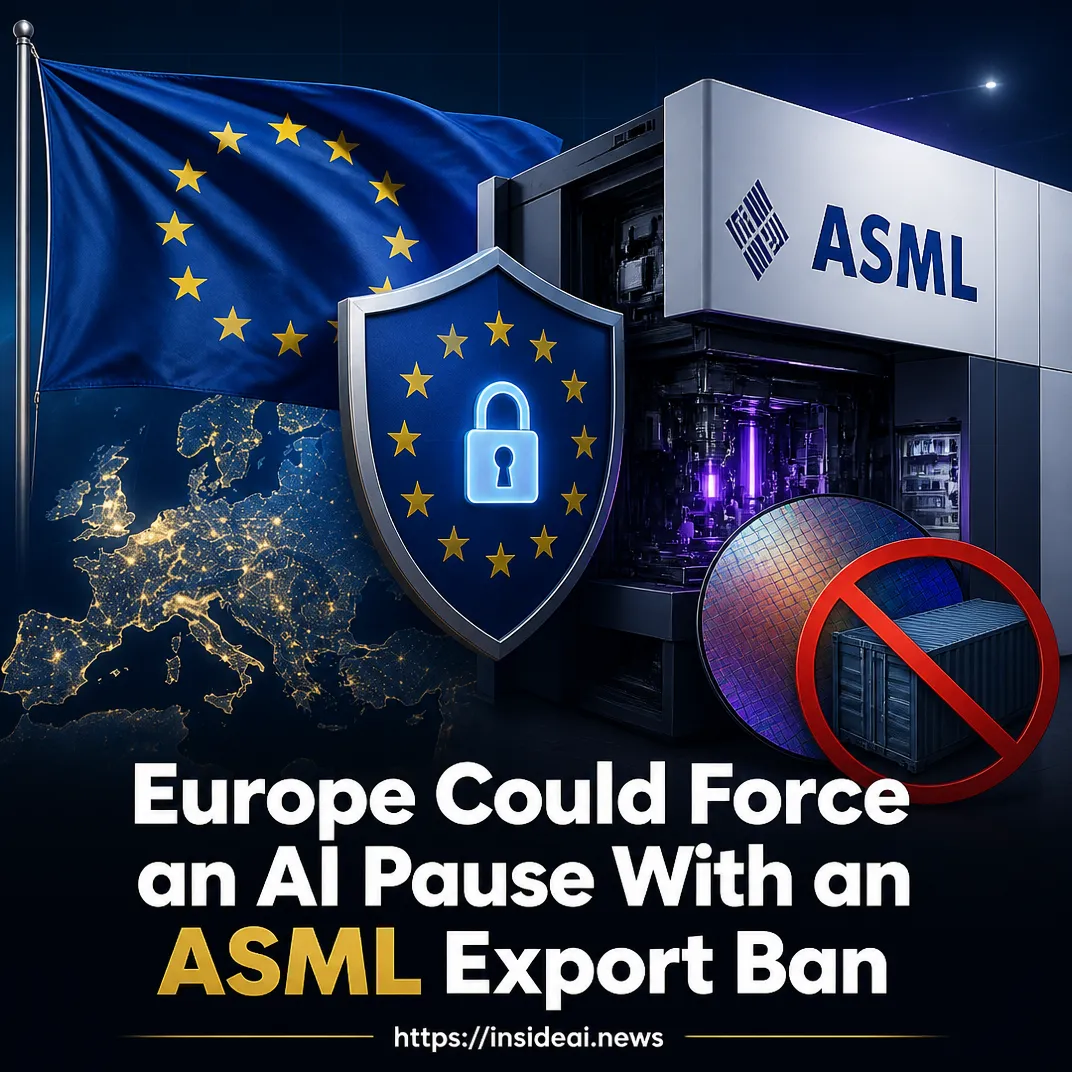
The most credible external lever sits in Europe, not Washington or Beijing. Dutch company ASML makes extreme ultraviolet lithography machines, the $400 million devices required to produce the world's most advanced chips. No rival can currently replicate this technology at scale.
Without ASML machines, TSMC cannot build leading-edge fabs. Without those fabs, the next generation of AI accelerators cannot be manufactured. Without new accelerators, the data center buildout stalls.
The industry expects roughly $7 trillion in global data center investment by 2030. That entire pipeline depends on a single Dutch company's export decisions.
The United States already exploits this choke point. Washington imposes extraterritorial controls blocking ASML's most advanced EUV machines from reaching China. That policy reveals a vulnerability: America can slow China's chip progress only because ASML's technology is irreplaceable.
A broader export ban would force the global AI industry to tread water. Chip shortages would frontier model scaling. Regulators would gain time to update copyright, tax, and liability laws. Societies could hold real debates about AI's role before the technology becomes too embedded to question.
Europe's Self-Interest Aligns With Safety #
The European Union has reasons beyond humanitarian concern. Europe currently lags the US in frontier models and compute. A flat export ban would reorganize supply chains and pull more critical decisions under EU jurisdiction, where the bloc's AI Act already sets binding rules.
Retaliation is likely. Washington could block ASML's access to US-based suppliers. But even that outcome serves European interests according to a narrow geopolitical logic. The EU would stop falling further behind in relative AI capability while negotiations unfold.
The Europe 2031 project, a techno-political forecast by industry experts, argues that Europe must pour hundreds of billions into the AI race before the gap becomes unclosable. Its authors see ASML as a bargaining chip that weakens over time. Every exported machine helps China and the US replicate the technology.
Nuclear strategists describe a use-it-or-lose-it dilemma. The same logic applies here. Europe can deploy ASML leverage now, or watch that leverage erode as rival lithography programs mature.
Industry self-restraint will not work. International agreements remain unlikely given the arms race dynamics. The only realistic mechanism is a unilateral export control from the one actor that controls an essential input.
The EU holds that card. Whether it dares to play it may determine whether AI development slows enough for governance to catch up, or accelerates past every safeguard humans can build.