Editorial analysis: Practitioners and product teams should treat national adoption metrics as a core signal for real-world impact, not merely academic interest. High model performance and growing investment do not automatically translate into broad consumer or enterprise uptake; design, trust, regulation, and local workflows determine whether models reach end users. The gap Etzioni highlights is not incidental -- it reflects a structural pattern where countries with concentrated knowledge-work sectors, permissive regulatory stances, and higher digital-infrastructure density outpace R&D leaders in real-world usage.
What happened
Stanford University published the 2026 AI Index, a 400-page data-driven annual report that tracks technical performance, investment, labor markets, environment, public attitudes, and adoption (Stanford HAI, April 13, 2026). The Index's cross-country adoption metric for generative AI places the United Arab Emirates at 54% and Singapore at 61%, while the United States ranks 24th at 28.3% (Stanford HAI). Oren Etzioni, in a column published on GeekWire, emphasizes the surprise of that split and characterizes it as a growing chasm between builders and adopters.
What the broader Index shows
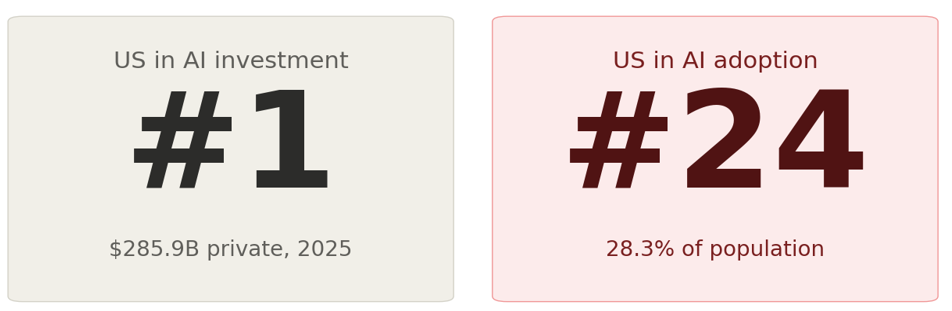
Global generative AI reached 53% population adoption within three years -- faster than the personal computer or the internet -- but pace varies strongly with GDP per capita and regulatory environment. The U.S. leads all countries in AI private investment ($285.9 billion in 2025, 23x China's $12.4 billion), yet adoption lags most comparable economies. The Index also documents that AI talent inflows to the U.S. dropped 89% since 2017, down 80% in the last year, adding a supply-side dimension to the development-adoption gap.
Implications for practitioners
For ML engineers and product managers, the Index's finding implies that evaluation priorities should include local usage signals and deployment friction, not just benchmark scores. Adoption rates shape data collection opportunities, user feedback loops, and the representativeness of real-world evaluation datasets. Monitoring policy and public-attitude metrics matters when planning rollouts across markets, especially in regions with lower baseline adoption.
What to watch
Track whether follow-up Index releases show converging adoption as integrations mature, and watch leading indicators such as enterprise SaaS integrations, API call growth by region, and regulatory changes affecting consumer-level tools.
Key Points #
- 1Adoption and development diverge: the U.S. leads AI investment by 23x but ranks 24th in generative-AI adoption at 28.3%, behind UAE (54%) and Singapore (61%).
- 2For practitioners, national adoption metrics are operational signals for deployment choices, telemetry needs, and localization priority -- not just academic data.
- 3Observed patterns show infrastructure, regulatory clarity, and workforce composition consistently predict higher generative-AI adoption rates across markets.
Scoring Rationale #
The Stanford AI Index is the field's most comprehensive annual data source; Etzioni's column surfaces an actionable and counterintuitive cross-country adoption finding -- US 24th despite 23x investment lead -- directly relevant to product, deployment, and evaluation decisions. Upgraded from 6.8 to 7.0 reflecting the breadth of the primary report and the factual correction to UAE figure.
Practice with real Ad Tech data
90 SQL & Python problems · 15 industry datasets
[Active Search Campaigns by BudgetEasy](https://letsdatascience.com/problems/sql/active-search-campaigns-by-budget)

[High CPC Clicks & Poor Landing PagesMedium](https://letsdatascience.com/problems/sql/high-cpc-clicks-poor-landing-page)

[Campaign ROAS by Attribution ModelHard](https://letsdatascience.com/problems/sql/campaign-roas-by-attribution-model)
250 free problems · No credit card