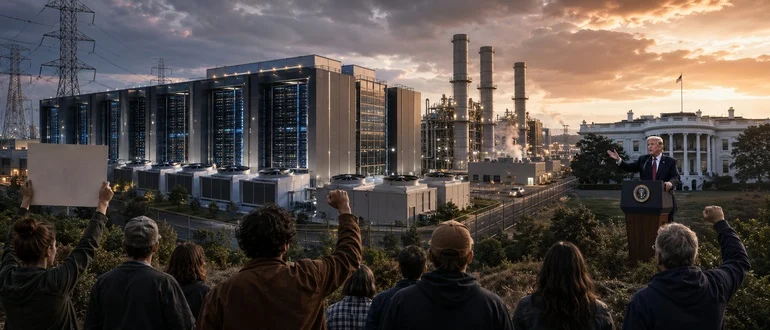
The Environmental Protection Agency (EPA) is advancing a rule change that would eliminate mandatory federal public notification requirements for air pollution permits issued to industrial facilities, including the massive data centers powering the nation’s artificial intelligence (AI) boom.
Under the Clean Air Act, state agencies have historically been required to notify the public and solicit feedback when reviewing permit applications for minor pollution sources. The proposed rule by the Trump administration shifts this requirement from mandatory to voluntary, placing public disclosure entirely at the discretion of state and local authorities.
Advocacy groups warn the policy shift could allow developers to secure emissions approval behind closed doors, shielding facilities from community oversight and legal challenges.
“The administration is basically saying: ‘You all may have thought this was an ironclad promise, but it no longer is,'” said Joe Goffman, a former assistant administrator for the EPA’s Office of Air and Radiation, referring to the federal guarantee of public participation in environmental oversight.
Data center facilities rely heavily on diesel generators or gas turbines to maintain uninterrupted power or supply off-grid energy. These systems frequently emit nitrogen oxide, carbon monoxide, heavy metals, and particulate matter linked to asthma, heart disease, and cancer. To avoid the stringent federal oversight applied to major industrial facilities, developers routinely parcel permit applications into smaller, individual units. This practice allows multi-generator installations to qualify for state-managed “minor source” permits.
Public health advocates and legal watchdog groups argue that public notice requirements are critical for monitoring these minor source applications. Without mandatory disclosure, journalists, environmental law clinics, and residents will lose access to data showing what pollutants are entering their air shed. Supporters of the administration’s direction argue the change will streamline regulatory hurdles and accelerate economic growth. In official filings, the EPA said the policy aims to “reduce administrative burden and responsibly speed up permitting” by placing local state agencies “in the driver’s seat.” The agency added that the rule change does not alter existing emission standards or reduce environmental protections.
Critics contend that placing disclosure authority in the hands of state officials creates a loophole. Because state and municipal governments frequently compete for technology investments, observers fear local authorities will offer waived public notice as a regulatory incentive to attract developers.
The regulatory push comes as public pushback against data centers intensifies across the country. Communities have increasingly raised concerns over high water and electricity usage, localized air pollution, ambient noise, and limited long-term job creation.
President Donald Trump dismissed community opposition to facility expansion, framing data centers as crucial economic engines.
“Frankly, communities that don’t take a data center, they’re making a mistake because there’s plenty of communities that want them,” Trump said, emphasizing the tax revenue and construction jobs the projects bring to local municipalities.
The EPA’s public comment period for the proposed rule has closed. Environmental law organizations and public health coalitions are preparing legal challenges should the agency issue a final rule.