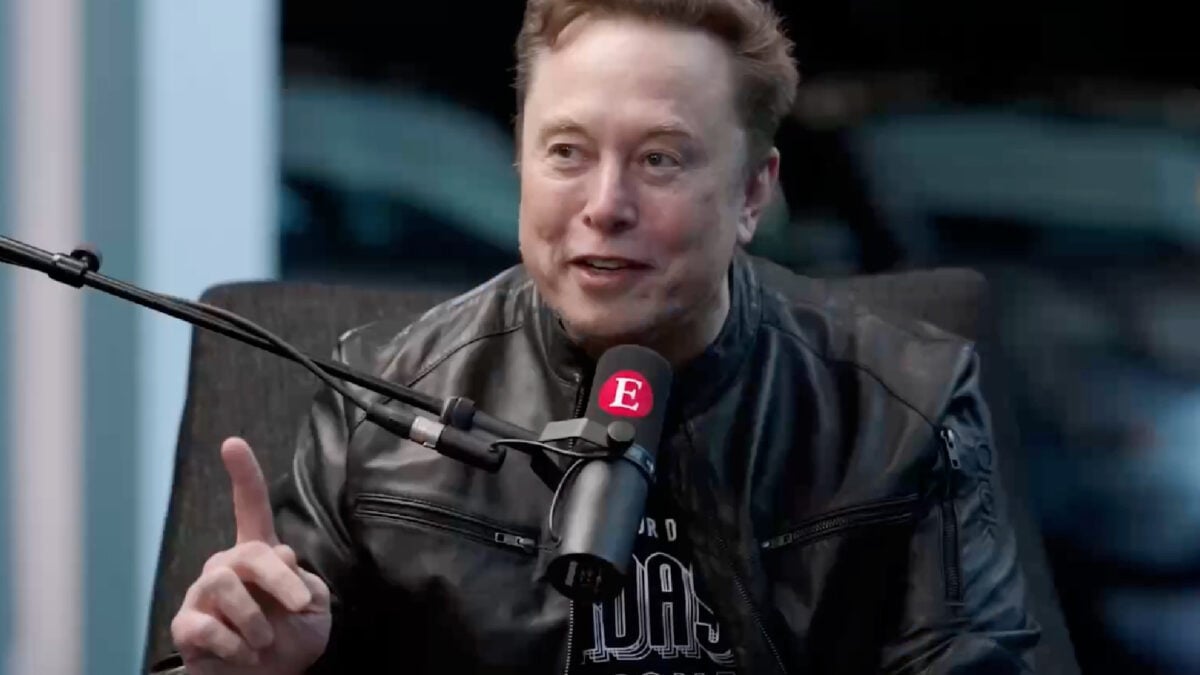
Elon Musk sat down with the editor-in-chief of the Economist for a taped interview that went live Thursday. The Tesla CEO has been avoiding normal journalists recently, even cancelling a planned interview with CNBC earlier this month. And it now seems pretty obvious why. Musk has a hard time answering normal questions about his often fascist and sometimes incoherent worldview.
The interview started cordially enough, with Economist editor Zanny Minton Beddoes asking Musk about his thoughts on the future of artificial intelligence. Musk said many things that he’s said before, including that AI will deliver an age of abundance, where “anyone can have anything they think of.”
Musk insisted that AI will exceed human intelligence in five years and that humans will no longer be in charge of the world in 10 years. Beddoes pressed Musk several times on what that means and how his companies will continue to exist. The billionaire rambled on and on in a way that didn’t really stand up to any scrutiny.
“If you have vast numbers of robots with vast amounts of digital intelligence, you have a sort of a quasi-infinite economy,” said Musk. “The future is going to be very, very different from the past. There’s no analogy or metaphor that I think illustrates the magnitude of change that we’re going to experience here.”
Musk was asked how his companies would make money in this version of the future, and he insisted that “money won’t matter in 2036.” He claimed that everyone would have a high income from doing nothing and that people might still perform some kind of labor as a hobby, much in the same way that people might grow their own tomatoes in a home garden. Musk insisted backyard tomatoes weren’t as good as those you can buy from the store, but people still do it anyway. That would be news to anyone who’s had a delicious backyard tomato, which frequently tastes much better.
Again, Musk has said this kind of thing before. Interviewers, especially podcasters who are just fans of Musk, won’t probe for specifics after he makes such bold statements. But Beddoes didn’t let him get away with the idea that everyone will just have a high income. She asked how this would be implemented.
“What do you want money for? You want money for goods and services, right? You want money for mostly food, housing, transport, entertainment,” said Musk. “Well, if that is so abundant that […] the robots and AI are providing more goods and services than you…than any human, could possibly consume, what do you need money for?”
From that point on, it was all downhill for Musk. He suggested that everyone read Iain Banks for a vision of the future, and Beddoes pointed out that Banks was a socialist. Musk insisted he wasn’t. Musk said he wanted a Star Trek version of the future, which is also a version of the future that is routinely referred to as “space communism.” When Beddoes asked Musk about his time with the so-called Department of Government Efficiency (DOGE), he got extremely defensive. She pointed out that people had suffered and died from the destruction of USAID as an agency. Not only did Musk insist that no one died, but he also said that USAID’s functions were transferred to the U.S. State Department and all he did was get rid of the fraud. In fact, there have been many deaths from the cuts to foreign aid.
Musk was pressed again on how his high-income future would work in practice. “I think that the Treasury should just simply issue people checks,” said Musk. Beddoes responded, “But where’s the revenue coming from? I mean, I’m enough of an economist. If you just issue checks, you’re going to have inflation.” Musk claimed inflation wouldn’t be a problem. He said that you could print money and actually get deflation because there will be so much abundance produced.
Beddoes pointed out that Musk frequently antagonizes people online, especially when it comes to what he claims is happening in Europe. The billionaire promotes racist, far-right political actors in the UK and Germany; most recently, he used X to spread a racist movie that villainizes immigrants called Citizen Vigilante. Musk appeared to shrug when Beddoes noted that the German political party he supports, AfD, is home to some neo-Nazis. Beddoes also pointed to Musk’s belief that Britain is headed for civil war, a prediction she clearly does not share.
Musk defended his actions but really flew off the handle after Beddoes asked about the contradictions Musk seemed to present. She noted that Musk talks about this utopian world that’s just over the horizon, with humanoid robots and AI doing all the work. But how does he square that with the idea that Europe is a hell-hole of immigrants ruining everything?
“On the one hand, we started this conversation, and you described to me this extraordinarily transformative, amazing civilizational changing stuff that’s happening in the next 10 years. And yet you’re also, you know, an ongoing participant in the worst kind of tribalism… cesspit of social media.”
Beddoes asked how he can believe in these “two very different views of the world.” Musk simply responded, “I don’t think they’re inconsistent,” without elaborating further. She then noted that people believe Musk is a racist. The billionaire defended against the accusation that he’s a racist by pointing out that his partner, Neuralink executive Shivon Zillis, is half Indian.
“My partner is… she’s half Indian, and my… and I have four children with her. One of them was named after a famous Indian physicist. So I would say I’m not racist,” said Musk. “And also, if you look at the people that are employed at my companies. You know, we have senior executives of all races. I don’t think there’s any racism there.”
Beddoes followed up by asking if he was anti-Muslim, and he was much less willing to explicitly deny that he is. Again and again, Musk insisted that Europe was in decline and dangerous, while Beddoes correctly pointed out the U.S. is much more dangerous than the UK when it comes to violent crime. Musk refused to believe that was true.
By the end, Musk was so agitated by facing real questions that he just resorted to whining about how awful the media can be. He seemed to think that his popularity on X, the platform he owns, was evidence that most people actually love him.
“A quarter billion people follow me,” Musk said, referring to his X followers, adding “I think a lot more people actually like me than don’t.” The billionaire then said that “a lot more people hate you and the media more than you realize.”
Beddoes acknowledged that many people hate journalists, but Musk kept going, repeating “they hate you, they hate you,” like an emotionally wounded child. Musk, flailing, tried to come up with some way to attack The Economist specifically.
“There are more people that die in Europe from heat deaths than people that die from gun deaths in America. Why aren’t you writing an article about air conditioning?” asked Musk.
“Well, we’ve done several on air conditioning, and we had on our cover last week a whole long piece about…” said Beddoes.
“Pro-air conditioning?” Musk asked sheepishly. “Very pro-air conditioning,” she responded. “You should read us sometime.”
It’s kind of the perfect moment. Musk throws out some meaningless gotcha and then asks why the media isn’t talking about something that he’s become hyperfocused on. In his ignorance, he demonstrates they actually are writing about the thing he cares about. And he just looks like an idiot.