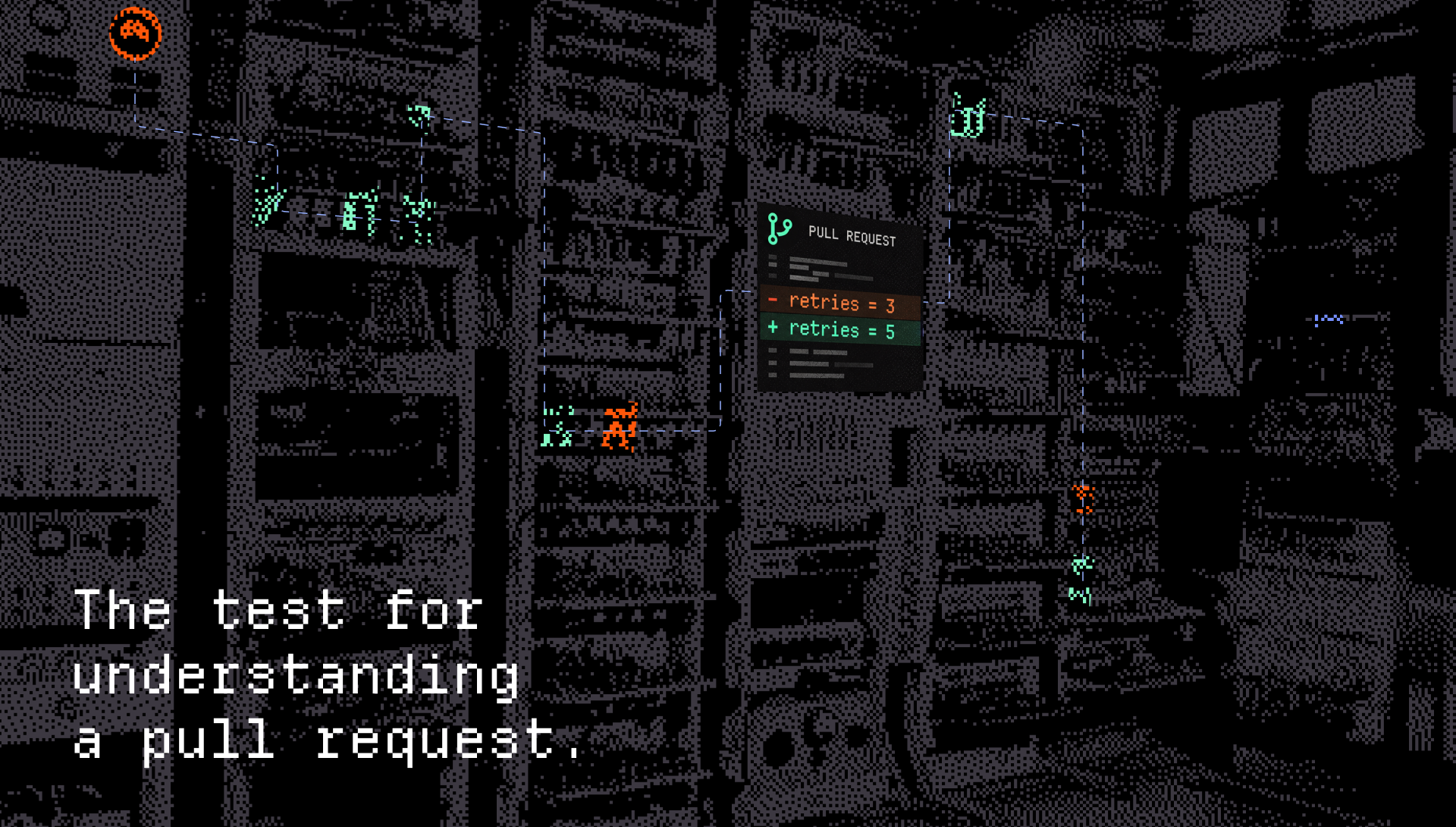
Agents can create a pull request in minutes. The PR can span many files, combining a new API, a database migration, and tests in a single change. Reviewing it means understanding how those pieces work together and what they affect elsewhere in the application.
Before anyone merges it, they need to answer one question: Do I understand what I’m about to merge?
That question is easy to wave away when the pull request has a description, a diff, and a summary at the top of the page. Those are useful starting points, but reviewers still need to confirm that the explanation matches the implementation and understand the consequences of merging the PR.
We built Change Stack to connect a pull request’s intent, behavior, and dependencies to the code itself, so reviewers can understand what the change means and verify the explanation.
What is this pull request trying to do? #
Intent is one of the first things reviewers need and often the last thing the diff makes clear. The author may have it in their head or a ticket may describe a part of it, but the pull request description may be stale by the time the implementation settles.
A reviewer should be able to state the purpose of the change in terms of its consequences. For example, it might do one of the following:
- This adds a new approval path
- This moves ownership of a record
- This changes when a customer receives a notification
Change Stack starts with a PR overview page and then breaks the work into layers that follow the change's own logic. The reviewer gets a summary of the PR, with links to code findings and actions to take.
What the diff cannot explain #
In a typical file-based review, reviewers are often handed a file list sorted in alphabetical order and asked to reconstruct the change. A configuration update may alter a service’s behavior, while a change to a shared function may affect other parts of the application that use it. Those changes are individually readable while the context behind them remains obscure.
A reviewer may turn to the PR summary to understand how those changes fit together. The summary can explain the intended behavior and point out dependencies. To confirm that explanation, they need to find the code behind it.
Change Stack supports that step by providing a semantic diff view of the pull request. It also groups related changes into layers and places explanations beside the code they describe. The reviewer can then check whether the implementation supports what the pull request says it does.
Which behavior changes #
Once the purpose is clear, the reviewer needs to examine how the implementation changes the application’s behavior. A new endpoint may appear in one file and be called from five others. The reviewer needs to understand what happens when those parts interact and whether the tests cover that behavior.
In CodeRabbit Change Stack, changes are grouped into layers so the reviewer can examine related changes together. For example, a layer can bring an endpoint’s implementation and its tests into the same step of the review, with an explanation linked to the relevant code. A diagram can help show how the request moves through the application.
What depends on my PR #
Once the reviewer understands how the changed pieces work together, they need to check what else depends on them. A change to a subscription’s status, for example, could affect the background process that renews it even if that process is untouched by the PR. The reviewer needs to check whether it will still handle the new status correctly.
The security blast radius part of Change Stack surfaces those relationships beside the layer they belong to, helping reviewers follow dependencies as they read. That context can reveal downstream behavior or assumptions that need further checking before merge.
Show me the code #
Review tools often offer a polished explanation of a change. The natural next question is, where is that happening?
If a service retries a failed request, the reviewer should be able to open the retry path. Likewise, if an explanation says a change is limited to an internal API, the reviewer should be able to inspect the code that uses that API and check that boundary. Change Stack links its explanations and findings to precise ranges in the diff so reviewers can check each statement against the implementation while keeping the surrounding context in view.
What this merge commits us to #
The merge decision is the final piece of the test. At this stage, the team should understand the change well enough to own the behavior, the dependencies, and the risk that remains after the code reaches production.
That understanding needs to apply to the version being merged. If someone pushes a new commit after a review, the reviewer needs to know which parts of the explanation still describe the current code. Change Stack preserves a snapshot of the reviewed commit and shows when the PR has changed since that review.
The snapshot represents a completed review of a particular commit. Actions on the PR apply to its live state. Making the distinction visible helps reviewers recognize when the code has moved beyond the version they examined.
A test for understanding #
Before approving a pull request, a reviewer should be able to answer five questions.
- What is this change intended to accomplish?
- How will the application behave differently?
- What does the changed code depend on, and what depends on it?
- Where in the code can I check the explanation?
- What behavior, dependencies, and remaining risks are we accepting by merging this version?
Change Stack brings explanations, dependencies, and relevant code together so reviewers can answer these questions and decide whether the change is ready to merge.