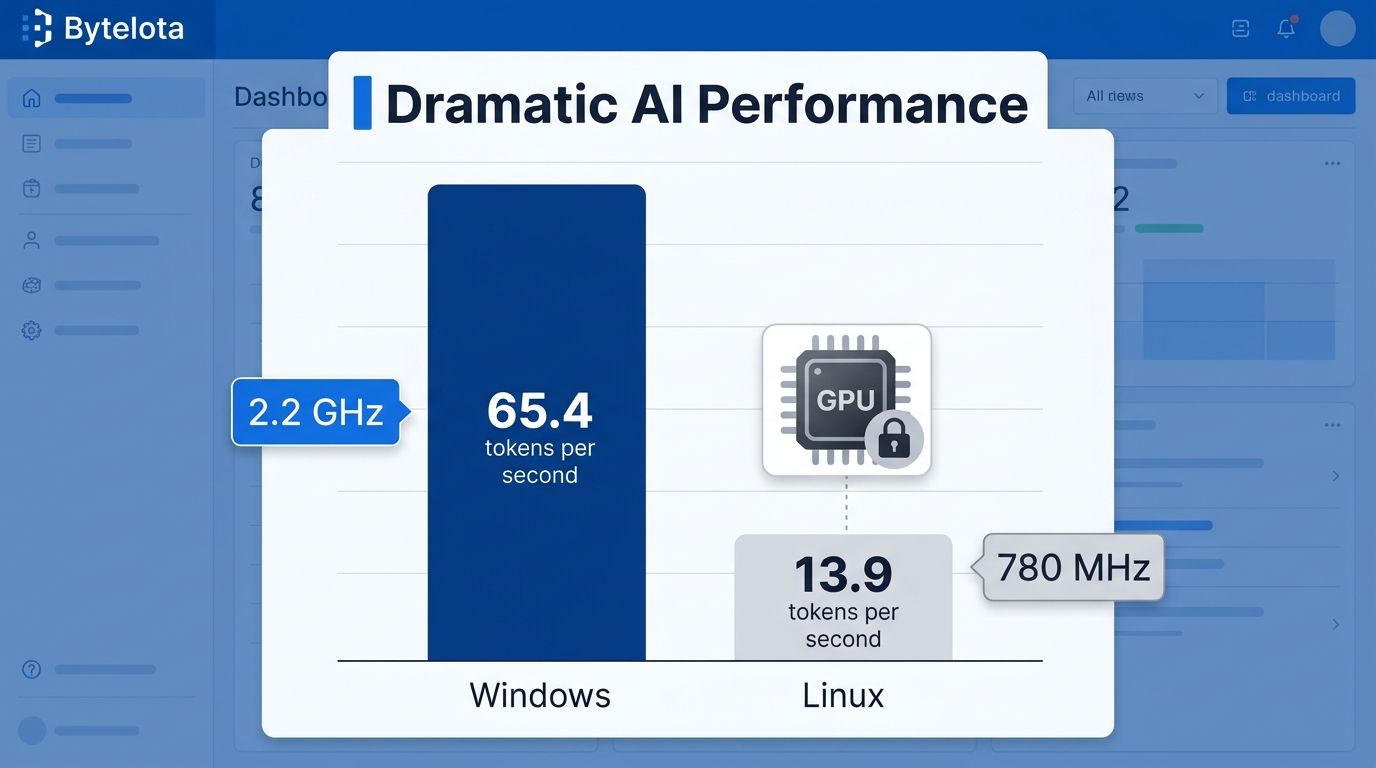
Nvidia’s RTX Spark laptop is throttling AI inference to 13.9 tokens per second on Linux when plugged into wall power — against 65.4 tokens per second on Windows. The same hardware. The same model. A 79% performance drop. The story broke this morning (November 4, 2026) on Hacker News with 368 points and 185 comments, and the root cause isn’t a driver bug waiting for a patch. It’s an encrypted Windows-only firmware component that Nvidia has explicitly declined to open up to developers.
RTX Spark Linux Performance: The Numbers Are Worse Than You’d Expect #
MindStudio ran a head-to-head benchmark on GPT-OSS-120B across Windows, WSL, and native Linux on the RTX Spark laptop. Windows hit 65.4 tokens per second. WSL hit 65.1. Native Linux on wall power: 13.9. The same test run takes 8 minutes on Windows and 37 minutes on Linux. If you bought a $1,800 AI development laptop for local inference on Linux, you’re running at 21% capacity every time it’s plugged in.
The GPU clock tells the full story. Under Windows, the Blackwell GPU boosts to 2.0–2.2 GHz under AI workload. On Linux plugged in, clocks lock at 780–790 MHz. That’s not a gradual slowdown — it’s a hard floor. Switch to battery, though, and Linux clocks recover to ~1,800 MHz, with throughput climbing to 61 tokens per second. The wall-power behavior is firmware-enforced, not a hardware ceiling. The hardware is fully capable. The firmware is what’s throttling it.
It’s Not a Bug — It’s the Architecture #
The bottleneck is a Windows-only firmware component called the Nvidia Platform Controllers and Framework (NPCF). This component manages the shared CPU-GPU power budget on the Blackwell platform using an encrypted power table. Only the Windows driver can decrypt and act on this table. Linux has no equivalent — when plugged in, the system defaults to a conservative 20W power floor, which is why GPU clocks stay buried at 780 MHz.
Developer Christopher Owen documented the specific failure mode on the Nvidia Developer Forum: on an affected unit the EC publishes 0W power limits and the SoC falls back to 20W. He requested Jetson-style owner keys so the community could fix the firmware directly. Nvidia’s response: “We will not be providing keys for installing custom FW.” The fix requires Nvidia to port NPCF logic into its Linux driver. No timeline has been given.
DRM for AI Hardware, or Just Linux-Last? #
The HN discussion is running two parallel debates. The first view: encrypted power tables, encrypted debug output (nvidia-smi –debug returns encrypted blobs), and declined firmware keys form a pattern. This isn’t Linux-last prioritization — it’s deliberate hardware segmentation to keep local AI inference slow on Linux, pushing developers toward Windows or Nvidia’s cloud infrastructure. The second view: this is Nvidia’s standard laptop-first-on-Windows approach. The desktop DGX Spark ships with DGX OS and runs Linux at 61 tokens per second without issues. Nvidia historically takes 2 years to port platform-specific power management features to Linux — Dynamic Boost followed this same trajectory.
Both readings carry weight. The HN thread is 185 comments and counting. What’s harder to dismiss: Nvidia shipped a device called a “personal AI supercomputer,” marketed directly at ML developers, and that device runs at a fifth of its capability on the developer OS of choice. Whether the cause is negligence or intent, the outcome is the same.
What You Can Do Right Now #
Three options exist today. The battery workaround gets Linux to 61 tokens per second — near Windows parity — but you can’t run sustained 70B+ model inference on battery power for long. The WSL approach gives full performance: WSL uses the Windows Nvidia driver stack, so GPU clocks reach 2.2 GHz and throughput matches Windows exactly. However, WSL defaults to 14GB of system memory — catastrophically inadequate for a device with 128GB unified memory. Add this to %USERPROFILE%\.wslconfig before you start:
[wsl2]
memory=96GB
processors=16
Without that config, vLLM will OOM on anything larger than a 7B model. The third option: skip the laptop entirely. The desktop DGX Spark ships with Nvidia’s Linux-based DGX OS and delivers 61 tokens per second natively — no WSL, no battery tricks required. If you want Linux-native local inference on Blackwell hardware today, the desktop is the right device.
Key Takeaways #
- The RTX Spark laptop delivers 13.9 tokens/sec on Linux (plugged in) versus 65.4 on Windows — a 79% performance gap caused by an encrypted Windows-only firmware component (NPCF)
- The battery workaround recovers most performance (61 t/s), confirming this is firmware-enforced rather than a hardware limitation
- Nvidia declined community requests for firmware access; a Linux driver fix requires Nvidia to port the NPCF logic — no timeline given
- WSL is the most reliable workaround but requires manually setting memory limits in
.wslconfig; default WSL allocation (14GB) is completely inadequate for this hardware - The desktop DGX Spark runs Linux natively at full performance — if Linux-first development is non-negotiable, that’s the hardware to buy