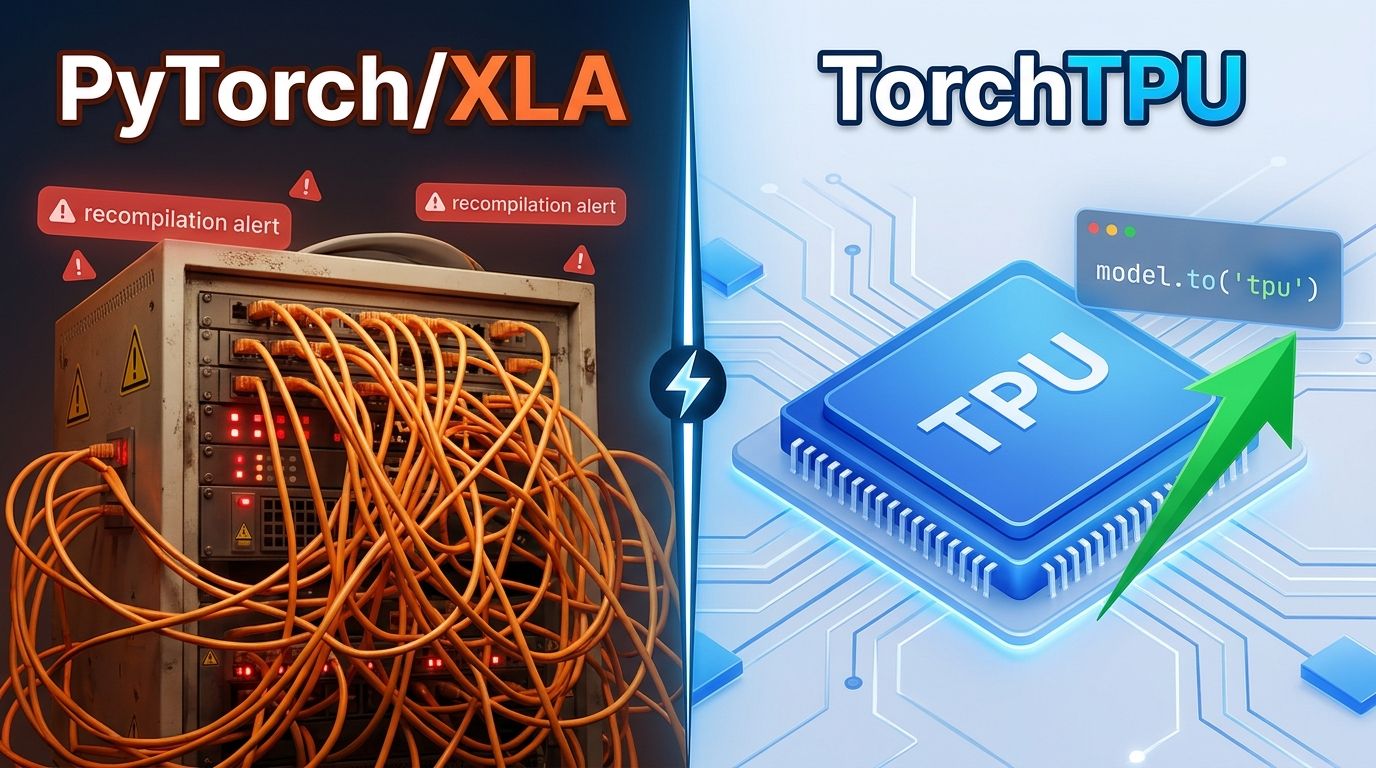
PyTorch/XLA has 11 days left. Google open-sourced TorchTPU on October 20, and the PyTorch/XLA repo officially goes read-only on November 15 — no new issues, no new pull requests. If your team runs PyTorch on Google TPUs and you have not looked at TorchTPU yet, now is the time. The migration story is simpler than anything XLA ever offered.
What XLA Got Wrong #
PyTorch/XLA launched in 2020 as a bridge between PyTorch and Google’s XLA compiler. The bridge worked, but it demanded a toll: intrusive rewrites to annotate compilable regions, explicit xm.mark_step() sync calls scattered throughout your code, and a lazy tensor model that broke PyTorch’s core eager-execution semantics. Shape changes triggered full graph recompilations. Debugging meant learning a separate XLA toolchain. It was the kind of infrastructure that worked well enough to be tolerated but never loved.
TorchTPU Changes the Model #
TorchTPU is a native PyTorch backend — not a wrapper, not a bridge. It uses PyTorch’s PrivateUse1 interface, which means standard tensor types with no special subclasses. The practical result: most GPU workloads migrate to TPU with a single line change, according to the official PyTorch announcement.
import torch_xla.core.xla_model as xm
device = xm.xla_device()
model = MyModel().to(device)
xm.mark_step()  # required explicit sync everywhere

import torch
device = torch.device("tpu")
model = MyModel().to(device)
For distributed workloads, swap the nccl backend for tpu_dist. DDP, FSDP2, and DTensor are all supported. Multi-slice training via DCN MegaScale transport is also available for large-scale jobs.
Three Execution Modes — Use DeferAndFuse in Production #
TorchTPU ships with three execution modes that let you control the performance-versus-debuggability tradeoff:
- Strict — default mode; dispatches operators asynchronously with standard PyTorch semantics. Good starting point.
- Debug — adds runtime assertions and diagnostics. Use this during migration to surface errors early.
- DeferAndFuse — the production mode. Fuses multiple ATen ops into larger chunks before dispatch, reducing round-trips to TPU high-bandwidth memory. Google reports it runs 50%+ faster than Strict while cutting peak HBM usage.
DeferAndFuse is TorchTPU’s answer to CUDA kernel fusion. Instead of paying the overhead of dispatching each operation individually, it batches them. For large models, the memory reduction matters as much as the speed improvement.
Who Is Running It in Production #
TorchTPU is not vaporware. Meta’s SGLang-TorchTPU plugin handles live inference workloads now — not a pilot. Meta signed a multibillion-dollar deal to rent Google TPUs in February 2026, and TorchTPU is the technical foundation that makes that viable without rewriting models from scratch. Google ran Qwen3 235B on 8,192 TPU v7x chips at 28% model FLOPs utilization — a credible number at that scale.
What It Does Not Do Yet #
To be clear: torch.Stream is not yet implemented. That matters if you are combining eager FSDP2 with layer-wise torch.compile — you will hit limitations. Distributed initialization also requires two TPU-specific environment variables that standard torchrun does not set. Neither is a blocker for most workloads, but there is no stated SLA, and the API can still change.
The November 15 Deadline #
Mark it: November 15, 2026. After that date, the pytorch/xla GitHub repo is read-only. Existing XLA code keeps running — Google is not pulling the library from PyPI — but there will be no security patches, no bug fixes, and no community support through GitHub. Teams that delay migration are accepting technical debt with a known expiration date.
The good news: for the common case, the migration really is a one-line change. HuggingFace has published a TPU migration guide for teams running Transformers workloads. Start there, check your distributed init setup, and move before the deadline.