This week the backlash against data centers, especially hyperscalers to power frontier AI models, intensified.
Things are so bad that the right-leaning Wall Street Journal and left-leaning * New York Times* both are devoting front page coverage to the issue. And the backlash against data is
bipartisan. People on both the right and the left are organizing to voice their opposition to data centers in their communities.
WSJ reads:
NYT reads:
Other media recognize the stakes with the midterm elections:
pres. Trump tries to rally support for data centers
Things are so bad President Trump is trying to shore up support for them.
The National Republican Senatorial Committee even reportedly sent an urgent memo flagging how the backlash against data centers can torpedo the Republicans’ chances in the midterms. The NRSC points to Sherrod Brown’s campaign making his opposition to building data centers in Ohio the “centerpiece” of his messaging. And, as NRSC, the messaging is working.
the relationship between data centers and Democracy
We started tracking the lawsuits filed over the building of data centers. By our unofficial count, there are 52 lawsuits in the United States.
This doesn’t even include all the local and state moratoria on the building of new data centers. Interconnected Capital’s tracker places that number at 211 active moratoria. More will follow.
**This data center controversy is a sign of democracy in action. **The opposition to data centers started at the local level and has proliferated around the country. (Granted, China, Russia, and other foreign states may be happily fanning the flames on social media, as the NYT reported.) Now, it is even a hot button issue that may affect the midterm elections in Congress, state, and local levels.
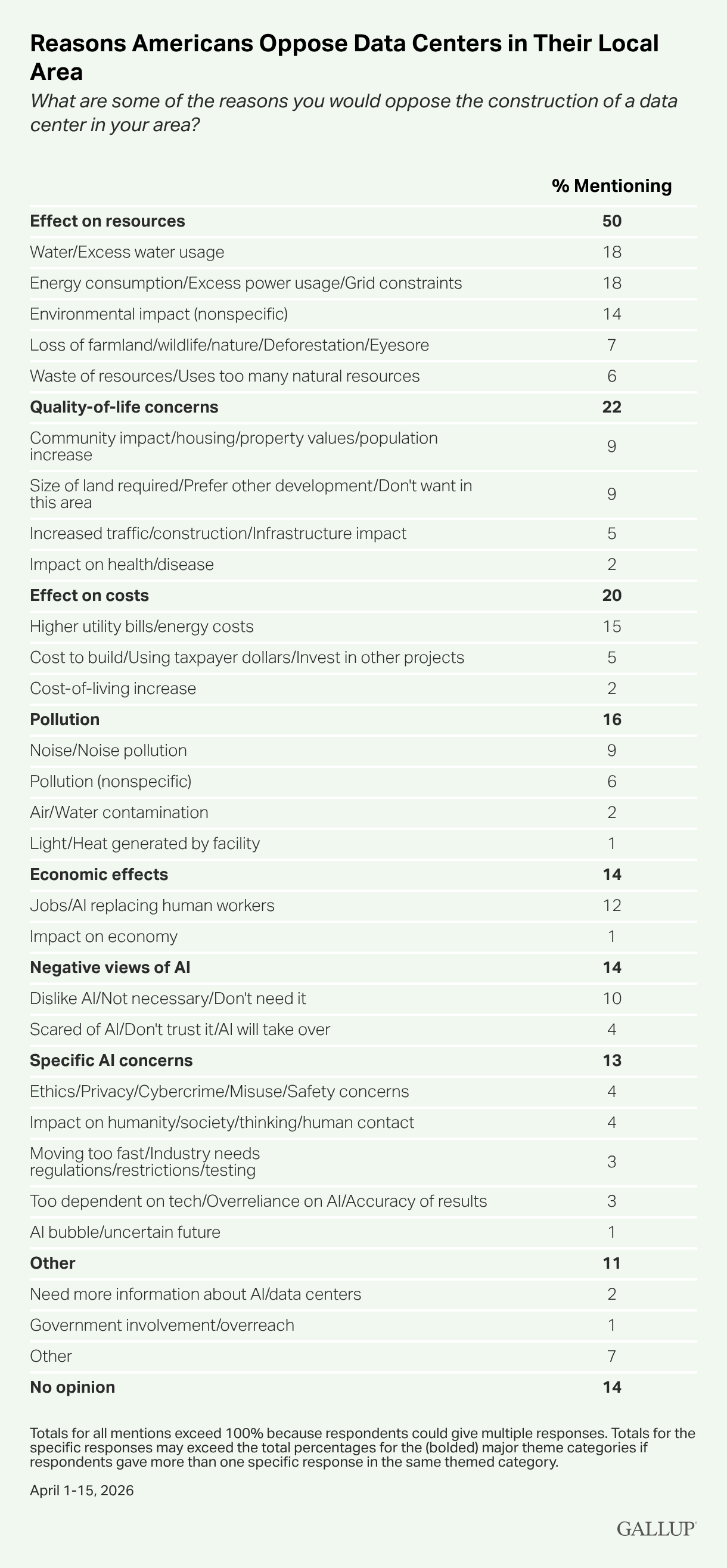
The reasons for the opposition are numerous, according to a Gallup poll in May. It turns out that opposition to AI is a tad lower down the list of reasons. Effect on resources, quality of life concerns, effect on costs and electricity, and pollution are foremost in Americans’ minds. These reasons are not surprising. The lawsuits against data centers are being filed by people from the community whose lives have been affected by the allegedly constant humming noise and data centers’ effect on the community’s resources and energy prices.
Everyone would be upset if they can’t sleep due to noise that becomes a nuisance.
This controversy has forced AI companies to address people’s concerns and to explain why the communities should support the building of new data centers. For example, OpenAI hosted an open house at the Effingham County College & Career Academy, as reported by the Wall Street Journal.
It’s also forced executives at AI companies to “increasingly talk[] about AI in ways that emphasize potential broad-based economic opportunity rather than job displacement or other scary scenarios.”
In other words, AI companies are being asked to explain how the companies will invest in the communities and share in the wealth the companies may accrue.
All the talk about the US government establishing an AI Sovereign Wealth Fund may not be as far fetched as it first may seem. The data center controversy has raised a foundational question of the responsibility of AI companies to the communities the data centers affect, as well as the role that AI companies envision for local, state, and national economies. Who benefits from data centers? How?
Big Tech can no longer hide behind their faceless online networks. They will have to account to the American people.