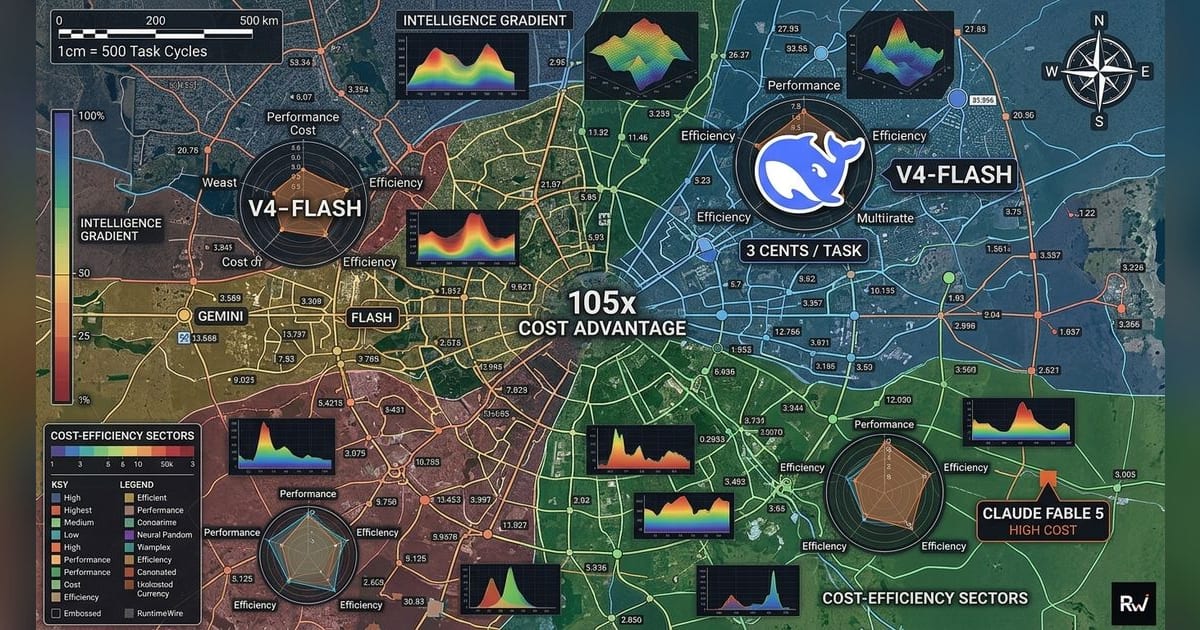
Liang Wenfeng's DeepSeek released V4-Flash on July 31st with the lowest average cost per task among the well-known AI models tested by Artificial Analysis, according to benchmark results reported by Reuters on August 3rd. The research firm calculated an average cost of $0.03 per test, compared with $0.86 for Moonshot AI's Kimi K3, $1.86 for OpenAI's GPT-5.6 Sol and $3.15 for Anthropic's Claude Fable 5.
The release extends a strategy Liang developed before DeepSeek existed. He studied information and communication engineering at Zhejiang University, then applied machine learning to quantitative investing and co-founded the High-Flyer hedge fund. In a 2025 Reuters profile, Liang argued that Chinese AI developers needed to pursue original research rather than remain followers of American labs. DeepSeek has since used aggressive API pricing and open model releases to turn that research thesis into a distribution strategy.
V4-Flash is the clearest expression of that strategy so far. The model trails the benchmark leaders on raw intelligence, but gives developers a competitive reasoning model at a price that can materially change the economics of products making thousands or millions of model calls.
The benchmark is a cost story
Artificial Analysis gave V4-Flash a score of 50 on its Intelligence Index, which combines nine evaluations covering coding, reasoning and workplace-style tasks. Reuters reported that the score matched Google's Gemini 3.6 Flash, trailed Moonshot's Kimi K3 by seven points and sat at least nine points behind the leading OpenAI and Anthropic models in the comparison.
That performance gap establishes the trade DeepSeek is offering. V4-Flash is aimed at workloads where a strong answer at a low recurring cost creates greater value than the highest available benchmark score.
DeepSeek lists V4-Flash at $0.14 per million uncached input tokens and $0.28 per million output tokens. Cached inputs cost $0.0028 per million tokens. The model supports a 1 million-token context window, thinking and non-thinking modes, tool calls, JSON output and up to 384,000 output tokens.
Artificial Analysis' cost-per-task calculation matters because token prices alone can mislead buyers. Reasoning models may generate long internal traces or take additional steps to finish a job. Artificial Analysis includes the tokens consumed while completing each evaluation, producing a closer approximation of what a developer pays for a finished task under the benchmark conditions.
The resulting spread is substantial. Claude Fable 5's $3.15 average test cost was roughly 105 times V4-Flash's $0.03. Kimi K3 delivered a higher intelligence score, though its average task cost was almost 29 times higher.
These figures remain benchmark measurements. Prompt length, cache behavior, tool execution and the number of retries can move production costs sharply.
Liang's cost discipline reaches AI agents
DeepSeek introduced the V4 family on April 24th. Its official release documentation describes V4-Flash as a mixture-of-experts model with 284 billion total parameters and 13 billion active parameters. Activating a smaller portion of the model for each token is central to DeepSeek's effort to provide strong reasoning without paying the inference cost associated with running every parameter for every request.
The July 31st release sharpened V4-Flash for agent workloads. DeepSeek says the V4-Flash public beta significantly enhanced agent capabilities while V4-Pro was unchanged. That focus helps explain why the cost benchmark carries more weight than a conventional chatbot price comparison.
An agent can turn one customer request into a chain of model calls: planning the job, searching files, invoking tools, checking intermediate work and repairing errors. Each step consumes tokens. Small differences in unit cost compound quickly, especially for coding products and enterprise automation services running continuously in the background.
DeepSeek is giving those developers another option between premium frontier models and smaller systems that may need more retries. A product team can route its hardest requests to a top-scoring model while sending routine planning, extraction and tool-calling work to V4-Flash. DeepSeek's support for OpenAI- and Anthropic-compatible API formats lowers the engineering work required to test that arrangement.
Liang's approach also puts pressure on model providers to justify premium prices with measurable improvements in completed work. A nine-point intelligence advantage can be valuable for difficult research or coding tasks. It becomes harder to defend when the workload consists of repetitive calls where the cheaper model succeeds reliably.
Price is DeepSeek's route back into the contest
DeepSeek's R1 release in January 2025 made Liang one of the most closely watched AI founders after the model challenged assumptions about how much capital and computing power a competitive reasoning system required. Since then, Moonshot AI, MiniMax, Z.AI, Alibaba and ByteDance have accelerated their own releases, giving Chinese developers a crowded domestic field alongside OpenAI, Anthropic, Google and Meta.
V4-Flash gives DeepSeek a direct response to that competition. Rather than claiming the top overall benchmark position, Liang is competing for the layer where model performance becomes a product cost. The buyers at that layer are developers running APIs, coding agents and automated workflows, where every additional reasoning step lands on a bill.
The strategy fits Liang's background. Quantitative investing rewards systems that produce an acceptable result repeatedly at lower marginal cost. V4-Flash applies similar discipline to inference: DeepSeek is offering enough capability to handle a broad set of tasks, then using price to make high-volume deployment easier to justify.
The remaining test will happen outside benchmark suites. Developers need to measure V4-Flash's reliability, tool-use behavior, cache performance and retry rate on their own workloads. A three-cent test becomes less compelling if an agent needs repeated attempts or human review. If the model completes production jobs consistently, Liang has created room for AI product companies to lower prices, widen margins or run workflows that were previously too expensive to automate.