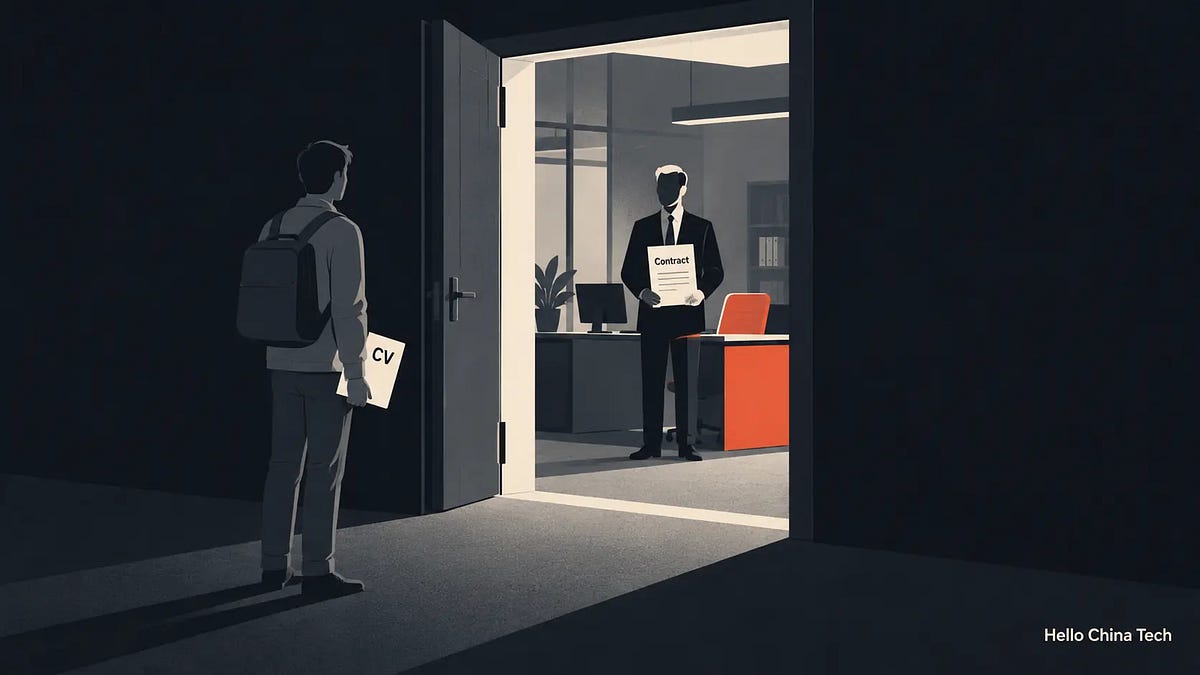
A Rulebook for the Worker Already Hired #
In January 2025, a technology company in Hangzhou offered one of its quality-control supervisors a lower post. His work was to check the answers a large language model gave to users. The new post would cut his monthly pay from Rmb 25,000 to Rmb 15,000. He refused, and the company ended his contract. Only in arbitration did it give the reason: AI could now do his job. An arbitration panel, a district court and the Hangzhou Intermediate People’s Court all found the dismissal unlawful. The company owed him more than Rmb 260,000 (about $38,000) in damages.
On October 24, China’s cabinet, the State Council, released a policy document on AI and employment through its General Office. It encourages companies to try an “unemployment buffer period,” to warn affected workers in advance during large AI rollouts, and to help them move to new roles. Read next to the court rulings, the document looks like a limit on AI layoffs. In May, months before the document appeared, a Wall Street Journal headline summed up Beijing’s stance as China wanting its companies to embrace AI without firing workers.
A narrower reading of the rules fits the evidence better. China has put a price and a procedure on replacing a worker who already holds a contract. That price sits in statute and in court rulings, and it applies when a named person is displaced. The new document is soft on both sides. Its protective items aim at workers affected by AI adoption. Its hiring items offer loans, training and job services, and set no hiring level for firms. Yet hiring studies in China and the US show weaker demand for junior workers. In the US data, that gap for young workers comes from fewer hires rather than more departures.
Pricing an AI dismissal from China's labor statute and court rulings, then checking the hiring data for where firms cut instead, is one example of how Hello China Tech reads China's tech sector: primary sources first, new analyses every week, across AI, chips, robotics, and EVs. Subscribe free to get the next one in your inbox.
This matters outside China. I expect other governments to meet a similar problem when they focus protection on dismissed workers. A dismissal gives a worker an employer and a decision to challenge. A smaller hiring plan dismisses no one. It creates no dismissal decision for an applicant to challenge.
Firms Already Cut Quietly #
Western coverage has noticed the behavior. Nine workers in tech, entertainment and advertising told Reuters in June that their employers were letting people go a few at a time. The aim, they said, was to avoid attracting government scrutiny. One contractor at a large internet company said her employer had started reducing graduate hiring. An engineer at the cloud unit of Alibaba, the Chinese e-commerce and cloud group, expected AI-linked cuts to come gradually, partly by not replacing people who leave.
Those accounts fit a market where a visible exit carries a price. Firms have a reason to cut where the price is lower or the record is thinner: contractors, people who leave and are not replaced, and graduates who are never hired.
Chinese labor law shapes that choice. Article 41 covers layoffs of 20 or more people, or of 10% or more of the workforce. The employer must explain the situation to the union or all staff 30 days in advance and hear their views. It must also report the layoff plan to the labor authority. Below that threshold, the reporting procedure does not apply. Article 43 still requires the employer to tell the union its reasons before any unilateral dismissal. As the paid section shows, a smaller round does not give the firm a cheaper legal ground. A decision to leave a post unfilled creates no dismissal claim at all.
The paid section works through the statutory arithmetic of what one AI dismissal costs a Chinese employer. It then reads the policy’s main items by the risk each one addresses, and sets both against hiring evidence from China and the US.