DeepSeek closed its first external funding round last week at $7.4 billion, pushing its valuation above $50 billion. Most coverage led with the number. The number is not the story.
The story is in the deal structure. Every commercial investor — including Tencent’s $1.4 billion check — put their money into a limited partnership managed by CEO Liang Wenfeng. LP investors received no equity in DeepSeek, no voting rights, and accepted a five-year lock-up. One investor got something different: China’s National Artificial Intelligence Industry Investment Fund received direct corporate equity, full voting rights, and no lock-up requirement. The Chinese state is now the only investor in DeepSeek with structural governance control.
What the Deal Actually Says #
The mechanics matter here. Tencent invested $1.4 billion and controls nothing. CATL put in $735 million and controls nothing. Liang Wenfeng invested approximately $3 billion of his own capital and runs the LP — so he retains practical day-to-day control, but the state fund can vote on corporate matters directly. It is the only entity that can.
The state fund in question is China’s National Artificial Intelligence Industry Investment Fund, a one-year-old vehicle with roughly $8.8 billion in total capital, seeded by the same government apparatus that built China’s multi-billion-dollar semiconductor fund. Its mandate is to direct capital into strategic technology sectors. DeepSeek just gave it a formal seat at the table.
For context: Alibaba and ByteDance both sat out this round entirely. That alone tells you something about how other major Chinese tech companies are reading the political dynamics here.
What This Means If You’re Running DeepSeek in Production #
There are two distinct developer situations, and conflating them leads to bad decisions.
If your team is calling [DeepSeek’s public API](https://www.techtimes.com/articles/318483/20260616/deepseek-closes-74-billion-round-state-fund-gets-votes-other-investors-get-none.htm), your prompts are going to servers in China. That concern predates this funding round — but the governance announcement gives your security and procurement teams new documented grounds to flag it. Several US states (New York, Texas, Virginia) and multiple federal agencies already ban DeepSeek API access. The new round formalizes what was previously informal.

If your team is self-hosting DeepSeek weights via Ollama, vLLM, or similar, prompts never leave your infrastructure. The immediate data-privacy concern is different. The more relevant question is what happens to future model versions. The weights you downloaded last month were trained before this deal closed. The next major DeepSeek release — V5, a next-generation Coder model — will be trained under governance where the state fund holds a vote. You cannot audit that.
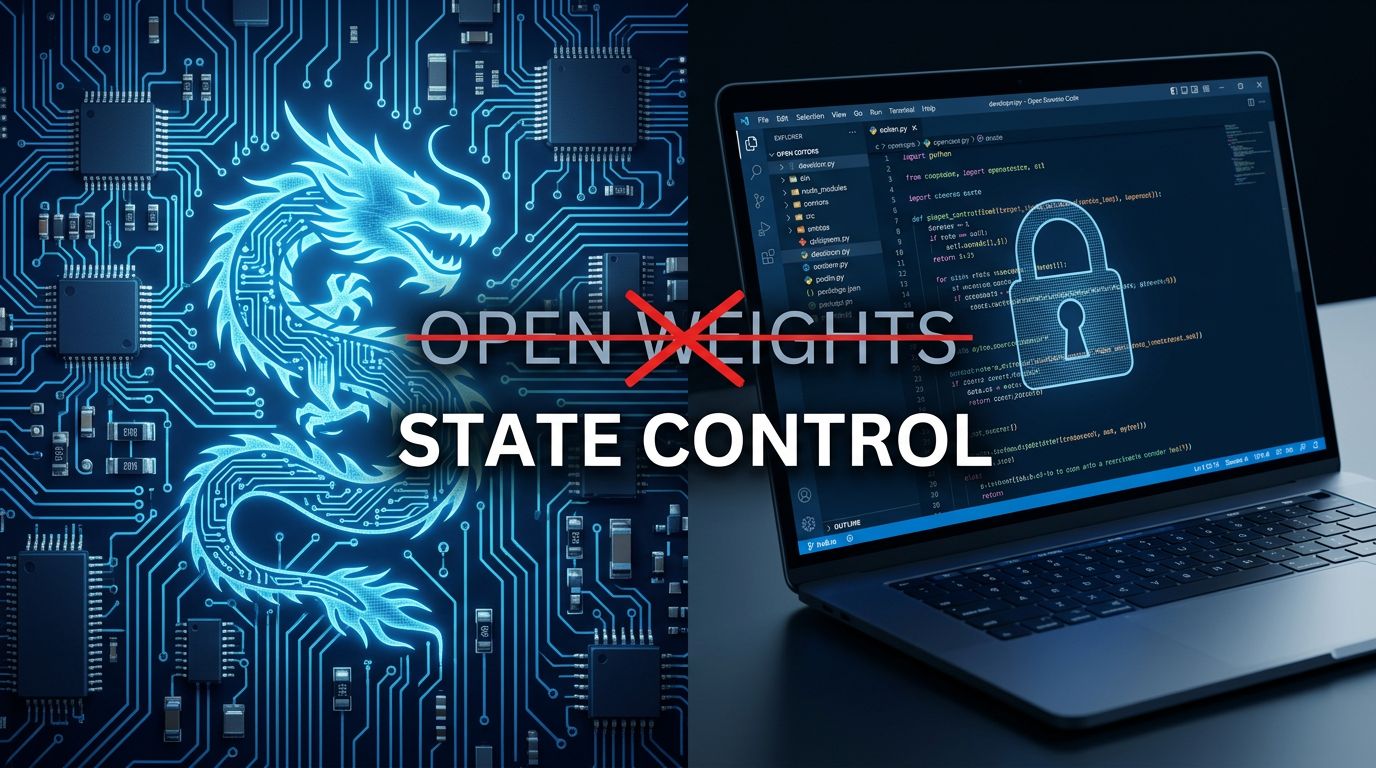
Open Weights Is Not Open Governance #
DeepSeek’s model weights carry MIT licenses. MIT says nothing about who controlled training, what data was included or excluded, or who can influence the direction of future models. The open-weights argument is about artifact access, not organizational accountability.
This is the same distinction the software supply chain community had to learn the hard way after Log4Shell. A permissive license does not mean the dependency is safe. Model provenance — who trained it, under what governance, with what incentives — is becoming an enterprise procurement question. DeepSeek just handed that question a concrete answer.
Practical Steps for Teams Using DeepSeek #
A few things worth doing this week:
API users: Route zero sensitive or regulated data through the DeepSeek API. If your workload requires it, evaluate switching to a self-hosted alternative or a non-Chinese-jurisdiction provider.Self-hosted users: Document that you are running specific released weight versions. Note the training cutoff and governance context at the time of release. Flag for review before upgrading to any post-round model version.Enterprise procurement: Add DeepSeek to your vendor AI governance review process. The state fund’s structural governance position is now a matter of public record and should be documented in your vendor risk assessments.
The Alternatives (With Honest Tradeoffs) #
DeepSeek V4-Pro is roughly 34 times cheaper than GPT-5.5 on output tokens. That cost gap is real. Switching has a price. Here are the most viable alternatives:
| Model | Org | License | Jurisdiction |
|---|---|---|---|
| Qwen 3.5 | Alibaba | Apache 2.0 | China (no state-control event) |
| Mistral Small 4 | Mistral AI | Apache 2.0 | EU — clean compliance story |
| Llama 4 Maverick | Meta | Llama license | US — permissive for internal use |
| Kimi K2.6 | Moonshot AI | Open | China — tops coding index |
The question each team needs to answer is whether the concern is Chinese origin broadly or formalized state-governance control specifically. DeepSeek is now the clearest example of the latter.
The Bigger Pattern #
AI model supply chains are following the same maturation curve as software dependency supply chains. A few years ago, nobody audited where their npm packages came from. Log4Shell changed that. The question “who controls the upstream?” is now standard in security reviews for code dependencies. It is not yet standard for model dependencies — but it will be, and this round accelerates that timeline.
DeepSeek’s models remain technically impressive. The cost advantage is genuine. But the funding round formalized something that was always structurally true: the organization that builds and trains these models is now explicitly governed in the interest of the Chinese state. Developers who treat that as a footnote are making a risk decision, not just a technical one.