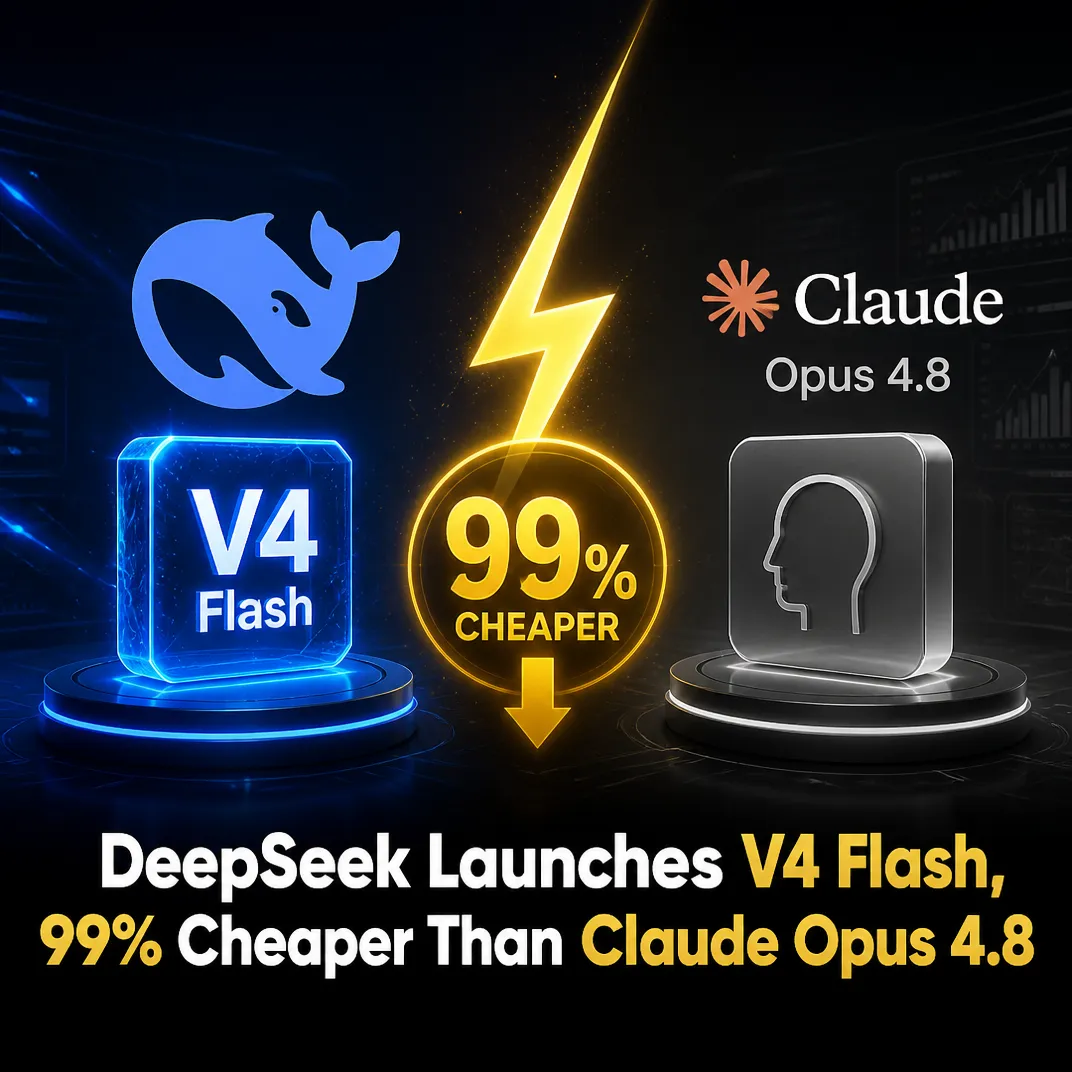
August 3, 2026, (Inside AI) — Chinese AI startup DeepSeek has launched V4 Flash, an open-weight code-generation model that dramatically undercuts competitors on price while delivering competitive performance. The model is available under the permissive MIT License, allowing free commercial use, modification, and local deployment, with weights hosted on platforms like Hugging Face.
DeepSeek charges approximately 28 cents for the same coding output that costs $25 on Anthropic’s Claude Opus 4.8, making V4 Flash roughly 99% cheaper. This pricing disrupts a market where intelligence costs are plummeting weekly, intensifying a full-scale price war across the AI industry.
V4 Flash uses a mixture-of-experts (MoE) architecture, activating 13 billion of its 284 billion total parameters for efficient reasoning across a one million-token context window. On Arena.ai, a crowdsourced leaderboard for front-end coding, V4 Flash outperformed Opus 4.8, delivering the best performance for its price among models in its class.
DeepSeek is known for triggering a market meltdown last January by releasing a cutting-edge model with far fewer resources than US rivals. The V4 Flash launch signals that AI is rapidly becoming a commodity, with the shrinking performance gap between top-tier models giving buyers more leverage to shop on price. This trend could reshape the industry, as many applications may no longer depend on a single model provider.
Nadella’s Commodity Thesis Gains Ground #
Microsoft CEO Satya Nadella has repeatedly argued that AI will emerge as a commodity. In a recent essay, he warned against relying on just a handful of AI model providers, urging companies to build and retain their own AI capabilities alongside human expertise rather than ceding organizational knowledge to a small number of AI models.
Nadella’s view aligns with the market shift driven by models like V4 Flash. However, falling prices may not spell doom for frontier labs. OpenAI CEO Sam Altman suggested on the ‘Invest Like the Best’ podcast that vastly increased usage could offset lower margins.
“We will have so much usage of our models that we do not need to be a gigantically high-margin business to be able to afford model training,” Sam Altman, CEO, OpenAI.
Last week, OpenAI slashed the price of GPT-5.6 Luna, its fastest and cheapest model for high-volume tasks, by over 80%. Anthropic, meanwhile, has maintained premium pricing for its top-tier Claude models, betting that developers will pay extra for safety and precision. This divergence highlights competing strategies: volume-driven accessibility versus value-driven differentiation.
Architecture Drives Efficiency #
V4 Flash’s MoE design is central to its cost advantage. By activating only a fraction of its total parameters per token, it achieves high throughput and low latency, making it suitable for real-time coding tasks. The open-weight nature under the MIT License also allows enterprises to fine-tune and deploy the model on their own infrastructure, avoiding recurring API fees.
Research on sparse expert models, such as the Switch Transformer paper, has shown that MoE architectures can scale efficiently without proportional increases in compute. DeepSeek’s implementation pushes this further, optimizing for both cost and performance on consumer-grade hardware.
Despite the hype, challenges remain. Open-weight models require significant technical expertise to deploy and secure, and they may lack the safety guardrails of managed APIs. Additionally, the long-term sustainability of ultra-low pricing is uncertain, as training costs for frontier models continue to rise. DeepSeek’s own DeepSeekMoE paper details their approach to scaling sparse models, but the economic viability hinges on massive adoption.
As the AI race between the US and China accelerates, V4 Flash exemplifies how open-weight models can democratize access while pressuring incumbents. The coming months will test whether premium safety and precision can command a durable premium in a market flooded with cheap, capable alternatives.