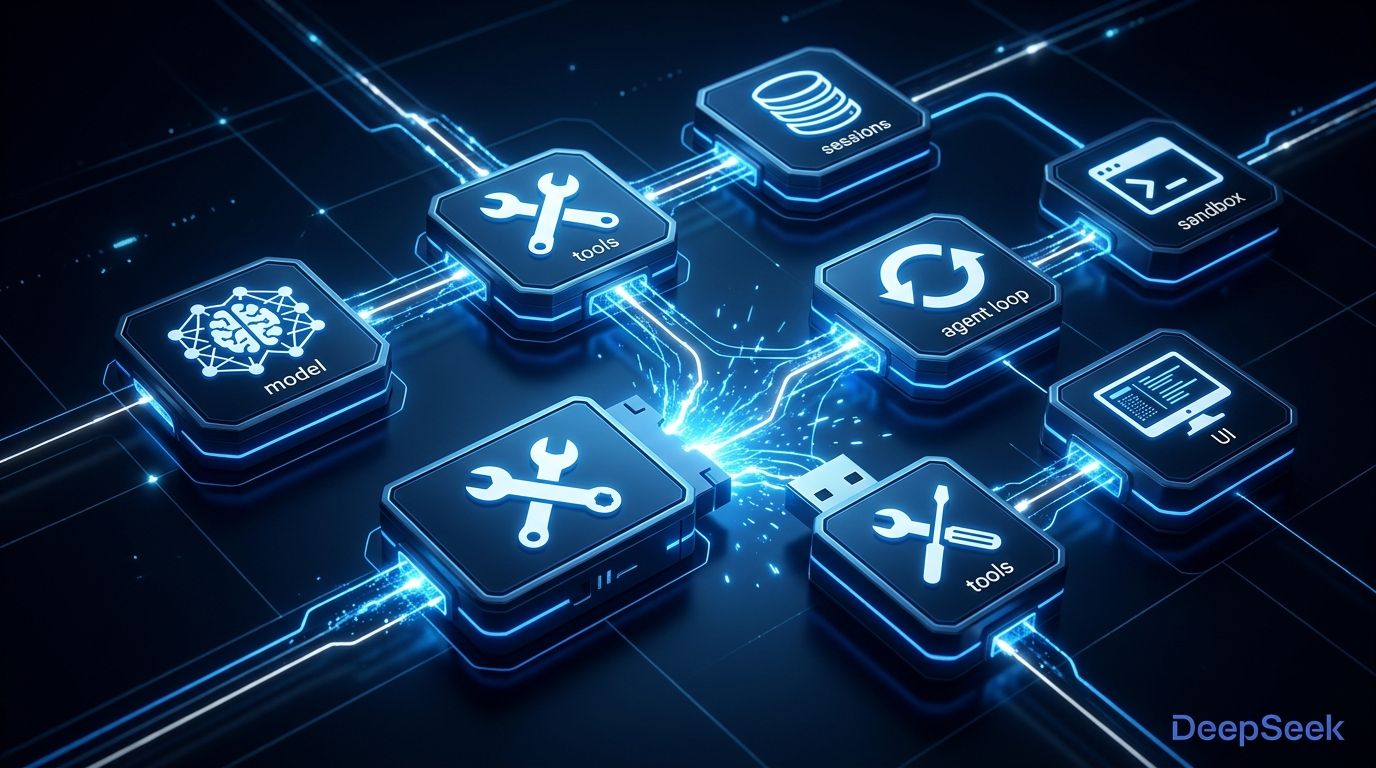
DeepSeek shipped an open-source agent runtime on August 13 and immediately broke GitHub’s all-time star-growth record — 100K stars in under 48 hours, now past 140K. DeepSeek Harness v0.1 is MIT-licensed, free to download and use, and built on a single organizing principle: every layer of an AI agent should be a swappable plugin. Models, tools, session state, sandbox, the agent control loop, even the web UI — all plugins, all replaceable from configuration without touching source. There is a catch: on the same week DeepSeek handed out the runtime for free, they raised V4-Pro API output pricing by 355%.
What “Everything Is a Plugin” Actually Means #
The phrase sounds like a marketing tagline, but in DeepSeek Harness it describes the literal architecture. The runtime is built on Cordis, an independent meta-framework by developer Shigma that has been the plugin kernel behind the Koishi chatbot framework since 2019. DeepSeek published an academic preprint alongside the launch formalizing the underlying theory: “A Programming Paradigm for Spatiotemporal Composability.”
Practically, it means three things developers care about:
Model adapter is a plugin. Swap DeepSeek V4-Pro for Claude Sonnet, Kimi K3, or any OpenAI-compatible endpoint in your config file. Zero source changes. The harness supports 75+ providers out of the box.The agent control loop is a plugin. The logic that decides when to call a tool, how to reason over the result, and when to stop — that “brain” is also replaceable. You can swap it for your own loop if you disagree with DeepSeek’s defaults.The web UI is a plugin. Even the interface ships as a Cordis plugin. Replace it, extend it, or strip it for headless deployments.
When a plugin unmounts, Cordis walks a LIFO stack of registered effects and reverses all of them. No side effects left behind, no state corruption. That property — temporal composability — is what makes the system safe to hot-swap at runtime.
The Four Run Modes #
DeepSeek Harness ships with four preset modes, each a different plugin set:
Standard— Full default toolset. Where you will spend most of your time on general coding tasks.** Code (PTC)**— Programmatic Tool Calling. The model writes code to orchestrate multiple tool calls rather than calling them directly. Useful for complex, multi-step pipelines where you want the model to reason about sequencing before executing.Minimal— Shell and file editor only. The right choice when you want to benchmark a model in a controlled, low-noise environment.Creator— Inherits Standard and adds live runtime inspection, in-memory plugin experiments, and preset-authoring guidance. This is where you build your own modes. Keep it out of production.
How to Install #
The harness installs with one command. You need Node.js and an API key for at least one supported provider.
npx @deepseek-ai/dsh web
That starts the Web UI at 127.0.0.1:3080
. Credentials go in ~/.dsh/.credentials.yaml
; model preferences in ~/.dsh/settings.yaml
. If you want the full source rather than the npx shortcut, clone from GitHub.
The Price Hike: Free Runtime, Expensive Inference #
Here is the part that warrants a second read. DeepSeek moved V4 API billing to a peak/off-peak structure effective August 16, three days after the Harness launch. V4-Pro output tokens went from $0.87 per million to $3.96 at peak and $1.98 off-peak. V4-Flash output jumped from $0.28 to $1.32 at peak.
Peak hours are 01:00–04:00 UTC and 06:00–10:00 UTC, which aligns with Asia business hours. US developers working standard hours mostly land in the off-peak window, but high-volume agentic workloads do not respect business hours.
DeepSeek V4-Pro is still materially cheaper than Anthropic’s models at peak rates — Claude Opus output runs $25 per million. But the relevant lesson is not the absolute price: it is that single-provider cost assumptions break without warning. If you built a cost model on DeepSeek’s $0.87 rate and did not model for volatility, that model is now wrong. The harness’s model-agnostic architecture is, conveniently, the exact mechanism that lets you route away from DeepSeek inference if the economics shift.
Versus Claude Code: What You Are Actually Comparing #
Most “DeepSeek Harness vs Claude Code” comparisons miss a structural point: these tools do not occupy the same abstraction layer. Claude Code is a finished, opinionated coding product tied to Anthropic’s model stack. DeepSeek Harness is a runtime you assemble agents on top of. Comparing them is a bit like comparing a car to an engine.
That said, if your goal is autonomous coding assistance right now, Claude Code is the better-tested choice. DeepSeek Harness v0.1 is a developer preview — it will have rough edges, missing documentation, and breaking changes before it stabilizes. The community reaction was unusually positive about the architecture, but architecture alone does not ship features.
The comparison that actually matters is the architectural bet: does the future of AI agents belong to closed, polished products with opinionated defaults, or to open, composable runtimes where every layer is replaceable? DeepSeek is placing a clear bet on the latter. And notably, DeepSeek Harness can call Claude Code as a sub-agent — you do not have to choose.
The Bigger Picture #
OpenCode crossed 160K GitHub stars earlier this year on a model-agnostic, open architecture. DeepSeek Harness just set a new record on a plugin-first, open architecture. The pattern is not coincidence. The developer community is consistently rewarding tools that decouple the agent runtime from the model provider — the same decoupling that protects you when any single provider decides to quadruple prices on a Tuesday.