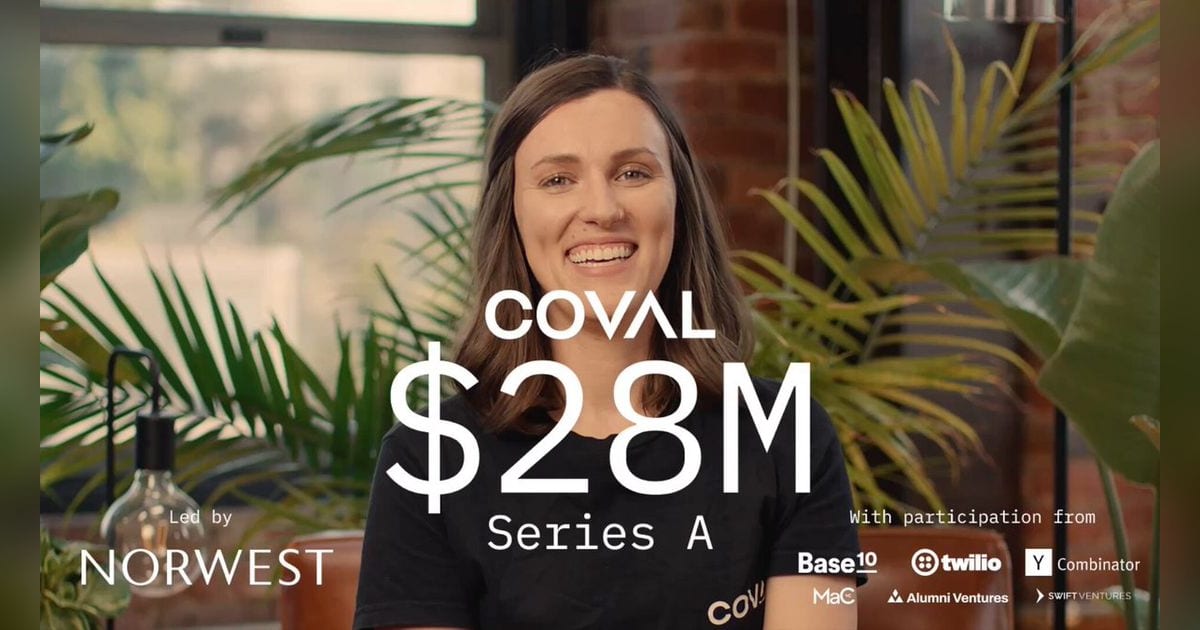
Brooke Hopkins (@bnicholehopkins) raised a $28 million Series A for Coval, the San Francisco voice AI evaluation startup she founded after building evaluation infrastructure at Waymo, she said Wednesday in a post on X.
The round was led by Norwest, with participation from Base10 Partners, Twilio Ventures, Y Combinator and others. Coval said in a press release that the financing brings total capital raised to $31 million since Coval's 2024 launch. Coval did not disclose a valuation.
The financing is a bet that the bottleneck in voice AI is moving from model capability to operational proof. Companies can now assemble a phone agent from speech-to-text, LLM reasoning, text-to-speech, telephony and workflow integrations. The harder question is whether that system behaves consistently when customers interrupt it, speak with accents, provide conflicting information, fail authentication or ask for something outside policy. Coval is selling the answer as infrastructure, not as a better bot.
Hopkins' founder-market fit is the core of the round. Before Coval, she worked on evaluation systems at Waymo, where simulation was not a demo feature but a release gate. In a 2024 MLOps Community talk, Hopkins said she had led evaluation infrastructure at Waymo, including developer tools for building datasets and launching simulations on distributed compute. She framed conversational agents as a similar class of autonomous system: software that perceives an environment, takes actions and must be tested across a wide range of possible inputs before users encounter failures.
That thesis has been consistent since Coval's seed round. In January 2025, TechCrunch reported that Coval had raised a $3.3 million seed led by MaC Venture Capital, with participation from Y Combinator and General Catalyst. Hopkins told TechCrunch then that when she left Waymo, she saw AI teams trying to rebuild testing practices from first principles even though self-driving companies had spent a decade developing simulation-heavy approaches to autonomous systems. Seventeen months later, the Series A turns that argument into a go-to-market race.
Coval's product covers pre-deployment simulation, production monitoring and human review. Its homepage says the platform lets teams benchmark agents, stress-test thousands of realistic scenarios, score production calls and route failed samples into human review. Its documentation shows support for text-based and voice-based simulations, recurring evaluations, tag-based filtering, human-in-the-loop review, deterministic scripted turns and audio uploads. That matters because voice agents are not just chatbots with audio. Latency, interruptions, transcription errors, tone, turn-taking and compliance failures all become product behavior.
Coval says it runs tens of millions of evaluations and will use the new money to expand sales and solutions engineering, as well as deepen simulation, integrations, human review and monitoring features. The company also claims customers use Coval to reduce manual QA by up to 30x and accelerate voice agent deployment by up to 10x. Those metrics are company-provided, but they point to the operating pain Coval is exploiting: manual call review does not scale when each prompt change can alter behavior across thousands of possible conversation paths.
Coval's customer claims are also doing work in this announcement. The company says it is trusted by more than 60 organizations, including Zoom and Deepgram, and its site lists logos including Perplexity, ServiceNow, Chime, StubHub, Zoom, Hippocratic AI, Toast, GEICO and Upstart. The named customers put Coval close to the part of the market where voice AI has to survive real contact-center complexity rather than staged demos.
Norwest partner Scott Beechuk, quoted in Coval's release, tied the investment directly to Hopkins' Waymo background, saying she is positioned to define how companies deploy and scale voice agents reliably. Twilio's participation is strategically legible for the same reason. Twilio sells communications infrastructure; if more companies replace phone trees and support scripts with AI agents, evaluation and observability become adjacent infrastructure, not optional tooling.
The market Coval is entering is crowded from both sides. General LLM evaluation tools are stretching toward agents, while voice AI startups are adding monitoring and QA around their own stacks. Coval's claim is narrower and sharper: voice agents should be treated like autonomous systems, where simulation, regression detection and production monitoring are part of the deployment pipeline. That positioning gives Hopkins a credible wedge, but it also raises the standard Coval has to meet. Enterprises buying reliability infrastructure will expect Coval to prove not only that an agent sounds good in a demo, but that it behaves correctly when the call goes off-script.
Coval's Y Combinator jobs page shows the company hiring across engineering, customer success, sales and finance, with nine listed roles and a San Francisco team profile that says Coval is closing six-figure enterprise deals. That page is recruiting copy, not audited financial disclosure. But it fits the timing of the Series A: Coval is moving from founder-led technical credibility into enterprise distribution, where the buyer is not just the engineer building the agent but the operations, QA, product and compliance teams responsible when that agent fails.
The unanswered question is valuation. Coval has disclosed the size of the round, the lead investor and total capital raised, but not the price Norwest paid for the bet. What is clear is the company has moved quickly from a $3.3 million seed in January 2025 to a $28 million Series A in June 2026, on the back of a thesis that voice AI's next constraint is not whether agents can talk. It is whether companies can prove they are safe to put on the phone.