13 min read
When an AI agent doesn’t know your organization’s context, it guesses. It makes uninformed decisions and performs actions that may hurt your organization.
That gap helps explain why only 34% of agentic AI projects reach production, according to an MIT Technology Review Insights survey of 300 senior executives. The production leaders who get 61% of their AI projects live include stronger knowledge capabilities.
Contextual organizational knowledge is what an agent needs to know about how your organization works. It covers what your data means, how the business operates, which data to trust and where it lives, and what’s been learned from earlier decisions. Without this contextual organizational knowledge, the agent produces outputs that are inconsistent, unexplainable, and ungovernable.
In this post, we first look at what an agent needs to know about your organization. Then we walk through how to model that knowledge as a graph, build an ontology from your existing systems that serves as a shared map, and connect it to your agents — so they can provide more reliable, explainable answers for your business.
Why agents guess about how your business works, and what it costs #
For decades, two kinds of consumers have used your data: applications and people. Each one carries context and what to do with it in different ways. An AI agent is a third kind of consumer, and someone has to give it that context. To work reliably in your organization, an agent needs three things, and each one has a gap:
- Meaning: What your data means sits in application code, in people’s heads, and in casual conversations. An application knows that status 2 means “suspended pending review” because a developer wrote that rule into its code, but the agent sees only 2.
- Reach: Your data sits across clouds, platforms, and vendors, and each system holds part of what an agent needs. Agents often can’t access all of that knowledge, so they answer from the part they can see.
- Learning: Agents make decisions on every task, and what one decides is useful to the next. If those decisions stay in logs, the next agent starts from scratch.
The meaning that does exist is scattered across databases, applications, and documents. Each team that works around the meaning gap rebuilds its own version of what the business means inside its own agent, so definitions drift and the work repeats for every new agent.
In an MIT Technology Review Insights survey of 300 senior executives, only 34% of agentic AI projects reached production, and the production leaders, who got 61% of theirs live, had stronger knowledge capabilities. Closing these gaps starts with knowing what an agent needs to know about your organization.
Six questions your agents need answered #
Meaning, reach, and learning break down into six questions an agent has to answer about your organization.
Say someone asks an agent why a customer’s account is suspended, who can lift the suspension, and whether the agent may lift it itself. It’s one request, and it takes all six questions to answer well.
- How does the business operate? The agent needs to understand the processes, the organization, and the rules behind how work gets done. For the suspended account, that means which process suspended it and who owns the decision to lift it. Without that, the agent guesses who decides.
- What does the information mean? This is about understanding key terms and concepts, defined once. In the example, it means knowing what a status of 2 stands for. An agent that sees only the 2 guesses.
- What trusted information can I use? The agent is looking for data the organization has approved for use. Here, it’s the approved source for account status. Without it, the agent draws on whatever data it finds.
- Where does that information live? The agent should refer to the systems that hold that trusted information. In this case, it’s the system holding the status and reason for suspension. If it’s missing, the agent asked the wrong system.
- How can I access or act on it? This is the connection an agent uses to read data and take actions. That covers how to read the account and whether the agent can lift the suspension on their own. Without that guidance, the agent has no safe way in, or it acts when it shouldn’t.
- What has been learned? The agent should be able to reference decisions and actions other agents have taken previously, along with its own prior decisions and actions, and what came of them. In this case, it would be how earlier suspensions were handled. Otherwise, the agent starts from scratch and repeats earlier mistakes.
Together, the answers to those six questions are contextual organizational knowledge. A business ontology holds them in one shared map of how your business works. It has six interconnected layers, one for each question and in the same order: business process and organization, domain ontology, data products, physical systems, tools and integration, and runtime knowledge. The first two layers give agents meaning, the next three give them reach into your data, and the last lets them learn.
To check your own agent, take its most important task and see which of the six questions it can answer today. Each one it can’t is a place where it guesses. (We’ll share how to address that at the bottom of this post.)
Neo4j Context Engine, now in private preview, is built on this six-layer business ontology. It gives agents the context to answer questions about your business and carry out its processes, with every answer and step governed and explainable.
Build the business ontology from your existing systems #
The ontology starts from what you already have. Neo4j Context Engine builds it from your existing data sources, like Databricks or Snowflake, and works across your data platforms, catalogs, and storage, so agents can find data wherever it lives. AI helps by proposing mappings across your systems, and nothing is published without human validation.
Some of what agents need isn’t in any system, like who owns a decision and the rules for lifting a suspension. Context Studio is where teams add it. It has a visual builder for the ontology and the workflows that run on it, such as the steps for lifting a suspension.
Context Studio is the one place to manage and govern the ontology, while Context Engine includes change management for when the ontology needs to change. Developers can work without the interface too, using the command line or Python packages. Once something is published, agents can use it within the data they’re authorized to access.
Why contextual organizational knowledge needs a graph #
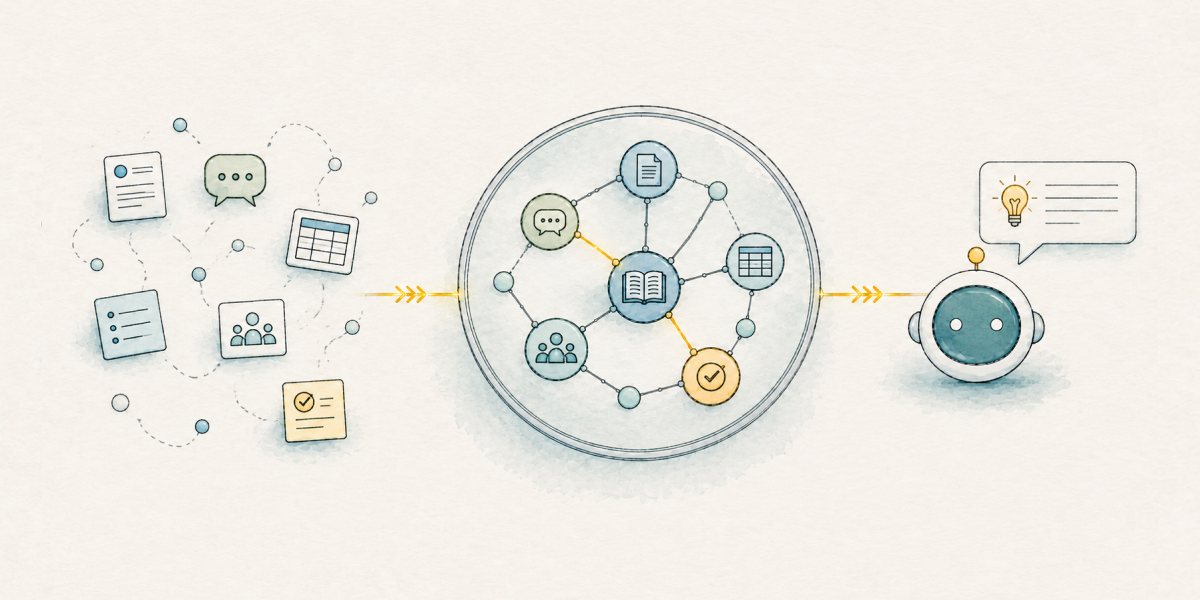
Many of the answers an agent needs about your business live in the connections between facts, and those facts sit in different places.
Take the suspended-account question. Answering it requires a chain of steps: from the account in one system to the workflow tool’s suspension process to the team that owns the decision on an org chart to what the agent may do in a policy document. Those connections live in application code and in people’s heads, so the agent has to reconstruct them.
A graph makes each connection explicit, as a record of its own: this suspension was caused by that process, and that process is owned by this team. Each thing is a node, each connection is a relationship, and the agent can query both.
A graph database stores relationships directly with the data, so following a connection means reading from the database as it already exists, with no joins to piece it back together. In Context Engine, the ontology is a graph model that you define and store in Neo4j.
With the connections stored, the agent can do multi-step reasoning. It starts at the account and follows each link to the next fact, so each step uses a fact the graph already holds. Then it shows the path it took, so you can see how it reached the answer and check any step.
The graph also sits outside any one agent. Another agent that handles suspended accounts reads the same definition, process, and owner, so no team has to rebuild them inside its own agent. When the owning team changes, the graph changes once, and every agent sees it.
Connect your agents to the business ontology #
Once the ontology is published, agents can use it to answer questions about your business and carry out its processes. Context Engine serves context to any agent over Model Context Protocol (MCP) and APIs. You keep your LLM and agent framework, and Context Engine reaches the data platforms you already run. An agent can reach only the data it’s authorized to access.
Agents retrieve what they need with GraphRAG, which combines vector search and following relationships through the graph. Vector search finds a starting point that resembles the question. Traversing relationships from there, an agent reaches the connected facts, such as the process and team behind a suspension, even when they reside in different systems.
Conversational analytics lets you ask questions across all your data in plain language. Take the example of someone asking how many accounts are suspended pending review. The account system stores a status of 2, and the support system tracks the same thing with a suspended flag. The ontology defines what “suspended pending review” means and maps it to the systems that hold the data, so the agent can find it in both, and the answer shows where it came from.
Business process automation lets agents carry out your existing processes step by step. If lifting a suspension takes a review, approval from the owning team, and a status change, the agent follows those steps in order. The ontology tells it who approves and what it may do itself. Every permitted action is governed, and every step is traceable, so you can review what the agent did.
Help agents learn from past decisions #
Every task an agent works on involves decisions: how a suspension was reviewed, who approved lifting it, how it turned out. If those decisions stay in logs, the next agent starts from scratch.
Runtime knowledge, the sixth layer of the ontology, is where agents store past decisions and actions and learn from them. Agent memory lives in the same graph as your business knowledge, a setup known as a context graph. Every agent decision and the path the agent took to reach it are tracked and stored.
In that graph, a stored decision connects to what it concerned. Say an agent lifts a suspension. The record links to the account, the process it followed, and the team that approved it. When another agent handles a similar suspension, it starts from the validated decisions already in the graph.
Learn to build context graphs #
Take the free GraphAcademy course to learn how context graphs give AI agents memory of past decisions alongside your business knowledge.
Getting started with contextual organizational knowledge #
Giving AI models connected context matters. In an IDC study, organizations using Neo4j graph technology reduced LLM hallucinations by 44%.
Contextual organizational knowledge includes the answers to the six questions an agent asks about your organization, all held in a single graph that all your agents share. With it, an agent can answer based on what your organization knows, act within its guardrails, show how it arrived at each answer, and learn from past decisions. That’s what makes an agent accurate, explainable, and governable enough to earn trust and go live.
We provided the six-question list earlier in the blog, along with the recommendation to see what your agent can’t answer today. As you work through that list, you should:
- Find where each answer lives. It might be in application code, in people’s heads, in documents, or in a system the agent can’t reach.
- Name an owner for each one. Pick the person or team who can confirm the answer is right.
- Start with the gaps where a wrong guess costs the most. Those are the answers to define first.
- Define those answers in a shared graph. That’s the first piece of your ontology. Connect a second agent to the same graph, and it starts with the same answers, so nobody has to rebuild them.
Request access to Neo4j Context Engine #
Neo4j Context Engine, now in private preview, helps you build a business ontology from your existing systems to provide contextual organizational knowledge. You can contact us to request access.
Contextual organizational knowledge FAQs #
Agents stall when they lack knowledge of how the business works. When the context of your data lives in application code and in people’s heads, an agent has to guess. In an MIT Technology Review Insights survey of 300 senior executives, only 34% of agentic AI projects reached production. The production leaders, who got 61% of their projects live, had stronger knowledge capabilities.
An AI agent needs to know six things: how the business operates, what its key terms and concepts mean, which trusted information it can use, where that information lives, how it can access or act on it, and what has been learned from earlier decisions. Together, those answers are contextual organizational knowledge.
Model this knowledge as a graph that makes relationships explicit and organizes it into the six layers of a business ontology. Store it in one shared graph outside any single agent, so every agent reads the same definitions, processes, and owners.
Start from your existing systems. In Neo4j Context Engine, AI proposes how business terms map to them, and a person validates each proposal before anything is published. Teams then add what previously lived only in people’s heads, like who owns a decision, in Context Studio’s visual builder.
In Neo4j Context Engine, agents retrieve context from the ontology with GraphRAG retrievers, which combine vector search with following relationships through the graph. Vector search finds a starting point that resembles the question, and following relationships reaches the connected facts, like the process and team behind a decision.
Because the knowledge sits in one shared graph, a change is made once, and every agent sees it. Neo4j Context Engine includes change management for the ontology, and Context Studio is one place to manage and govern it. For traceability, answers show where they came from, and every step an agent takes is traceable.
In Neo4j Context Engine, agent memory lives in the same graph as your business knowledge, and every agent decision and the path the agent took to reach it is tracked and stored. When another agent handles a similar case, it starts with the validated decisions already in the graph, learning from what earlier agents decided.
Neo4j Context Engine is one. It gives agents the context to answer questions about your business and carry out its processes, with every answer and step governed and explainable. You keep your LLM and agent framework.