Quick answer #
Codex session files record the working directory, so cost per project is a two-step calculation: total tokens for that directory, then multiply by the rate for each token type. On a subscription the marginal cost is zero until you hit a limit, so value the tokens at API rates if you want a comparable number.
Attribute sessions to a project #
- Open the session file and read the recorded working directory.
- Group sessions by that path, not by the repository name; monorepos and worktrees share a name.
- Total input, cached input, output, and reasoning separately.
- Exclude sessions that only read a file from the project while working elsewhere.
Directory attribution is imperfect. A session that starts in one repo and edits another still belongs to the first. Note that when a project looks unusually expensive.
Convert tokens to money #
cost = input_tokens * input_rate
     + cached_tokens * cached_rate
     + output_tokens * output_rate
| Token type | Why it has its own rate | Common mistake |
|---|---|---|
| Input | Fresh context sent to the model | Using output rate for everything |
| Cached input | Discounted reuse of a stable prefix | Counting it as full input |
| Output | Generated text | Forgetting reasoning tokens |
| Reasoning | Billed with output, often shown apart | Double counting |
Read the rates from the provider's current pricing page. Do not hard-code a rate you saw in a comparison post.
Compare projects fairly #
- Normalise by merged pull requests or shipped features, not by hours.
- Separate exploration from implementation on the first pass.
- Track the same project for a full week before ranking it.
- Record the model used; a model switch can double a line without any behaviour change.
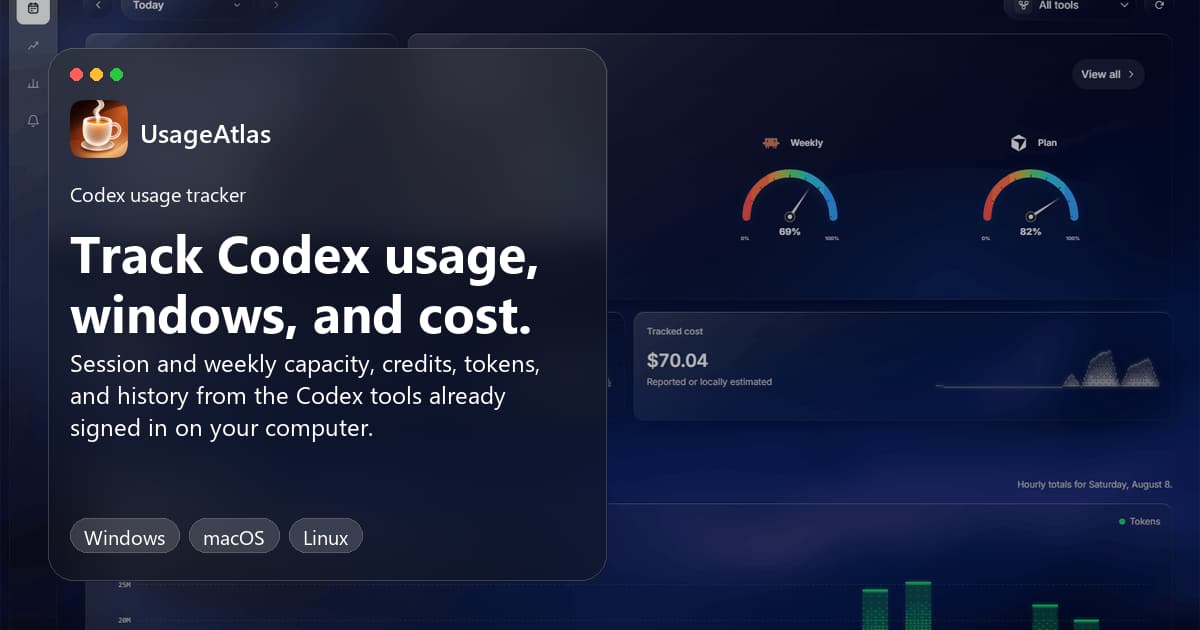
UsageAtlas keeps the directory and model fields together, which is enough to produce this table without a spreadsheet.
Attribute sessions before you divide #
Per-project cost only works if each session is attributed to one repository. Codex records the working directory per session, so the attribution is available; the mistake is dividing a monthly total by the number of projects you touched.
- Group sessions by working directory.
- Exclude sessions with no completed work.
- Keep shared setup work in its own bucket.
- Separate model cost from plan cost.
UsageAtlas groups local sessions by project and shows the 30 or 90-day total, which is the number to divide. The formula is in AI coding cost per project.
Questions, answered #
Does Codex store the project name?
It stores the working directory. The project name is derived from that path, and a monorepo will collapse several projects into one.
Is cost per project meaningful on a subscription?
Only as a shadow price. You do not pay per token until you exceed the allowance, but valuing usage at API rates shows which projects would be expensive if you did.
Should I include cached tokens in project cost?
Yes, at the cached rate. They are still billed, just cheaper, and ignoring them understates the total.