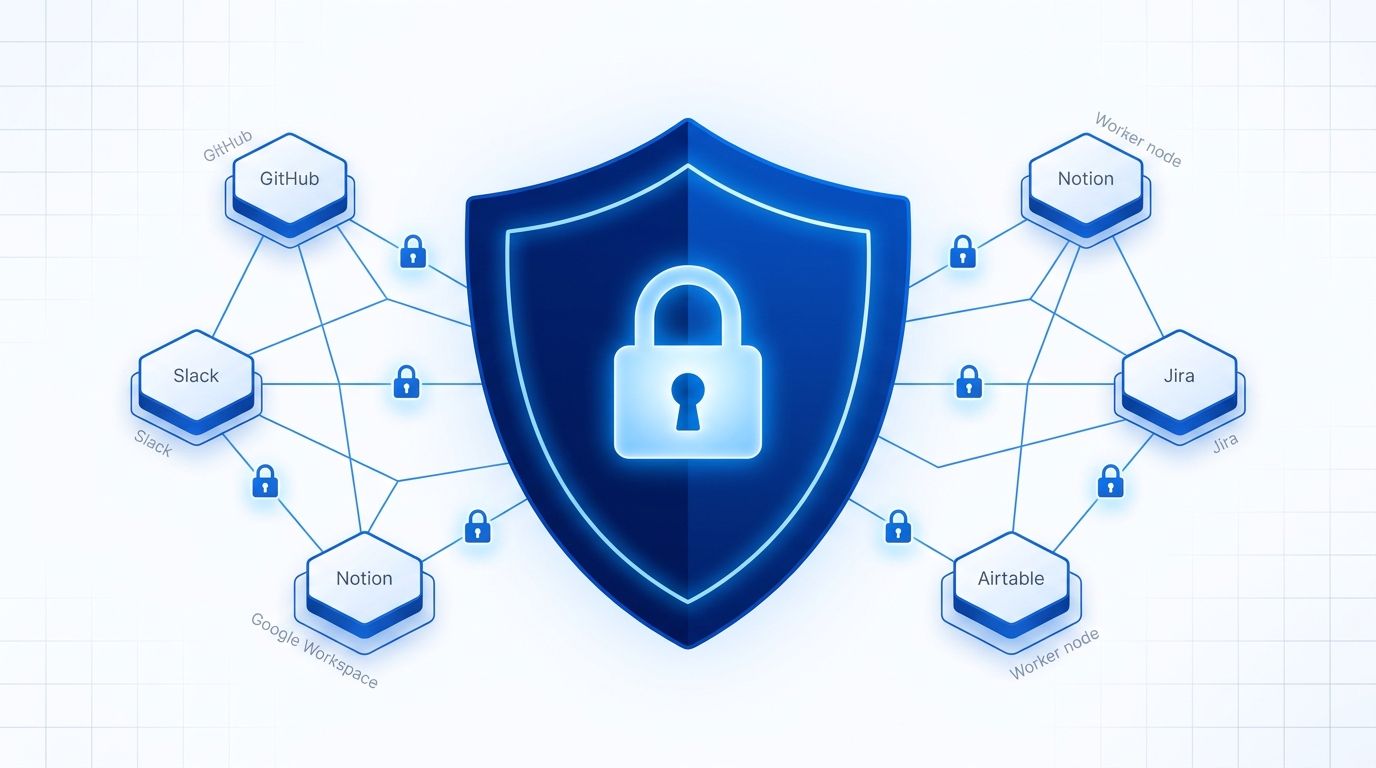
Cloudflare open-sourced its internal AI agent workspace on August 5, 2026 — and developers can deploy it to their own Cloudflare account today. The platform, called Cloudflare OS, is not a Linux distribution or anything resembling a traditional operating system. It is a zero-trust AI workspace where agents research, write documents, build full-stack micro-apps, and automate workflows, all without ever touching a raw credential. It hit 8,000 GitHub stars in its first week. The reason to pay attention is not the star count — it is the security architecture underneath.
Not an OS. An Agent Platform Built on Workers. #
The name is a marketing choice. Cloudflare OS runs entirely on Cloudflare Workers: isolated V8 runtimes, Durable Objects for stateful compute, and sandboxed browser frames for client code. Every employee gets a personal agent workspace in the browser, no terminal required. Agents can search internal docs, draft presentations, generate data visualizations, and build what Cloudflare calls Gadgets — small, fully isolated full-stack applications tailored to a team’s specific workflows.
Cloudflare deployed an earlier version to all its employees in May 2026. By August, non-engineers were using it daily to knock together internal tools, write documentation, and automate repetitive tasks. The managed product is coming to the Cloudflare dashboard, but it is already self-deployable today.
Gatekeepers: Why This Security Model Is Different #
Most enterprise AI tools fail the credential question. Giving an agent access to GitHub, Slack, or your database means handing it keys — and keys can be logged, leaked, or misused by a model that misunderstands intent. Cloudflare OS takes a different approach: agents never hold credentials at all.
Every external system — GitHub, Notion, Supabase, Slack, Google, Confluence, and more — is fronted by a per-service Gatekeeper Worker. The Gatekeeper holds the credential. The agent receives a scoped capability object instead. In practice, an agent calls something like:
const issues = await env.PROJECT.listIssues({ teamId: "ENG", state: "open" });
It gets the data it is allowed to see. It never sees the token. The Gatekeeper enforces field masking, read-only permissions, rate limits, and repo-level access boundaries at the infrastructure layer — not in application code.
The system goes further with observation tracking. Every resource an agent reads is logged. That log travels with whatever the agent produces. When someone shares an AI-generated document, the platform checks the recipient’s clearance against the underlying sources before granting access. Sensitive data can block the document from being shared at all. Jamie Lord, who wrote the best independent technical analysis of this release, called this an architecture of distrust: the system does not trust the agent to get it right — it builds so that mistakes cannot matter.
There is also a provisional writes model. An agent can simulate merging a pull request, draft a reply to an email, or propose a database change — while a human holds final approval. The agent sees a fabricated state so the workflow can continue; the actual write does not happen until a human approves it. This transforms oversight from an interruption into the commit mechanism itself.
Gadgets: Agents That Build Your Internal Tools #
Gadgets are full-stack applications agents generate on request. Ask your agent to build a lightweight issue tracker for your team, a custom dashboard for monitoring a specific metric, or a small CRM tuned to your sales process — it builds it. Each Gadget is a complete application: React frontend running in a sandboxed browser frame, a Dynamic Worker handling server logic with outbound networking disabled by default, and its own Durable Object SQLite database. No Gadget can touch another Gadget’s data.
Cap’n Web RPC, the communication layer, lets agents and clients call app methods identically. A tool a user builds in their workspace is reusable by their agent. The boundary between “tool I wrote” and “tool my agent can use” dissolves intentionally.
The Lock-In Question (Be Honest with Yourself) #
The license is Apache 2.0. The code is real. But the architecture — Gatekeepers, Durable Object isolation, observation logging, sandboxed Workers — runs on Cloudflare’s platform. The open-source Workers runtime (workerd
) exists, but running the full Cloudflare OS stack outside of Cloudflare requires non-trivial infrastructure work. The 2026 State of Open Source Report found that 55% of developers cite avoiding vendor lock-in as a primary driver of OSS adoption — up 68% year over year. Cloudflare OS is honest about this trade-off in a way many enterprise AI products are not. You own the code. Cloudflare owns the platform it runs best on.
Kenton Varda, the Workers tech lead who architected Cloudflare OS, acknowledged that he tried to build something like this a decade ago and it failed — the AI was not capable enough. That constraint no longer exists. The lock-in is real, but so is the ambition.
How to Deploy It Today #
Three deployment paths are available right now:
Local development:pnpm run-local
launches the workspace athttp://localhost:8787
Cloudflare account: Guided deploy atos.cloudflare.app/deploy
Custom setup: Fork theStarter repository on GitHub, add your own Gatekeepers, and wire in your integrations
Out-of-the-box Gatekeepers cover GitHub, Google, Cloudflare, Supabase, Notion, Confluence, Email, Home Assistant, Slack, Spotify, and ZoomInfo. Adding a new Gatekeeper means writing a Worker that mediates access to whatever system you need — the pattern is documented and consistent across integrations.
Alongside the OS release, Cloudflare also open-sourced triagebot-action — the agent pipeline that helped the Astro JavaScript framework reduce its GitHub issue backlog from over 200 open issues to roughly 30. That is an 85% reduction. It is a working production example of this architecture, and worth forking if you maintain a project with a growing issue queue.
The Bottom Line #
Cloudflare OS is the most architecturally serious attempt at an enterprise AI workspace to ship in 2026. The Gatekeepers model solves a real problem. The Gadgets concept is genuinely novel. The lock-in is real and you should price it in. For teams already on Cloudflare, the deployment path is straightforward. For teams not on Cloudflare, the architecture is worth studying even if you build something similar on a different substrate. The full technical blog post has the depth; read it before deploying.