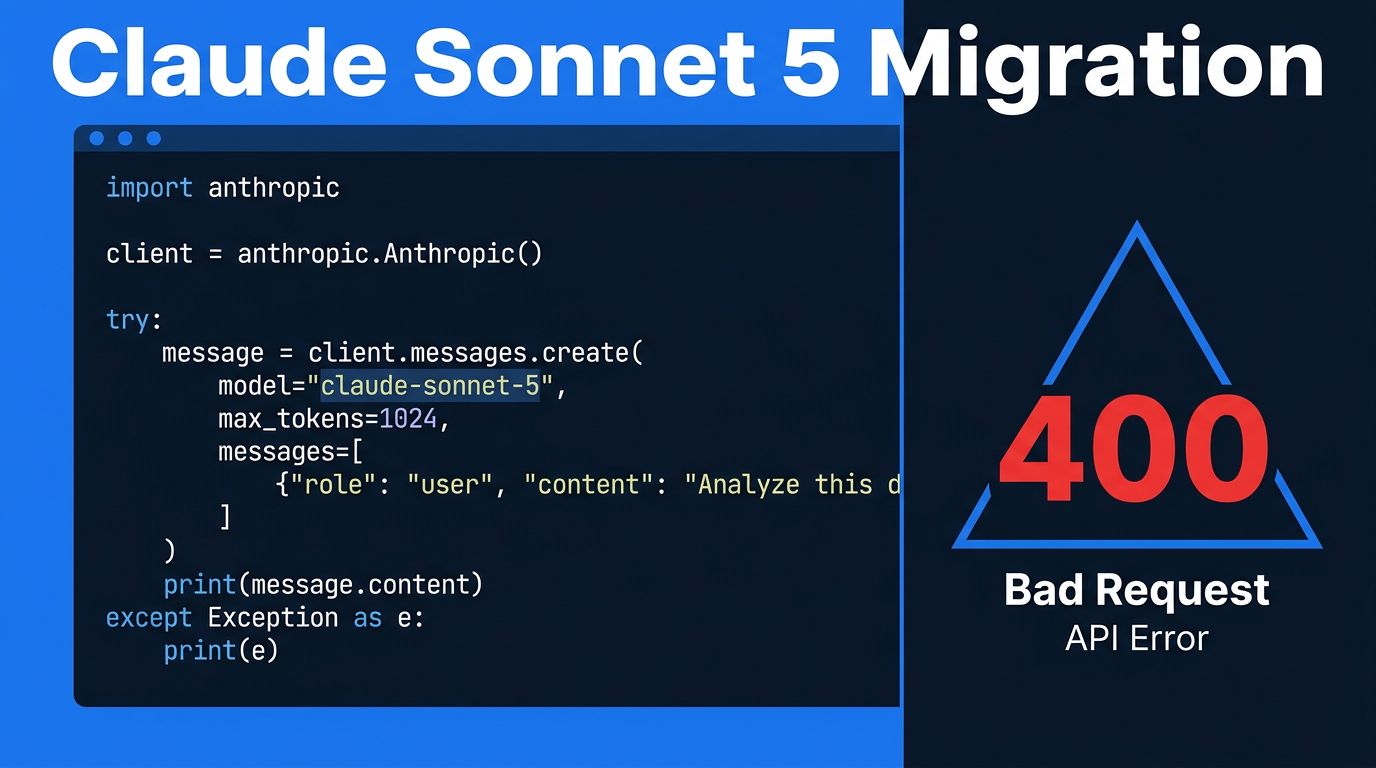
Claude Sonnet 5 launched June 30 and is now the default model across Claude Code, Free, and Pro plans. Migrating looks trivial: swap claude-sonnet-4-6
for claude-sonnet-5
and ship. It is not trivial. Three API changes will hard-fail your code before you get to performance testing, and a fourth change will quietly inflate your bill by up to 41% the moment introductory pricing expires on August 31.
The model brings genuine upgrades — 1M context window, 63.2% on SWE-bench Pro (up from 58.1% on Sonnet 4.6), FrontierCode performance that more than doubled, and near-Opus 4.8 coding at Sonnet-class pricing. But none of that matters if your API calls are returning 400s. Here is what to fix first.
Breaking Change #1: Sampling Parameters Now Return 400 #
If you set temperature
, top_p
, or top_k
to any non-default value, Sonnet 5 rejects the request with an HTTP 400 error. This catches two camps at once: developers who raise temperature for creative variation and developers who set it to zero for deterministic outputs. Both patterns break identically.
The one exception: temperature=1.0
— the literal default — is still accepted. Every other value fails. This constraint was already enforced on Opus 4.7 and 4.8; Sonnet 5 rolls it down the model line. The reason is architectural: adaptive thinking requires the model to control its own sampling during reasoning, so external temperature control conflicts with that process.
The fix is to remove these parameters entirely. For tone and style control you previously handled through sampling, move that logic to your system prompt instead.
response = client.messages.create(
    model="claude-sonnet-4-6",
    temperature=0,
    max_tokens=1024,
    messages=[{"role": "user", "content": "Summarize this report"}]
)

response = client.messages.create(
    model="claude-sonnet-5",
    max_tokens=1024,
    messages=[{"role": "user", "content": "Summarize this report"}]
)
Breaking Change #2: budget_tokens Is Gone — Meet the Effort Parameter #
If any of your code uses thinking: {"type": "enabled", "budget_tokens": N}
, it will return a 400 error on Sonnet 5. This syntax was deprecated in Sonnet 4.6; Sonnet 5 removes it entirely. That includes every tutorial, blog post, and Stack Overflow answer written before June 2026 that shows the budget_tokens pattern.
The replacement is adaptive thinking with the effort
parameter. On Sonnet 5, adaptive thinking is on by default — you do not need to configure anything to get thinking. The model evaluates each request’s complexity and decides whether and how much to reason through it. When you need explicit control:
low— latency-sensitive workloads, high-volume chat, non-coding tasks** medium**— cost optimization; comparable to Sonnet 4.6 at high effort in intelligence terms** high**(default) — complex reasoning, coding, agentic tasks** xhigh**— the hardest agentic and coding workloads
response = client.messages.create(
    model="claude-sonnet-4-6",
    thinking={"type": "enabled", "budget_tokens": 8000},
    max_tokens=16000,
    messages=[{"role": "user", "content": "Debug this system"}]
)

response = client.messages.create(
    model="claude-sonnet-5",
    max_tokens=16000,
    messages=[{"role": "user", "content": "Debug this system"}]
)

response = client.messages.create(
    model="claude-sonnet-5",
    thinking={"type": "adaptive"},
    extra_body={"effort": "medium"},
    max_tokens=16000,
    messages=[{"role": "user", "content": "Debug this system"}]
)

response = client.messages.create(
    model="claude-sonnet-5",
    thinking={"type": "disabled"},
    max_tokens=1024,
    messages=[{"role": "user", "content": "Echo this back"}]
)
Breaking Change #3: The Tokenizer That Will Inflate Your Bill #
This one does not throw a 400. It just costs you money — and it will not hit you until September 1 unless you are paying attention now.
Sonnet 5 uses the same tokenizer adopted by the Opus 4.7/4.8 line. The same input text now produces 30 to 41% more tokens than it did on Sonnet 4.6. Code-heavy prompts land at the higher end of that range. Plain English sits closer to 30%. Independent analysis found up to a 41% increase in token counts for equivalent prompts.
During the introductory pricing window — now through August 31 — the math is roughly neutral. The 41% token increase is offset by the 33% lower rate ($2/$10 vs. the standard $3/$15 per million tokens). Migrate now and you pay about the same as Sonnet 4.6 for uncached prompts, with cheaper warm turns.
After September 1, the rate returns to $3/$15 but the token count does not revert. The same prompt costs up to 41% more than it did on Sonnet 4.6. Any token budget, rate limit calculation, context truncation guard, or cost projection based on Sonnet 4.6 numbers is now wrong. Audit these before September 1, not after.
The Payoff: Why Migrating Is Worth It #
SWE-bench Pro jumped from 58.1% on Sonnet 4.6 to 63.2% on Sonnet 5. FrontierCode v1 went from 15.1% to 38.8% — more than doubled. Terminal-Bench 2.1 added 13.4 points. The 1M context window was previously Opus-only territory.
For teams currently running Opus 4.7 for coding workloads: Sonnet 5 at high effort delivers comparable performance at significantly lower cost, especially during the introductory window. The migration work pays for itself quickly.
Migration Checklist #
- Update model ID:
claude-sonnet-4-6
→claude-sonnet-5
- Remove
temperature
,top_p
,top_k
if set to non-default values - Replace
thinking: {"type": "enabled", "budget_tokens": N}
with effort parameter or remove - Add
thinking: {"type": "disabled"}
to any paths where you want no reasoning - Audit token budgets, rate limits, and cost projections against the 30–41% token increase
- Update context truncation guards sized for Sonnet 4.6 token counts
Claude Code users can run /claude-api migrate
to automate the model ID swap, parameter fixes, and effort calibration across their codebase. It generates a checklist of items to verify manually afterward. The official migration guide covers the full parameter reference and edge cases.
Three breaking changes to fix, six checklist items to clear, and until August 31 to do it at $2/$10 pricing. The window is open. Use it.