Claude Code vs Cursor, checked 14 Sep 2026: where each runs, models, plans, the new Claude Code weekly limits, parallel agents and using both.
Choose Cursor for an editor where you steer an agent across models from several labs. Choose Claude Code if you would rather hand work to Anthropic’s agent in a terminal, IDE, desktop app or browser, built around Claude models. Outside India, paid plans for both start at $20 a month (14 Sep 2026), plus Cursor’s free Hobby plan.
Two things moved in the last month. Cursor became part of SpaceX on 14 Aug 2026 (Cursor’s announcement), and Claude Code’s weekly limits changed today. If you are choosing a whole setup rather than one tool, our roundup of multi-agent tools built on Claude Code covers the wider field.
Is Claude Code better than Cursor? # #
Neither wins outright, and the better pick depends on how much of the typing you want to keep.
Cursor fits you if you read every diff, like Tab completions while you type, or want Claude, GPT, Gemini and Cursor’s own Grok and Composer models behind one picker. Claude Code fits you if you already pay for Claude, prefer describing a task and reviewing the result, or live in a terminal.
Where does each one run? # #
Cursor grew out of a desktop editor, Claude Code out of the terminal.
Anthropic’s overview lists five surfaces: the terminal CLI, a VS Code extension, a JetBrains plugin, a desktop app and the web at claude.ai/code. Cursor has the classic editor, an Agents Window that shipped with Cursor 3 on 2 Apr 2026, a CLI, and cloud agents you can start from the web, iOS, Slack or GitHub.
Does Cursor have a CLI like Claude Code? # #
Yes. Cursor’s CLI docs install it with curl https://cursor.com/install -fsS | bash and start it with agent, where Claude Code’s is claude. It has the editor’s Agent, Plan and Ask modes, a print mode (agent -p "...") for scripts and CI, and a handoff: start a message with & and the conversation moves to a Cloud Agent that keeps working while you’re away.
How do you work with each one day to day? # #
In Cursor you tend to stay on the code; in Claude Code you tend to stay on the task. Cursor puts the agent next to the file you have open, shows its edits in place, and keeps Tab completion running (unlimited on Pro, Pro Plus and Ultra, per Cursor’s docs). Claude Code starts from a sentence, then plans, edits across files, runs commands and, per Anthropic’s docs, “stages changes, writes commit messages, creates branches, and opens pull requests.” Both support skills, hooks and MCP servers, so the gap is posture more than features.
Which models can you use in Claude Code and Cursor? # #
Cursor gives you a picker across labs; Claude Code gives you Claude. Cursor’s model docs feature Claude Opus 5 and Fable 5.1, GPT-5.6 Sol, Gemini 3.1 Pro and Muse Spark 1.3, plus a first party pool of Grok 4.6 and Composer 2.5. Claude Code’s model settings resolve the opus alias to Opus 5, sonnet to Sonnet 5 and fable to Fable 5.1 where Fable is available to you. A Claude model picked in Cursor’s own picker bills at that model’s API rate from Cursor’s Other Models pool.
Is Claude Code cheaper than Cursor? # #
Outside India, paid plans start at the same $20 (14 Sep 2026), so the real difference is what happens when usage runs out.
Claude’s pricing page on 14 Sep 2026 lists Pro at $20 billed monthly (or $17 a month billed annually) with Claude Code included, and Max from $100 a month for 5x or 20x Pro’s usage. Those plans cap Claude Code with a session limit and a weekly limit, and the weekly one moved today. Anthropic’s ClaudeDevs account said on 29 Aug 2026 that from 14 Sep standard weekly limits rise permanently by 25% for Pro, Max, Team and seat based Enterprise, replacing a temporary 50% boost. Against a base of 100, you had 150 until 14 Sep 2026 and 125 from then, which ClaudeDevs called a 17% reduction.
Cursor’s pricing docs, checked 14 Sep 2026, list Pro $20, Pro Plus $60 and Ultra $200 a month, each with a Cursor Models pool and an Other Models pool at API rates, plus Start (India only) at ₹649 with the Cursor Models pool alone. It puts daily agent users at $60 to $100 a month (14 Sep 2026). Hit a Claude limit and you wait for the reset or turn on usage credits; use up Cursor’s included usage and you pay on demand or upgrade.
How do Claude Code and Cursor run agents in parallel? # #
Both run agents in parallel, in different places. Cursor’s Agents Window runs cloud agents in parallel and local agents in their own git worktrees; its docs say you can run as many Cloud Agents as you want in isolated VMs, billed at API pricing on a paid plan. Claude Code’s claude agents view (a research preview) runs many background sessions from one screen, claude -w starts a session in its own worktree, and the web version runs tasks in parallel. Its agent teams, a lead session with teammates that message each other, are off until you set CLAUDE_CODE_EXPERIMENTAL_AGENT_TEAMS=1.
Can you use Claude Code and Cursor together? # #
Yes, and there are three sensible ways to do it.
- Claude Code inside Cursor. Anthropic’s VS Code docs include an “Install for Cursor” link for the extension. You keep Cursor’s editor and bill the agent work to your Claude plan.
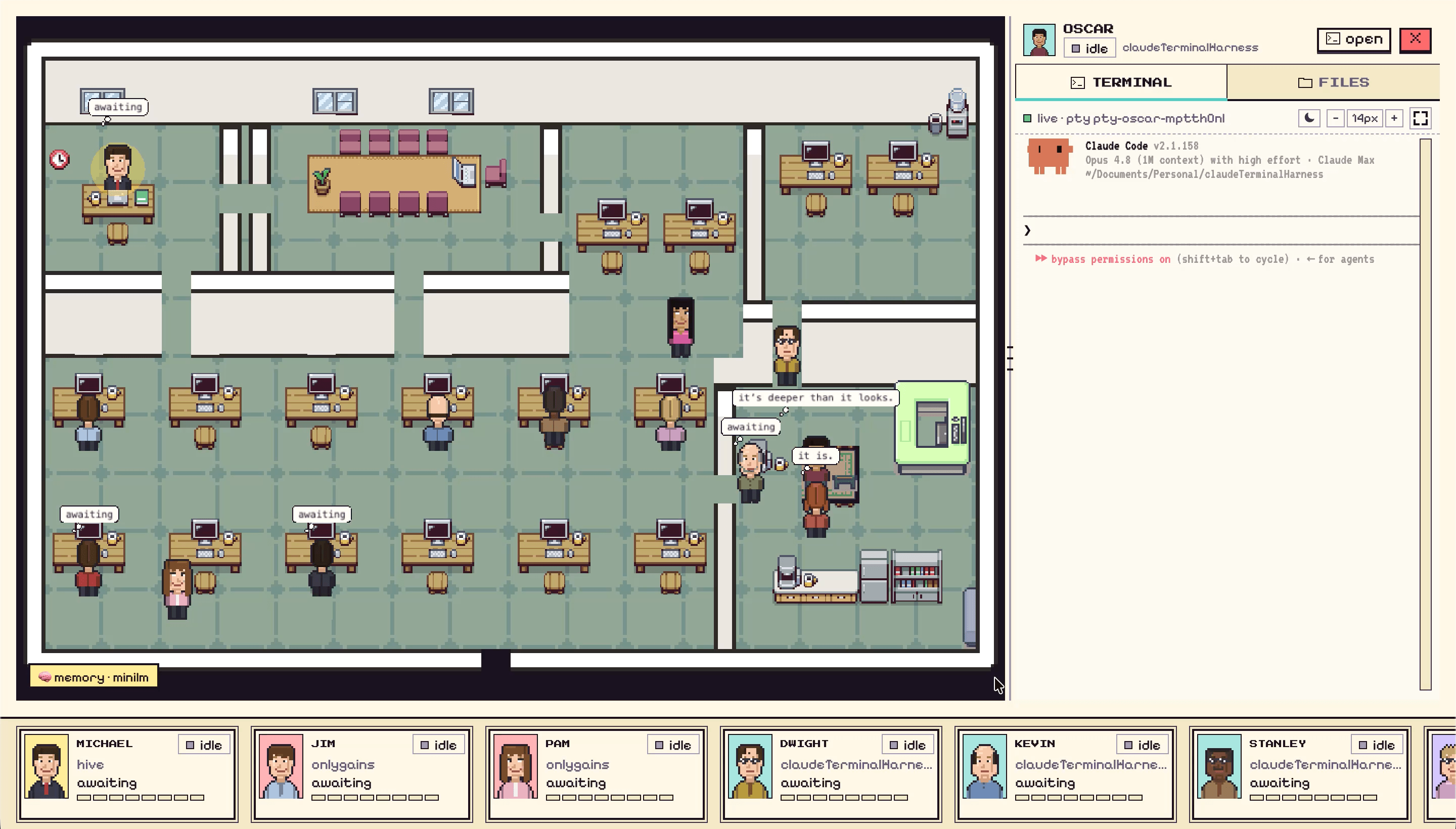
- Munder Difflin, both CLIs from one app. Munder Difflin is a free and open source desktop app where every agent picks its own engine and model, so a Claude Code agent and a Cursor agent (say on
composer-2.5) work side by side, each in a real terminal on your machine, on subscriptions you already pay for. If Cursor’s CLI is missing, the app can install it with Cursor’s own script. One limit as of 0.5.2, from its source: there is no Cursor hook bridge yet, so a Cursor agent gets messages typed into its terminal when it goes quiet, while Claude Code reports live status through hooks. It drives Cursor’s CLI, not its editor or cloud agents. - By hand. Open two terminals and give each agent its own git worktree, for example
claude -w authin one andagent -w uiin the other, so they never edit the same file.
Weighing Codex too? Read [Codex CLI vs Claude Code](/blog/codex-cli-vs-claude-code/), or see [the best AI coding agents](/blog/best-ai-coding-agents/) sorted by category.

## Claude Code or Cursor for beginners? [#](#claude-code-or-cursor-for-beginners)
Cursor is the easier start. Its Hobby plan needs no credit card, per cursor.com/pricing on 14 Sep 2026, and you watch every change land in a file you can see. Claude’s Free plan does not include Claude Code, so trying it means a paid plan or API credits. Claude Code’s hands off style pays off once you know what a good diff looks like.
FAQ #
Is Claude Code better than Cursor?
Neither is better for everyone. Cursor suits you if you want to stay in an editor, read each change and switch between models from several labs. Claude Code suits you if you already pay for Claude and prefer to hand over a task and review the result, in a terminal, an IDE, the desktop app or a browser.
Can I use my Claude subscription inside Cursor?
Yes, through Anthropic's Claude Code extension, which Anthropic's own docs list with an install link for Cursor. Claude models picked in Cursor's own model picker are a different thing: Cursor's docs say third party models draw from its Other Models pool at the model's API price, checked 14 Sep 2026.
Does Cursor have a CLI like Claude Code?
Yes. Cursor's docs install it with a curl script from cursor.com/install and start it with the agent command, which has Agent, Plan and Ask modes and a print mode for scripts. Prefixing a message with an ampersand hands the conversation to a Cloud Agent.
Is there a free plan for Claude Code or Cursor?
Cursor has one: the Hobby plan needs no credit card and includes limited agent requests, per cursor.com/pricing on 14 Sep 2026. Claude's Free plan does not list Claude Code; Pro is the first plan that includes it, at $20 billed monthly on claude.com/pricing the same day.
Did the SpaceX acquisition change Cursor's prices?
Not so far. Cursor's post of 14 Aug 2026 says SpaceX's ownership means it can offer more capable models at lower cost, and its pricing page on 14 Sep 2026 still lists Pro at $20, Pro Plus at $60 and Ultra at $200 a month with no change notice.