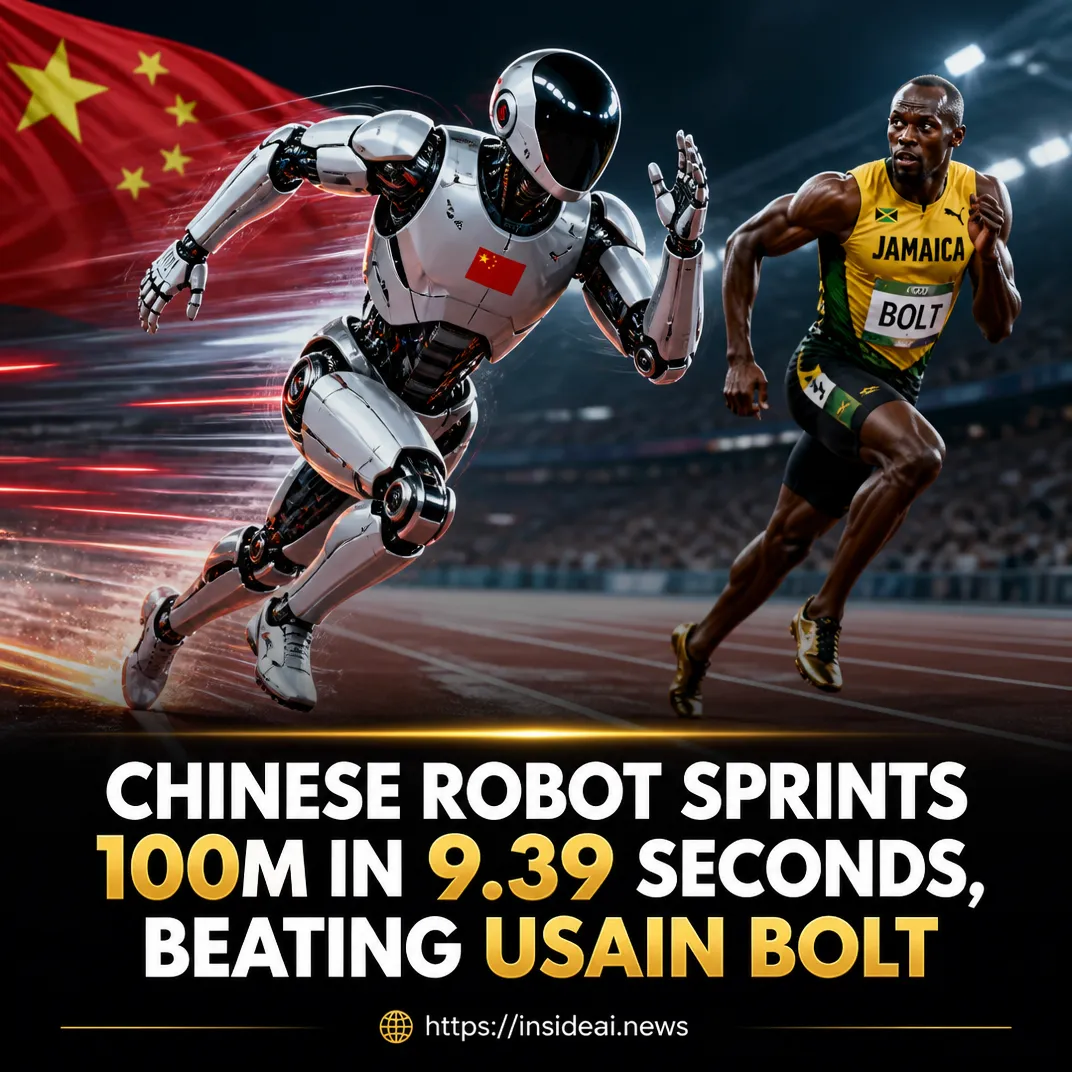
August 23, 2026, (Inside AI) — A Chinese humanoid robot sprinted 100 meters in 9.39 seconds on August 22, beating Usain Bolt's human world record of 9.58 seconds set in 2009. The machine, Tiangong Ultra, achieved the time during a preliminary round at the World Humanoid Robot Games in Beijing.
The event also featured Lightning, a robot built by Chinese smartphone maker Honor, which finished in 9.47 seconds but had to be carried off on a stretcher afterward. The race is part of a broader competition testing robots in football, cable connection, electric vehicle charging, and material transport.
These tasks are not mere spectacle. They force engineers to solve hard problems in balance, acceleration, limb coordination, and real-time response. A human tripping and recovering involves sensing, prediction, decision-making, and physical action in a fraction of a second. Teaching a robot to do this reliably is enormously difficult.
Once a robot can sprint without falling, it can handle disaster response, restaurant delivery, house cleaning, mine sweeping, and rescue operations. The U.S. National Institute of Standards and Technology runs a project for disaster-relief robots, listing tasks like maneuvering, mobility, dexterity, sensing, endurance, and autonomy.
China's investment in robotics is strategic. The International Federation of Robotics reports that China's latest Five-Year Plan (2026-2030) places robotics at the "heart of its modern industrial system." Currently, 54% of annual industrial robot installations worldwide are in China. The plan aims to pivot AI research toward physical applications with robots as main drivers for economic growth.
Why sprinting is a proxy for real-world competence #
A 100-meter sprint compresses many hard robotics problems into a short burst. The robot must accelerate from zero, coordinate dozens of joints, maintain dynamic balance, respond to tiny shifts in terrain, and decelerate without falling. Each of these subproblems maps directly to practical tasks: navigating rubble, climbing stairs, carrying loads, or turning valves in hazardous sites.
Military applications are also clear. A drone already navigates, observes, and carries equipment in dangerous places. Ground robots that can run and recover from stumbles could work alongside soldiers, carry supplies, or enter contaminated zones. The physical dimension of AI is the next frontier after large language models.
China's dominance in industrial robotics gives it a manufacturing and data advantage. The 54% installation share means Chinese engineers have more real-world deployment data to train locomotion models. The new Five-Year Plan explicitly ties robotics to economic growth, signaling a shift from software chatbots to embodied machines.
The limits of a 9.39-second headline #
The record time does not mean the robot sprinted like a human. Tiangong Ultra ran on a controlled track, likely with favorable surface conditions. Lightning's stretcher exit shows that finishing fast is not the same as finishing safely. Energy efficiency, battery life, and recovery from unexpected disturbances remain open problems.
Still, the competition format is a useful forcing function. It creates a public benchmark for locomotion, similar to how DARPA challenges accelerated autonomous vehicles. The next step will be robots that can sprint, stop, turn, and adapt to rain, gravel, or obstacles without falling.
The World Humanoid Robot Games will continue with football and manipulation tasks. Those events will test dexterity and teamwork, not just speed. If Chinese robots dominate those as well, the gap between Chinese and Western humanoid capabilities may widen further.