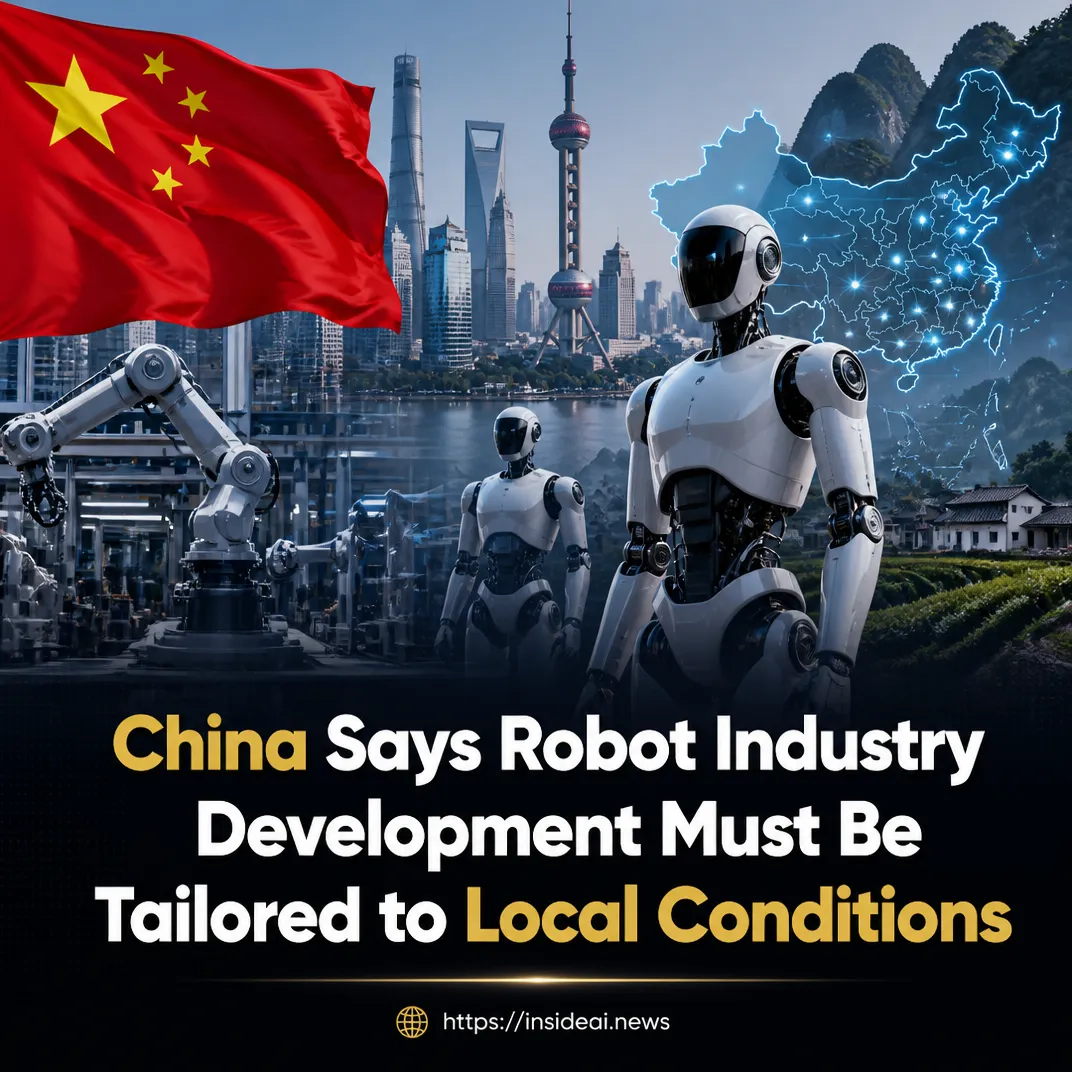
August 28, 2026, (Inside AI) — China’s top economic planning agency on Friday directed local governments and enterprises to develop the robot industry based on regional strengths, not hype.
At a regular press briefing, Li Chao, spokeswoman for the National Development and Reform Commission (NDRC), said the sector must be pursued in an orderly manner and built on local resource endowments and industrial strengths. The industry must not blindly follow trends, she added.
The statement signals Beijing’s intent to prevent overcapacity and wasteful investment in a sector that has drawn massive capital inflows. China is already the world’s largest market for industrial robots, accounting for more than half of global installations in recent years, according to the International Federation of Robotics.
The NDRC’s guidance comes as Chinese robotics firms expand rapidly. Unitree Robotics and UBTech Robotics have pushed humanoid robots into factories and logistics. Local governments from Shanghai to Shenzhen have announced robotics industry funds totaling tens of billions of yuan.
Beijing Targets Orderly Expansion, Not Speculative Bubbles #
Li’s comments reflect a broader policy shift. After years of subsidizing electric vehicles and solar panels, China faced overcapacity and price wars. The government now wants to avoid repeating that cycle in robotics.
The NDRC said development must be tailored to local conditions. That means a region with strong automotive manufacturing should focus on industrial robot arms, while a region with software talent might prioritize robot operating systems or AI control algorithms.
China’s robotics market is projected to reach $100 billion by 2030, according to CCID Consulting. But analysts warn that hundreds of startups are chasing similar humanoid robot designs, creating duplication.
“The central government is telling provinces to stop throwing money at the same robot projects,” said Zhang Wei, a Beijing-based industrial policy researcher who requested anonymity because he was not authorized to speak publicly. “They want specialization, not a thousand copycat firms.”
Local Governments Face Pressure to Show Results #
The directive puts pressure on local officials who have announced ambitious robotics clusters. Zhejiang province has pledged to build a 100 billion yuan robot industry by 2027. Anhui has targeted 50 billion yuan by 2026.
But the NDRC has the power to block redundant projects through investment approvals and land permits. It can also restrict preferential loans for projects that do not align with regional advantages.
China’s robot density in manufacturing reached 470 robots per 10,000 workers in 2025, surpassing Germany and Japan, according to the Ministry of Industry and Information Technology. The challenge now is moving from quantity to quality.
The NDRC’s warning also covers humanoid robots, a field where China aims to lead globally. Beijing has set a goal of mass-producing humanoid robots by 2027. But Li’s remarks suggest the government will not tolerate speculative investment in that race.
“Blindly following trends leads to overcapacity, price wars, and bad debt,” said Wang Lei, a senior analyst at China Merchants Securities. “The NDRC is drawing a clear line.”
China’s robot industry includes industrial arms, service robots, medical robots, and humanoid systems. The NDRC did not specify which segments face the highest risk of duplication.
The guidance aligns with China’s broader industrial policy under the 14th Five-Year Plan. That plan calls for breakthroughs in core robot components, including servo motors, reducers, and controllers, which remain partly dependent on imports.
Inside AI could not independently verify whether specific provinces have been told to revise their robotics plans. But the NDRC’s public statement is a rare explicit warning against trend-following in a strategic industry.