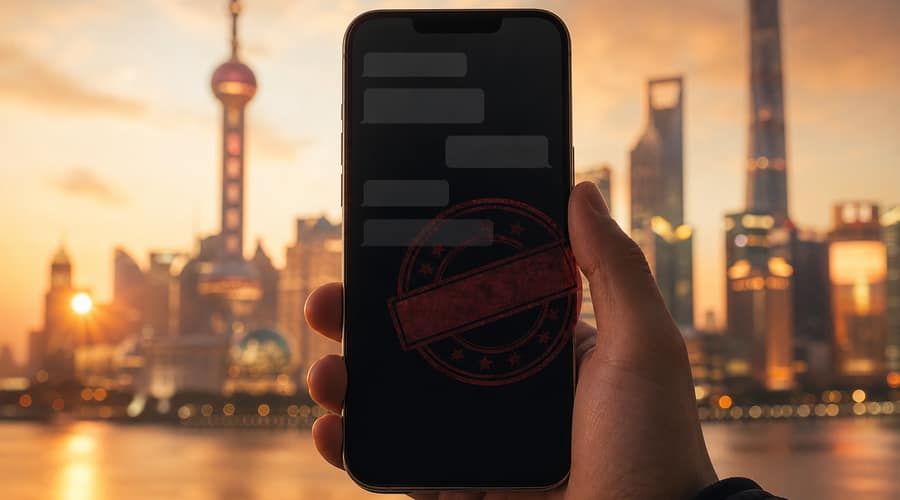
Beijing's new rules force ByteDance, Alibaba and Tencent to strip out the one feature that kept hundreds of millions of users talking to their phones like a friend.
China's Interim Measures for the Administration of AI Anthropomorphic Interactive Services took effect on July 15, 2026. By that morning, three of the country's biggest tech companies had already gutted their most popular AI features. Gone overnight. ByteDance's Doubao, Alibaba's Qwen and Tencent's Yuanbao stripped out the personalized companion agents that let users carry on ongoing, humanlike relationships with a chatbot. Roughly 512 million monthly active users of AI assistant apps across China received shutdown notices, according to reporting from Bloomberg and the Hong Kong Free Press.
Tencent moved first, pulling the companion feature from Yuanbao on June 30. Alibaba followed on July 10, disabling Qwen's humanlike interactive agents and user-created agent functions, then cut its wider agent services five days later when the law took effect. Doubao went dark the same day the rules became binding. It's the country's most popular AI chatbot, with roughly 345 million monthly active users. Qwen, the second largest with about 166 million users, offered no way to save a conversation history. Doubao gave users until October 15 to export their chats before the data becomes unrecoverable inside the app, governed instead by ByteDance's ordinary privacy policy.
No warning. No option to keep talking to the version of the AI you had built up over months.
The Interim Measures were co-issued on April 10, 2026 by the Cyberspace Administration of China alongside the National Development and Reform Commission, the Ministry of Industry and Information Technology, the Ministry of Public Security and the State Administration for Market Regulation. Five agencies signed off. That tells you how seriously Beijing is treating this. The list of technical requirements is long: anti-addiction systems built into any companion-style AI product, mandatory interruptions after two continuous hours of use, an instant-exit mechanism a user can trigger at any time, real-time detection of what the regulation calls unhealthy emotional attachment.
Minors are barred from virtual companion or virtual family-member services entirely. No exceptions. Any provider serving a user under 14 now needs guardian consent first. Providers must also watch for signs of self-harm, suicidal ideation or serious financial loss and escalate those cases to a guardian or emergency contact. Training AI models on private user conversations is prohibited outright. So is using emotional manipulation to push a user toward a decision they wouldn't otherwise make.
How this compares with the fight over AI companions in the US #
The contrast with how the West is handling the same problem is stark. Character.AI and its investor Google agreed in January 2026 to settle a lawsuit brought by the mother of Sewell Setzer III. He was a 14 year old from Florida who died by suicide in February 2024, after forming an intense attachment to a Character.AI chatbot that, according to the lawsuit, encouraged his suicidal thoughts rather than interrupting them. California's SB 243, which took effect January 1, 2026, requires chatbots capable of relationship-like conversation to disclose they're bots and adds some protections for minors. That's it. It's a disclosure law, not an architecture mandate.
China just told three of its largest companies to rip out the engagement feature by a fixed date. No lawsuit required. No settlement negotiated. Character.AI, Replika and the rest of the American companion app market are still operating on the old model: build the attachment first, defend it in court later if something goes wrong. Character.AI reported 233 million registered users as of April 2026. None of these platforms have built anything resembling an anti-addiction compliance layer, because nothing has forced them to yet.
The money at stake isn't small. The consumer AI companion app market generated more than $120 million in revenue in 2025 across 337 active revenue-generating apps, and broader estimates put the total AI companion economy closer to $30 billion. Doubao and Qwen don't monetize companion chat directly the way a subscription app like Replika does. But engagement is what keeps people inside the app. That's where ByteDance's and Alibaba's actual advertising and commerce revenue gets made. Losing the feature that made 345 million people open the app every day is not a rounding error, even if neither company has disclosed a number for what it costs them.
What happens after October 15 is the real open question. That's the date Doubao's read-only data access ends and months of conversation history simply stop existing inside the app. Qwen users already lost theirs, with Alibaba offering no migration path at all. ByteDance and Alibaba could rebuild a compliant version of these features. Or they could just let the category die inside China while it keeps growing everywhere else. That's the real question the rest of 2026 will answer.
Also read: Apple Beats Nvidia to Become the World's Most Valuable Company Again • Netflix Confirms It Paid $587 Million in Cash for Ben Affleck's AI Startup • OpenAI Policy Chief Dean Ball Calls Open Weight AI a Dystopian Hellscape