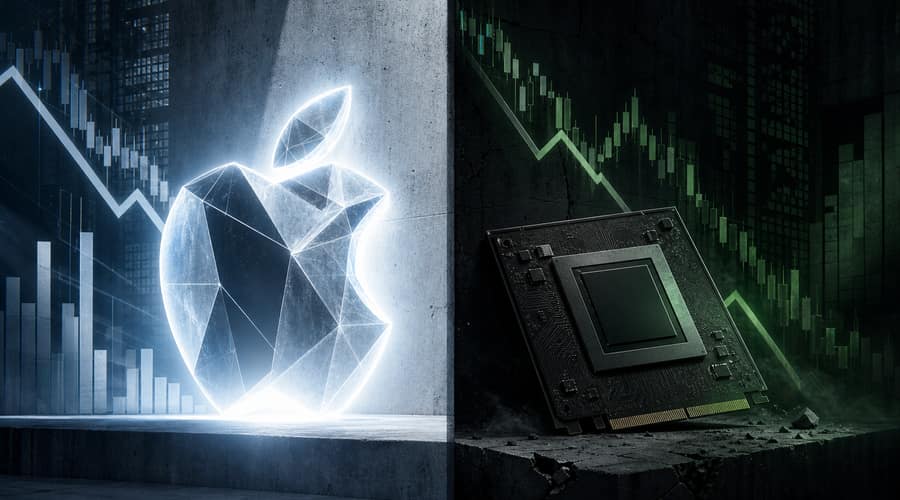
Apple briefly moved back above Nvidia on July 17, but the cleaner story is not a permanent handover. It is a market losing some patience with the price of the AI boom.
Apple did not win Friday because it suddenly solved every worry about artificial intelligence. It won because investors decided, for a few hours at least, that a company selling iPhones and collecting services revenue looked less fragile than a chipmaker priced for near-perfection.
The Financial Times reported that Apple briefly overtook Nvidia on July 17, 2026, becoming the world's most valuable company for the first time in more than a year. The move was narrow and did not hold cleanly into every market snapshot: FT put Nvidia at about $4.908 trillion and Apple at about $4.902 trillion after Nvidia recovered some ground. The Wall Street Journal's live market coverage also noted Apple touching roughly $4.91 trillion during the session.
That distinction matters. A brief leapfrog is not the same thing as an unquestioned closing victory. But it still tells you something useful about the market's mood. Nvidia has been treated as the cleanest way to own the AI buildout. On Friday, that trade looked crowded.
The chip selloff followed fresh anxiety around Chinese AI models and whether every dollar being poured into data centers will earn its keep. The New York Post, citing the day's market action, reported that chip stocks led a broader decline after Chinese AI developer Moonshot released its Kimi K3 model, adding to worries that cheaper Chinese systems could pressure the spending plans behind America's AI leaders.
Nvidia was the obvious target. It has spent the past two years being valued like the indispensable supplier to Microsoft, Amazon, Google, Meta, OpenAI and almost everyone else trying to train or serve frontier models. When investors start asking whether that infrastructure cycle is too expensive, Nvidia does not get judged like an ordinary semiconductor company. It gets judged like the keystone.
China remains the uncomfortable part #
China is still the part of the Nvidia story you cannot wave away. Jensen Huang has been blunt about the damage from U.S. export controls. Tom's Hardware reported last year that Huang said Nvidia's share of China's advanced AI accelerator market had fallen from about 95% to zero, with China previously representing 20% to 25% of the company's data center revenue.
That's not a small dent. It's a locked door in one of the most important AI markets in the world.
Huawei has filled some of that gap with its Ascend chips, and Chinese labs have every reason to keep reducing their reliance on American hardware. You don't need to pretend Huawei has already beaten Nvidia globally to see the problem. Nvidia's valuation depends on a long runway, and China has become the place where that runway is shortest.
Apple's China problem is different. It still has regulatory pressure, local competition and supply chain risk, but it also has hundreds of millions of customers already inside its hardware and services loop. That's boring compared with training clusters and billion-dollar GPU orders. Boring can be useful when chip stocks are falling.
Apple looks safer, not invincible #
Apple's recent strength has come from the old machinery of the business: iPhone demand, pricing power and services. Barron's reported that Citi analyst Asiya Merchant raised her Apple price target to $365 from $315, keeping a Buy rating and pointing to resilient demand, Apple's market position and the next iPhone cycle.
MarketWatch also reported that Morgan Stanley's Erik Woodring sees room for Apple to raise iPhone prices as memory costs rise, with a possible $200 increase on the next iPhone lineup. That is not a minor consumer test. If Apple can pass higher component costs to buyers without losing too many of them, its earnings story becomes easier for investors to underwrite.
Apple's AI story is still uneven. Siri has disappointed users for years, and Apple has not produced a model that makes developers reorganize their road maps the way OpenAI, Anthropic or Google have. Frankly, you should not buy the idea that Apple has suddenly become the leader in frontier AI because its stock had a good week.
What Apple does have is distribution. If its AI features become good enough, they arrive inside devices people already own, attached to subscriptions people already pay for, and wrapped into a product cycle Wall Street understands. That is a very different bet from selling the picks and shovels for a data center race that may be moving faster than demand can justify.
The corrected read is simple. Apple briefly passed Nvidia, and the moment was real. The original framing went too far by saying Apple ended the day clearly ahead and by leaning on several figures that were either unverified or too exact for the available public reporting. The better point is narrower and stronger: on July 17, investors briefly trusted Apple's installed base more than Nvidia's AI premium.
One day does not settle the world's most valuable company race. Nvidia can regain the lead on a single strong order cycle, a China policy shift, or another reminder that nobody else can match its AI hardware stack at scale. Apple can lose momentum if the next iPhone cycle disappoints or if its AI features arrive late again.
For now, the market has marked the question in public. AI infrastructure is still powerful, but it is no longer being treated as risk-free. Apple did not need a miracle to benefit from that. It just needed to look dependable when the hottest trade in technology started to wobble. Also read: Netflix Confirms It Paid $587 Million in Cash for Ben Affleck's AI Startup • OpenAI Policy Chief Dean Ball Calls Open Weight AI a Dystopian Hellscape • Zoox recalls 105 robotaxis after one drove blind into a wall of smoke