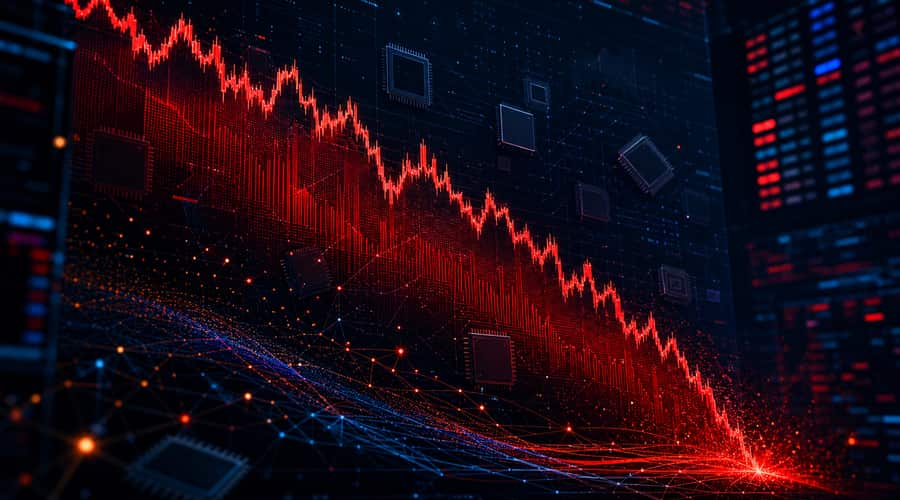
One weekend AI model release from Beijing just erased $3.3 trillion from the world's chip stocks.
The Philadelphia Semiconductor Index closed Friday down more than 20% from its late June record, tipping the 30 stock gauge into a bear market. It fell as much as 5.7% in a single session, its steepest weekly loss in over a year, according to Bloomberg. You don't need a finance degree to read that chart. It's the sound of a trade unwinding fast.
The trigger came from Moonshot AI, a Beijing startup led by founder Yang Zhilin. On Friday it released Kimi K3, a 2.8 trillion parameter model it says performs near the level of the best systems from OpenAI and Anthropic, according to CNBC. The model is open weight, meaning anyone can download it, inspect it, and run it themselves. That detail is the one spooking Wall Street. It doesn't just challenge the pricing power of American model makers. It challenges the entire assumption that beating the competition requires an endless supply of expensive GPUs.
Bloomberg's framing captured the mood precisely, chips sinking into a bear market as a 105% AI rally fizzles. That's the rally since March, when the SOX bottomed out before rocketing higher on the assumption that AI infrastructure spending had no ceiling. Applied Materials, Lam Research, Intel, KLA and Arm Holdings each fell about 4% on Friday. Micron and Nvidia dropped more than 2%. The moves drew immediate comparisons to January 2025, when DeepSeek's low cost model triggered a similar one day shock to Nvidia's valuation. Traders are already calling this a new DeepSeek moment.
The selloff wasn't contained to chips. The S&P 500 fell 1%, closing at 7,457.78. The Nasdaq Composite dropped 1.4% to 25,511.12. The Dow slid 406 points, or 0.77%, to 52,146.42. For the week, the Nasdaq lost more than 2%, its worst stretch since March.
The real question is about demand, not supply #
Frankly, the panic says less about Moonshot's model and more about how fragile the market's AI capex forever thesis has become. For two years, the bull case for chipmakers rested on a simple idea. Whoever spends the most on compute wins, so demand for advanced GPUs only grows. Kimi K3 argues the opposite. If a Chinese lab can approach the performance of GPT and Claude class systems at a fraction of the cost, and give the model away as open weight, the case for buying ever more expensive silicon gets a lot harder to make.
That doesn't mean the thesis is dead. The SOX is still up roughly 65% year to date, an enormous cushion built over eighteen months of AI enthusiasm. Some of Friday's damage had already started reversing as investors moved back in to buy the dip, according to Yahoo Finance. Memory makers Micron, Samsung Electronics and SK Hynix had slipped into their own bear market even before Kimi K3 landed. This correction has more than one cause.
What changed Friday is the story chipmakers get to tell about the future. Investors aren't panicking that AI is failing. They're panicking that it might get cheaper faster than the chip industry priced in. That's a harder problem than a bad earnings report, because it isn't about this quarter's revenue. It's about whether the next decade of GPU orders looks anything like the last two years.
Moonshot isn't a household name yet, not the way DeepSeek became one overnight in January 2025. But Yang Zhilin's team just forced US chipmakers, and the investors betting billions on them, to answer a question they would rather have kept deferring. What happens to chip demand when good enough gets cheap.
Also read: Congress Takes the CLARITY Act to Wall Street as the Senate Clock Runs Out • DeepSeek Keeps Beating Billion-Dollar AI Labs on a Fraction of Their Budget • Kimi K3 Forces Wall Street to Question America's Grip on AI Leadership